Have you ever noticed that some of the most powerful spiritual disciplines are also some of the most misunderstood? Prayer. Worship. Sabbath. Giving.
And fasting.
For many believers, the word “fasting” immediately brings up images of extreme sacrifice: a 40-day fast, no food or water, something so difficult that it feels impossible for the average Christian to practice. And because we misunderstand it, many of us miss the gift God intended it to be.
Recently, I heard a phrase in a song that caught my attention: “The devil wants to extend the game: free throws.” That line made me think about basketball. A free throw is awarded after a foul. One team’s mistake gives the opposing team an opportunity to score. A free throw may only be worth one point, but one point can change the outcome of a game. A few seconds may seem insignificant, but those seconds matter when the clock is running down.
The enemy of our souls understands something important: he doesn’t always have to convince us to walk away from God. Sometimes, he only has to convince us to neglect the spiritual disciplines that keep us connected, strengthened, and spiritually alert.
Prayer becomes optional.
The Word gets pushed aside.
Worship becomes occasional.
And fasting? Many believers never even begin because they don’t understand what it is.
But fasting is not a burden. It is a gift.
What Is Fasting?
A fast is dedicating time to your relationship with God. A fast is a means of drawing closer to God. A fast is pushing away something that your flesh craves in order to embrace something that your spirit craves.
At its heart, it is about surrender.
It is choosing to say, “God, I want You more than I want this thing.”
Throughout Scripture, we see God’s people fasting during times of seeking, dependence, repentance, preparation, and prayer. Fasting creates space for us to quiet distractions and become more attentive to God.
Jesus modeled fasting during His time in the wilderness before beginning His earthly ministry. He did not fast because He was trying to earn the Father’s approval. He fasted as part of His dependence on the Father.
And when Jesus taught about spiritual disciplines in Matthew 6, notice His wording: “When you fast…” (Matthew 6:16)
Jesus did not say if. He said when.
Fasting was not presented as an extra-credit activity for the most spiritually mature believers. It was presented as a normal part of a disciple’s life.
What Fasting Is Not
One of the greatest obstacles to practicing fasting is misunderstanding what it is. Many people hear the word “fast” and immediately think: “I could never do that.”
But often, we have rejected something we have never truly understood. Fasting is not a way to manipulate God. Fasting does not force God to answer our prayers or make Him do what we want.
Fasting is not about controlling God—it is about surrendering ourselves to Him. It changes us. It positions our hearts to listen.
It reminds us that our deepest needs are ultimately met in Him.
Fasting is not a spiritual competition. A longer fast does not automatically make someone more spiritual. The goal is not to complete the most difficult fast or prove how disciplined we are.
The goal is intimacy with God.
A 40-day fast is not the standard every believer must achieve before fasting “counts.” Scripture contains many different examples of fasting for different purposes and seasons.
The question is not: “How extreme can I make this?”
The question is: “How can I intentionally seek God?”
Fasting is not about harming our bodies. God does not ask us to harm ourselves. Our bodies are gifts from Him, and we are called to steward them well.
Biblical fasting is not about punishment or self-destruction. It is about surrender and spiritual focus.
For some people, a traditional food fast may not be appropriate because of health considerations. That does not mean they cannot practice fasting. There are many ways to intentionally remove distractions and create space to seek God.
The heart behind the discipline matters.
Why Does the Enemy Want Us Confused About Fasting?
The enemy knows the power of spiritual disciplines. He knows that prayer strengthens us. He knows that the Word transforms us. He knows that worship redirects our hearts.
And he knows that fasting draws us closer to God.
When we misunderstand fasting, we often dismiss it before we ever experience the blessing of it. We convince ourselves:
“I don’t have time.”
“I’m not spiritual enough.”
“That’s only for certain people.”
“I could never do something like that.”
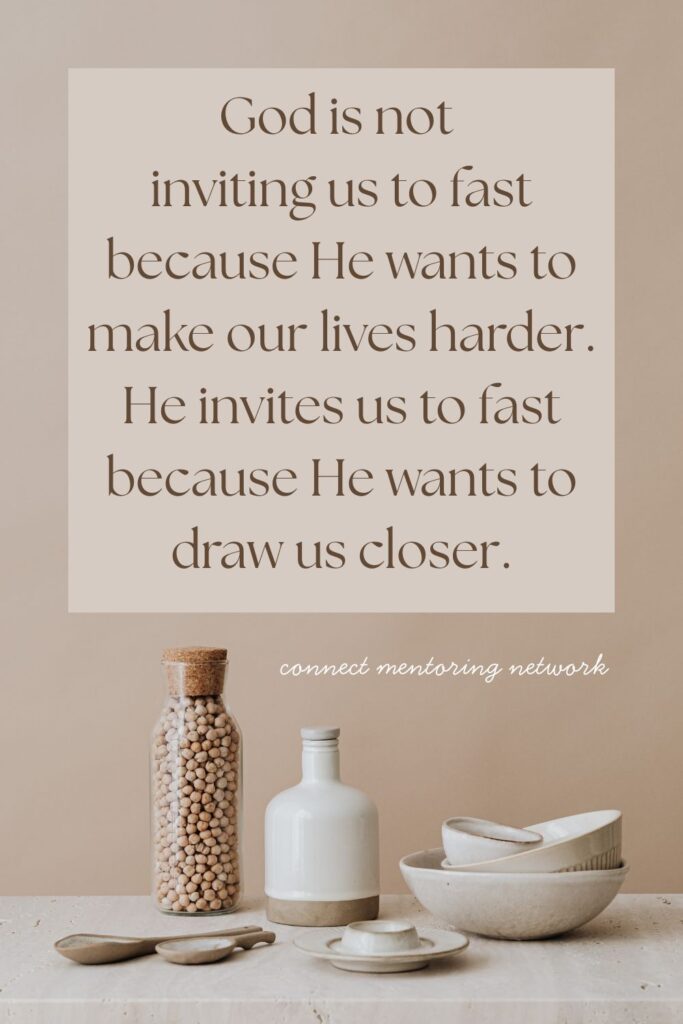
But God is not inviting us into this discipline because He wants to make our lives harder. He invites us into fasting because He wants to draw us closer.
Isaiah 58 gives us a beautiful picture of the kind of fast God desires. It is not merely about outward actions—it is about transformed hearts. God connects fasting with freedom, compassion, righteousness, healing, and His guidance.
A biblical fast is not simply about what we give up.
It is about Who we are making room for.
How Do We Begin?
If fasting is new to you, begin with prayer. Ask God:
“Is there something You are inviting me to surrender?”
“Is there something distracting me from seeking You?”
“How can I create more space for Your presence?”
Then, intentionally replace what you remove with time focused on God. If you remove a meal, use that time to pray. If you step away from a distraction, use that time to worship, read Scripture, or seek God.
The purpose of fasting is not simply subtraction. It is exchange. We are laying something down so we can receive something greater.
We are creating room for God.
A Final Invitation
Fasting is a powerful spiritual discipline, but it is often misunderstood. It is not about earning God’s love. It is not about proving our spirituality. It is not about achieving an impressive spiritual milestone.
It is about drawing closer to the One who already loves us.
If you want to learn more about this practice — including different types of fasts found throughout Scripture, why people fasted, and how to practically incorporate this discipline into your walk with God—I invite you to explore my Fasting e-Course available through Connect Mentoring Network. You can take the course on its own - or you can look into memberships and have access to a full library of resources!
My prayer is that fasting would not be something you fear or avoid, but a beautiful invitation to experience deeper intimacy with God. Thanks for connecting with me today - let's continue this conversation on the podcast on Thursday! Subscribe here so you don't miss a thing!