We've been discussing friendships in ministry for the past couple of weeks on the blog and the podcast. One of the most painful aspects of the question: "can a pastor's wife have friends?" is the inevitable next question: "is this going to cause pain?" To honest, I think the answer to the first question is YES. Continuing being honest - I think the answer to the second question is YES as well. Every season has a beginning and an ending, and we don't always love an ending. Not every relationship that ends in a transition ended because something went wrong. Sometimes, a relationship ends because the season changed.
This has been an especially important lesson for me as a woman who spent decades in ministry and as a pastor’s wife. I learned that I did in fact need friends - and the Lord blessed me in that area. However, when you serve in ministry, relationships can become complicated because sometimes it’s difficult to know what kind of relationship you actually have with someone.
Is this a friendship?
An acquaintance?
A casual friendship?
A relationship connected to my ministry role?
An intimate friendship that will continue no matter where life takes us?
Understanding the nature of a relationship can help us grieve what changes without turning every ending into a wound of betrayal.
Can a Pastor’s Wife Have Friends? Yes - But Remember Not Every Relationship Is the Same
I tend to think about relationships in a few different categories.
Acquaintances: these are people who know of you and you know of them. You may be in the same circles. You may see each other regularly. You’re glad to see each other. You may know a few things about each other.
But there isn’t necessarily a deep friendship.
That’s okay! That’s not a criticism, it’s recognizing the relationship for what it is.
Casual Friendships: these relationships go a little deeper. You may spend time together. You may laugh together. You may share some things about your lives.
But there are still boundaries around what you share.
Again, that’s okay! Not every relationship is meant to become deeply intimate.
Transactional or Contextual Relationships: this is a category that has been particularly helpful for me to understand. A transactional relationship isn’t necessarily negative. It simply means the relationship exists within a particular context, purpose, role, or season.
Let me use being a pastor’s wife as an example. My husband and I have served at several churches over the years, and I had wonderful relationships in those churches. We were genuinely happy to see each other on Sundays and Wednesdays. We prayed together. We shared life together. We laughed together. We loved each other.
But some of those relationships were also connected to my role. I was the pastor’s wife, and they were members of the congregation.
When that church transition happened and we moved into a new ministry, life and relationships changed.
A new pastor came. A new pastor’s wife came. And now she was in the relationship with them that I had once been in.
That’s not bitterness. That’s clarity.
They didn’t stop loving me. They didn’t decide I wasn’t valuable. They didn’t betray me. When I left the transaction, someone else rightly stepped in to fill that role. The season simply changed.
Part of the gift is that my positive relationships were part of creating possibility for positive relationship in the future, for all involved.
When we understand that, we can be grateful for what the relationship was instead of becoming angry about what it isn’t anymore.
Can a Pastor’s Wife Have Friends? Yes - But Recognize The Difference Between Transition and Betrayal
This distinction matters.
Because transition and betrayal are not the same thing.
Betrayal requires healing. Transition requires adjustment.
Betrayal may require boundaries. Transition may require open hands.
Betrayal can involve something that was broken. Transition may simply mean something changed.
Sometimes we’re grieving a relationship because it didn’t follow us into our next season, and we’re tempted to interpret that grief as evidence that something was wrong.
But what if nothing was wrong? What if it was simply time to move forward?
I remember processing through some hurt once, and the person I was talking to asked me: “Do you still feel sad about that loss, even knowing that the relationship was never real?”
I had to think about it - but I didn’t have to think very long.
The relationship was real. Both of us benefited from that relationship in that season. I enjoyed that friendship. I enjoyed that relationship. It mattered to me.
Just because I don’t have it anymore doesn’t mean it was never real.
It means it was a gift for that specific time.
Can a Pastor’s Wife Have Friends? Yes - But Remember the Church Won't Need the Former Pastor’s Wife Forever
This can be particularly difficult for pastor’s wives. When your husband leaves a church, you don’t just leave a job. You leave people. People you prayed with. People you celebrated with. People you cried with. People you watched their children grow up. People who became part of your story.
When you step into your next, and a new pastor and pastor’s wife arrive, the dynamics naturally change.
They should.
Those people now have a new pastor. They have a new pastor’s wife. They don’t need you in exactly the same way they once did. That doesn’t erase the relationship you had with them. It doesn’t mean they don’t care about you. It doesn’t mean you weren’t important.
It simply means the assignment changed.
Are there things I miss from previous seasons? Absolutely.
Are there people I wish I could still see regularly? Of course.
But would I go back and live those years with everyone at arm’s length so that leaving wouldn’t hurt as much? Absolutely not.
Maybe the pain could have been avoided, but the blessing would have been lost.
Can a Pastor’s Wife Have Friends? Yes - But Please Don’t Rewrite the Past Because the Present Changed
One of the most dangerous things we can do when a relationship changes is rewrite history.
We say things like, I guess they were never really my friend. I guess none of it was real. I guess they never really cared.
Maybe.
Sometimes those things are true. But sometimes they aren’t. Sometimes the truth is much simpler: It was real. It was good. And it ended.
Those three things can all be true at the same time.
You don’t have to make someone a villain in order to explain why they aren’t in your life anymore. You don’t have to decide the relationship was fake just because it didn’t last forever. And you don’t have to be bitter in order to grieve.
Sometimes you can simply say: Thank you, Lord, for that season. Thank you for what that person taught me. Thank you for the laughter. Thank you for the memories. Thank you for the ways we served together.
And now, Lord, I release it back to You.
That’s what holding lightly looks like.
Can a Pastor’s Wife Have Friends? Yes - But Remember to Have Open Hands for the Next Season
When we understand the nature of our relationships, we can enter transition differently.
We can move into a new church, a new job, a new city, a new ministry, or a new chapter without assuming that every person from the previous season should come with us.
Some will. Some won’t.
Some friendships will deepen through transition. Others will naturally fade.
Some acquaintances will remain acquaintances. Some casual friendships will become lifelong friendships. Some transactional or contextual relationships will organically shift with the season. Some relationships will end completely.
Somewhere along the way, God may bring you a rare gift: an intimate friend. A friend who sticks closer than a brother. A friend who knows you deeply and stays. Those friendships are rare. They are precious.
I am so grateful that I didn’t allow the pain of previous relationships to convince me that I should never let anyone get close again.
Because if I had, I would have missed some of the greatest friendships of my life.
Can a Pastor’s Wife Have Friends? Yes - But Don’t Avoid Long-Term Relationship to Avoid Short-Term Pain
This is the part I want every woman in ministry to hear: Don’t avoid long-term relationship so you can avoid short-term pain.
Yes, there may be pain. We’re living in a fallen world. People will disappoint us. People will misunderstand us. People will move away. People will change. Seasons will end. Sometimes friendships will break.
But there will also be joy.
Is there going to be pain? Probably.
Is there going to be joy? Certainly.
And if people hurt you, will Jesus heal you?
100%.
So don’t let fear make the decision about your friendships.
If you’re nervous about letting someone get close again, pray. Ask God to show you someone. When He does, start small. You don’t have to hand someone your entire heart on the first day. Let the friendship grow like a seed.
Use wisdom. Use discernment. Pay attention. Let trust develop. But don’t close yourself off before the relationship ever has a chance to grow.
Friendship is not possession. People don’t belong to you. They belong to the Lord. The people God brings into your life are gifts—not guarantees.
So hold them lightly. Love them deeply. Enjoy the season you’re given. When the season changes, release it with gratitude. Then turn your face toward what’s next.
Arms open.
Heart open.
Hands open.
Because the God who was faithful in the last season will be faithful in the next one, too.
So, can a pastor’s wife have friends? Absolutely.
Your calling to leadership doesn’t mean you have to live without meaningful friendship. In fact, the right friendships can be part of God’s provision—people who encourage you, remind you who you are, and help you stay rooted as you serve.
If you’re looking for a place to grow deeper in Christ while walking through the unique joys and challenges of ministry, I’d love to welcome you into the Connect Mentoring Network. Through biblical teaching, practical resources, courses, mentoring, prayer, and connection with other women in ministry, you’ll find encouragement for the journey and a reminder that you were never meant to navigate it alone.
Whether you’re a pastor’s wife or serving on a ministry staff, your influence isn’t measured by how often you stand behind a microphone. You can lead faithfully from your front-row seat—and you can learn to do that with wisdom, health, and longevity.
If you’re ready to explore what that can look like, take a look at our e-courses. You'll find courses on transition, healing from betrayal and leading from your front row seat - and lots more. Each are available as a stand-alone course or as part of Connect Mentoring Network membership.
Ministry is better when we don’t walk it alone. Hold your friendships with open hands, remain faithful to the calling God has given you, and make room for the people He brings into your life along the way.
We’ll continue this conversation on the Connect Podcast this week. Subscribe here so you don’t miss the next episode - and let's visit here on the blog next week!
Thanks for connecting with me today!
Last week on the blog and podcast, we asked the question: can a pastor’s wife have friends? The answer is yes - but there is something I’ve had to learn about friendship that I wish came naturally more often: Hold it lightly. For the pastor's wife and for anyone else who desires healthy friendships, there are a few important principles to remember. Let's share some of these today!
Like everything else in life, friendships have seasons.
Some friendships last a lifetime. Some last for a season. Some are deeply intimate, while others are simply a gift for a particular chapter of our lives.
Sometimes, a friendship that was once incredibly important changes. Sometimes it ends. That can hurt. I won’t pretend it doesn’t.
But I’ve learned that the ending of a friendship doesn’t mean the friendship wasn’t real. It doesn’t mean it wasn’t valuable. And it certainly doesn’t mean that everything we shared somehow becomes meaningless because we don’t share it anymore.
Sometimes it simply means the season changed.

Can a Pastor's Wife Have Friends? Yes - Remembering that We Learn to Grip Before We Learn to Release
Have you ever watched a baby grab something? A baby can grab your necklace and hold on for dear life. You might gently try to pull it away, but those tiny fingers seem incapable of releasing it.
The truth is that they are incapable of letting go. They haven’t learned how yet. A child learns how to grip before they learn how to release.
I think we do something similar with the gifts God gives us.
We grab onto people. We grab onto relationships. We grab onto seasons. And because something is good, we assume we should be able to keep it forever.
However, part of growing in Christ is learning how to receive God’s gifts with open hands. That doesn’t mean we don’t value them. It means we recognize that they belong to Him. Friendship is not possession.
People don’t belong to us. They belong to the Lord.
Sometimes the very friendship we are trying desperately to hold onto was never meant to be held forever. It was meant to be received, enjoyed, learned from, treasured—and eventually released.
That is hard. That is painful. But it is also part of learning to trust God.
Can a Pastor's Wife Have Friends? Yes - Remembering that God Is My Protector
One of the ways I try to live is with my arms open and my heart open. I remind myself: People might hurt me, but God will protect me. God will heal me.
Over the years, I’ve come to believe that when I build a wall between myself and another person, I’m also putting up a wall between myself and the Lord. I don’t want to build walls between myself and other people because I’m afraid of being hurt.
I think that those walls are essentially saying, God, I don’t believe that You are big enough to protect me.
I don’t want to live that way. I don’t want to have a wall between me and the Lord. I don’t want to have a wall between me and you.
Scripture repeatedly reminds us that God is our protector:
“The Lord is my protector; He is my strong fortress. My God is my protection, and with Him I am safe.” Psalm 18:2
“You are my defender and protector; I put my hope in Your promise.” Psalm 119:114
“He is my rock and my salvation, my defender; I shall not be greatly shaken.” Psalm 62:6
Psalm 84:11 reminds us: “For the Lord God is a sun and shield…”
When I walk into relationships keeping everyone at arm’s length, trying to protect myself from every possible hurt, I’ve stepped into an office that God belongs in. Protecting is an office that belongs to God. He is not going to share His office with me - I can let Him do it, or I can do it by myself.
I don’t think He’s angry with me when I do that. I think He’s gentle. I almost imagine Him saying: “Jennifer, when you’re tired of protecting yourself, tag Me in. This is My job. And I do it well.”
Can a Pastor's Wife Have Friends? Yes - Remembering that When You Protect Yourself From the Bad, You Also Protect Yourself From the Good
There is another problem with living behind walls. While I’m protecting myself from the possibility of being hurt, I’m also protecting myself from the possibility of being blessed.
I’m keeping people out - but I’m also keeping out the gifts they might bring into my life. I’m keeping out the gifts I might have brought into theirs.
What if that new friendship could have brought laughter into a hard season?
What if that woman needed your friendship just as much as you needed hers?
What if God wanted to use that relationship to teach you something?
What if He wanted to use you to encourage, strengthen, or comfort someone else?
Self-protection can keep out the very thing we’re praying for.
I want to live with discernment, but not fear. I want to be wise without becoming guarded. I want to have boundaries without building walls. I want to live with my arms open, my heart open, and my hands open.
Can a Pastor's Wife Have Friends? Yes - so Don’t Protect Yourself From Friendship
It can be very tempting to isolate ourselves after we’ve been hurt. We think, If I don’t let anyone get close, no one can hurt me. It makes sense on the surface. But it isn’t healthy.
Yes, friendship can hurt.
I’ve had friendships end. They broke my heart. They hurt deeply. There have been moments when I’ve wondered, How will I ever let someone get that close to me again?
But I’ve also learned to ask myself a different question: Would I trade the gift of that friendship to avoid the pain of losing it?
Would I trade the laughter? The memories? The conversations? The things I learned? The ways that person shaped me? The ways God used that relationship in my life?
Would I trade all of that just so I wouldn’t have to experience the pain of saying goodbye?
For me, the answer is no.
Maybe the pain could have been avoided, but the blessing would have been lost. I don’t want to live my life that way.
Can a Pastor's Wife Have Friends? Yes - Remembering that The Pain Doesn’t Erase the Gift
Think back over your own life. There are probably people who were once very close to you who aren’t close anymore. This is true for a pastor's wife and for anyone in any station of life.
Maybe you moved. Maybe they moved.
Maybe you changed jobs. Maybe they changed jobs.
Maybe one of you changed churches.
Maybe life simply took you in different directions. Maybe the friendship slowly faded. Maybe you don’t even know exactly why it changed.
That hurts, I won’t pretend it doesn’t. But here’s the encouragement: don’t let the ending erase the gift.
They were a blessing when you had them. The friendship mattered when you shared it. The laughter was real. The memories were real. The growth was real.
The love was real.
The fact that something didn’t last forever doesn’t mean it wasn’t beautiful while it lasted. We don’t have to punish every future friendship because one friendship didn’t stay. We don’t have to eliminate the possibility of blessing because we’re afraid of experiencing another goodbye.
Friends come and go like seasons come and go. Hold them lightly. Enjoy them fully. Love them well.
And trust God with what comes next.
Can a Pastor's Wife Have Friends? Yes - and Let God Do His Job
I think sometimes we forget that pain is part of living in a fallen world. You’re going to get hurt. Not necessarily because you did something wrong. Not necessarily because you weren’t discerning enough. Not because you should have kept everyone at arm’s length. Pain is simply part of life on this side of heaven.
But pain doesn’t have to become our reason for isolation - and fear doesn’t have to become our reason for loneliness.
Jesus is our protector. God is our shield. The Holy Spirit is our comforter. So let God do His job.
What’s your “job” here? Use wisdom. Use discernment. Pay attention to red flags. Set healthy boundaries.
But don’t build walls simply because you’re afraid of what might happen on the other side of them. The same open door that allows someone to hurt you also allows someone to love you. The same open heart that can experience grief can experience joy.
I don’t want to miss the joy because I’m trying so hard to avoid the pain.
A. A. Milne wrote a line that has stayed with me: “How lucky I am to have something that makes saying goodbye so hard.”
Maybe that’s the better way to look at it. Instead of saying, I’ll never let anyone get that close again, perhaps we can say: I’m grateful I loved deeply enough for goodbye to hurt.
And then we can open our hands with a friend. Open our hearts. Open our arms.
And trust the One who holds us both.
Can a Pastor's Wife Have Friends? Yes - You Don’t Have to Do Ministry Alone
So, can a pastor’s wife have friends? Absolutely. Leadership and friendship don’t have to compete with each other. In fact, healthy friendships can become one of God’s gifts for helping us remain grounded, encouraged, and connected as we serve.
If you’re longing for a place to grow deeper in Christ while navigating the joys and challenges of ministry, I’d love to invite you into the Connect Mentoring Network. Through biblical resources, courses, mentoring, encouragement, and meaningful connection with other women in ministry, you’ll find a place to grow and be reminded that you don’t have to figure this out by yourself.
Whether you’re a pastor’s wife or a woman serving on a ministry staff, you don’t have to be the one holding the microphone to make a difference. You can lead faithfully from your front-row seat—and you can learn to do it with health, wisdom, and longevity.
If that’s something you’re looking for, take a look at my Leading From the Front Row e-course, available as a stand-alone course or included with Connect Mentoring Network membership.
Ministry was never meant to be lived in isolation. Hold your friendships lightly, hold your calling faithfully, and stay connected to the people God places along the way.
We’ll keep exploring this conversation on the Connect Podcast this week. Subscribe here so you don’t miss the next episode. Thanks for connecting with me today!
Have you ever found yourself asking, “If this is God’s will, shouldn’t it feel easier?”
It’s a question many of us wrestle with. We naturally associate peace with comfort, ease with blessing, and open doors with God’s approval. But when we read Scripture, we discover a different pattern.
Again and again, God calls ordinary people to extraordinary obedience—often requiring them to leave behind what is familiar before they experience His provision.
Noah built before it rained.
Abraham left before he knew the destination.
Ruth walked away from everything familiar.
Jonah learned the hard way that comfort and calling are not always found in the same place.
God’s invitation has never been to pursue the easiest path. His invitation is to follow Him faithfully, trusting that His presence is greater than our preference for comfort.
As I reflected on this truth, I had the privilege of writing a new article for The Christian Post titled “Comfort Is Not Confirmation: Rethinking How God Blesses Us.” In it, I explore what Scripture teaches about obedience, God’s provision, and why we should be careful not to mistake comfort for His confirmation.
👉 Read the full article here: https://www.christianpost.com/voices/comfort-is-not-confirmation-rethinking-how-god-blesses-us.html

As you read, I’d encourage you to prayerfully consider these questions:
- Is there an area where I’ve allowed comfort to influence my decisions more than obedience?
- Am I waiting for circumstances to become easier before saying “yes” to God?
- Where has God already made His direction clear?
- What is one step of faithful obedience I can take today?
One of the beautiful truths of Scripture is that God doesn’t ask us to have every answer before we obey. He simply asks us to trust Him with the next step.
Whether you’re navigating a ministry transition, a career decision, a family challenge, or a season of uncertainty, remember this: God’s faithfulness isn’t limited by your circumstances. He is present wherever He calls you, and His grace is always sufficient for the journey.
I’d love to hear your thoughts after you’ve read the article. Leave a comment below or send me a message and tell me what resonated with you most. Your stories encourage me, and I know they’ll encourage others as well.
Grace and peace,
Jennifer Spivey
We’ve spent the last several weeks talking about transitions, and I wanted to write one more quick follow-up—this one a bit more personal.
As exciting as a new season can be, here are a couple of truths we don’t always talk about: (1) transition is hard work even in the best of circumstances; and (2) transitioning well is not a skill everyone has.
Trusting God in Transition: Not Everyone Will Go With You
Not everyone is going to rejoice at your new season.
Not everyone is going to go with you into your new season.
There will be people who criticize instead of celebrate.
There will be people who speak when they could have simply stayed silent.
And yes… that can hurt.
Some will quietly disappear. Others will walk away loudly. But your responsibility is not to manage their response. Your responsibility is to transition well—to trust the Lord and to walk in grace… even when grace requires you to walk away.
This is what trusting God in transition looks like.

Trusting God in Transition: Stay in Your Lane and Trust God as Your Defender
Let me take a quick rabbit trail here:
While you are not responsible for managing the response of others, you are also not responsible for reacting to their response. If there is criticism, silence, or anything that feels like it needs defending—remember this: protection belongs to the Lord.
Psalm 18:2 says, “The Lord is my rock, my fortress and my deliverer… in whom I take refuge.” He does not share His role as defender.
So don’t step into a position that was never yours to occupy.
Instead, lean into His peace—and let “the law of kindness” remain on your tongue (Proverbs 31:26).
(That’s a long way of saying: stay in your lane.)
Let’s get back to the subject at hand:
Jesus Modeled Trusting God in Transition
When Jesus Christ was in the Garden of Gethsemane (Matthew 26:36–46), He found His disciples sleeping. And while I’m paraphrasing—let’s just call this the Jennifer translation—His response was essentially, “Sleep on.”
In that moment, He demonstrated something deeply important: the next steps were His to take alone.
Whether the disciples went with Him or not did not change His assignment. He still had to walk forward in obedience—even to the point of death (Philippians 2:8).
Following His example, trusting God in transition means we must be obedient too.
Scripture reminds us in Ecclesiastes 3:1, “To everything there is a season, and a time for every purpose under heaven.”
Not everything assigned to one season is meant for the next. Not everyone assigned to one season is meant for the next.
Trusting God in Transition Means Letting Go
And that realization often brings grief.
Transition comes with loss. Some of that grief will be yours to carry. Some of it will belong to others. Both are real.
But here’s a lesson not just for transition—but for every season of life: hold loosely what God has given you to steward.
1 Peter 4:10 says, “Each of you should use whatever gift you have received to serve others, as faithful stewards of God’s grace…”
We are stewards—not owners.
God entrusts us with people.
He entrusts us with seasons.
He entrusts us with assignments.
Faithful stewardship includes both caring well… and releasing well.
When you hold something loosely, it is far less painful when God asks you to release it. Because the truth is—nothing we’ve been given was ever ours to keep forever.
Trusting God in Transition: There Is Grief—and There Is Joy
Yes, there is sadness.
There are people I loved deeply in my previous season—and I still do. People I would have held onto if I could. But for reasons both within and beyond my control, it simply wasn’t possible.
There are memories I will always cherish… and people I still miss.
But there is also joy.
Remember those open hands we’ve talked about? The ones that choose to hold loosely?
They don’t just allow people to flow out—they also allow new people to flow in.
As I was preparing to leave one season, I was also cultivating joy in the next. Or better said—as I was trusting God in transition, He guarded my heart on every side.
There were goodbyes—some necessary, some deeply painful.
There were hope-filled “see you laters”—texts, calls, Zooms, plans made and kept.
There were calendars opened, plane tickets booked, visits to look forward to.
And there were many hellos: new friendships, new connections, new rhythms that made space for new assignments. Space made for joy.
Trusting God in Transition: God Is Doing Something New
Isaiah 43:19 says, “Behold, I am doing a new thing…”
Sometimes, the new thing requires empty hands.
You can hold celebration and consolation at the same time. Joy and grief can coexist.
So feel it all. Process it honestly. Walk it out with the Lord.
But hold tightly to only one thing: your Heavenly Father—who sees all, knows all, and works all things together for your good (Romans 8:28).
Trusting God in Transition: Hold Tightly to God’s Promises
Whether your overriding emotion is joy or grief, whether you are in a season of celebration or sorrow, trusting God in transition means remembering that His kindness toward you remains constant.
Hold tightly to His promises.
“I have told you these things, so that in me you may have peace. In this world you will have trouble. But take heart! I have overcome the world.” (John 16:33)
Trouble will come—but so will His peace.
“I remain confident of this: I will see the goodness of the Lord in the land of the living.” (Psalm 27:13)
His goodness remains—and so can your confidence.
Trusting God in Transition: You Will Walk This Well
Let’s visit this one more time on the podcast this Thursday—be sure to subscribe here so you don’t miss it. If you’re looking for practical tools, I’ve created “Transition Toolbox” e-courses, along with additional mentoring resources, at Connect Mentoring Network.
Transition isn’t easy—but you don’t walk it alone.
And by God’s grace, as you continue trusting God in transition, you will walk it well.
Ministry leadership transitions, when done well, can be beautiful. They are a blessing—not just for you as you move out of a role, but for the person stepping in. Think of it like a relay race: you’ve trained, you’ve run your leg, and now it’s time to hand off the baton. You trust that the next runner is prepared to carry it forward. I talked about some of these principles in a previous podcast if you want to take a listen - however, this one will stand alone as well.
This is the last in this healthy ministry and leadership transitions series, but please check out the rest on youtube in the Healthy Ministry Transitions Playlist. You can also read this blog series here.
Emotions will naturally accompany the process—joy, pride, grief, even fear. All of it is valid. But in the midst of it, remember: we are led by the Spirit, not by emotion. A healthy transition sets an example, blesses leaders on both sides, and impacts everyone within your sphere of influence—the one leaving and the one stepping in.
Healthy Leadership Transitions: Transitions Are a Beginning, as well as an Ending (and that's not bad!)
Handing off leadership doesn’t mean your contribution is over. Successful ministry leadership transitions honors everything you’ve stewarded—the systems you’ve built, the relationships you’ve nurtured, and the vision you’ve advanced—while also creating space for new life, fresh ideas, and renewed energy.
When done well, it blesses not only the organization but also the next leader stepping in, and it affirms your own journey as a faithful steward.
In Every Beginning, There is an Ending
Passing the baton in this way also provides a powerful model for healthy leadership. People are watching, and the way you release responsibility can influence the culture long after you’ve moved on.
Demonstrating integrity, grace, and intentionality in a transition teaches others how to steward authority well, how to celebrate successors, and how to prioritize the mission above personal recognition.
We aren’t talking about an ending of anything except your involvement. Your legacy remains. Your fingerprints will be visible for years to come. However, times will change under new leadership and that’s not bad! New ideas and new directions are not a criticism of your time in leadership - your purpose was to prepare them for the new! That’s worth celebrating!
Truly, this example is one of the greatest gifts a leader can leave behind and a mark of legacy that endures beyond your tenure.
Healthy Leadership Transitions: Practical Steps for Passing the Baton
Passing the baton effectively requires intentional action. Here are key steps to help ensure leadership transitions are smooth, honoring, and healthy for everyone involved:
1. Document what matters
Capture the systems you’ve built, lessons you’ve learned—including the hard ones—and key relationships that are crucial to the organization or ministry. The goal isn’t to control the next leader; it’s to give them a launching pad so they can excel. It’s important to know where you are now in order to get where you are going. That’s a great way you can support the next leaders.
2. Make space for God’s voice
Ask the Lord to help you release control. Trust Him with the next leader and with the ministry itself. God loves people even more than you do, trust Him with their hearts. Prayer is not optional—it’s central to every healthy transition.
3. Shift emotionally early
Recognize that this season is ending and a new season is beginning. Emotional release is just as important as practical steps. Mature leadership means understanding that what you stewarded was never truly yours—it was entrusted to you.
4. Celebrate the next leader
If you know who’s stepping in, cheer them on publicly. Champion them! If you don’t know yet, begin praying for them and celebrating in advance.
5. Offer support if needed
Be available for advice, but don’t be intrusive. If you are needed, answer questions. If you are not needed in a practical way, pray for their success!
Give space for the new leader to adapt, grow, and even make mistakes. Remember, mistakes are part of learning, just as they were in your season.
If you don’t receive that call, don’t be offended! There is a multitude of wise counselors available (Proverbs 11:14). If the new leaders have other sources, this is a cause for joy.
Besides, your hands are full - you are moving into your new season too!
Healthy Leadership Transitions: This Is Not the End of Your Calling
Passing the baton doesn’t mean losing your calling. You are not being set aside—you are being set apart for a new season. Whether that next season is another ministry, a new business, or even a time of rest, God is moving you forward.
Take joy in seeing what you built continue without you. A ministry that thrives after you leave is a sign of legacy—and legacy is a gift. Ministries and organizations that thrive after leadership transitions are signs of great health and victory!
Isaiah 43:19 reminds us: “Behold, I am doing a new thing; now it springs forth, do you not perceive it?” God has done a great thing through your work, and now it’s time for the next runner to step in.
Celebrate that. Pray for that. And trust that the same God who led you will guide them too.
Healthy Leadership Transitions: Key Principles for Leaders in Transition
As the baton is passed during ministry leadership transitions, there are a few key truths to keep close to heart:
• Trust the process — You’ve run your race well. The work you’ve stewarded, the lessons you’ve learned, and the impact you’ve made have all prepared both you and the organization for this moment. Trust that God has orchestrated this season for a reason, and that the next leader is stepping into a foundation you’ve carefully laid.
• Release with grace — Don’t cling too tightly to what you’ve built. Healthy leadership transitions require letting go of control and giving the new leader space to grow, innovate, and make the role their own. Releasing with grace doesn’t diminish your contribution; it honors the ministry and models trust in God’s plan.
• Cheer loudly — Be a voice of encouragement rather than comparison. Celebrate the next leader publicly and privately. Your support can boost their confidence, strengthen the team, and set a tone of unity and collaboration that will benefit the organization for years to come.
• Stay prayerful — Keep both your own heart and the next leader’s path in prayer. Ask God to guide their steps, bless the ministry, and continue to lead you faithfully into the next season He has prepared. Prayer is the cornerstone of healthy leadership transitions and helps ensure decisions are rooted in obedience rather than emotion.
Transitions are hard, but they can also be profoundly beautiful. Not everyone gets to witness a healthy, God-honoring ministry leadership transition, but when you steward it well, it becomes a blessing for everyone involved—the ministry, the next leader, and yourself. Your thoughtful, prayerful leadership in this moment can leave a legacy that far outlives your time in the role.
Healthy Leadership Transitions: Walking Step by Step with God
Consider how God led the Israelites through the desert. They didn’t see the full journey to the Promised Land—they only saw the next step before them. Every day, they had to trust God to provide manna, water, and protection, even when the path ahead seemed uncertain or even impossible.
In the same way, during ministry leadership transitions, or any season of change, our best future is often waiting just beyond the place that feels uncomfortable or scary.
God doesn’t overwhelm us with the entire plan all at once. He asks for daily obedience, guiding us one step at a time. As Proverbs 3:5–6 reminds us: “Trust in the Lord with all your heart and lean not on your own understanding; in all your ways submit to him, and he will make your paths straight.” We don’t need to see the entire map—only the step He calls us to take today.
Sometimes we want to plan, control, and understand everything upfront. But God’s invitations are often bigger than our imagination, and they require trust. Take the next step He’s asking you to take, even if the whole journey isn’t clear yet.
As Psalm 37:23–24 encourages us: “The Lord makes firm the steps of the one who delights in him; though he may stumble, he will not fall, for the Lord upholds him with his hand.” Even if the path feels uncertain, God is steadying you, holding you close, and guiding the next step with love and care.
Remember, you are not alone in this. Lean into Him, take that next step in faith, and trust that He will reveal the step after that in His perfect timing. This is how God leads, and this is how He prepares you for the leadership transitions ahead—step by step, moment by moment, with patience, grace, and unwavering love.
Healthy Leadership Transitions: Continue the Conversation
If this series has been encouraging, I’d love for you to continue the conversation with us!
- Listen to the Connect Podcast for more insights on healthy ministry transitions.
- Subscribe to @JenniferWSpivey on YouTube to never miss a new episode.
- Explore mentoring opportunities and practical resources at www.connectmentoringnetwork.org.
- If you need guidance on your journey of leadership and life in Christ, don’t hesitate to reach out - I’d be honored to walk alongside you!
Leadership transitions are a sacred part of leadership. Take a deep breath. Pass the baton with confidence, prayer, and joy. Celebrate what has been and what’s coming next. God is faithful, and He is doing a new thing.
Thanks for joining me in this series, and I look forward to walking with you through the next season of your leadership journey.
Today, I want to share some insights on navigating transitions in ministry, inspired by a conversation I had with Pastor Sydney Morrow. If you want to check out our conversation, please click here. You can also catch up on the healthy ministry transitions blog series here.
Pastor Sydney Morrow, serves as the District Children’s Ministries Director for the Peninsular Florida District of the Assemblies of God. She has served in several pastoral and church leadership positions. Currently, she serves alongside her husband as lead pastor, and brings a wealth of lived experience in pursuing God faithfully through ministry transitions.
Transitions are both challenging and transformative. As Pastor Sydney’s story illustrates, walking through them with grace, patience, and faith allows us to release the past, embrace the present, and step boldly into what God has prepared.
Whether you’re navigating a leadership change, a ministry shift, or a personal calling, these lessons serve as a reminder: God orchestrates every season, and His peace accompanies obedience. Ministry transitions challenge our sense of stability, identity, and calling — but they also invite us into deeper trust.

Healthy Ministry Transitions: When God Leads Somewhere New
Sydney shared openly about a pivotal moment when her husband sensed God calling them to a different church. She felt deeply connected, fulfilled, and firmly planted where they were. Her first reaction was simple and honest: No, Lord. I like it here. (Anyone else relate here? Me too, friend!)
She was comfortable. Established. Fruitful. Invested.
But over time — through prayer, mentorship, and leaning into discernment — she realized that God’s leading wasn’t based on dissatisfaction. It was based on purpose. What followed was a beautiful example of healthy ministry transitions.
When God Moves
This is such an important truth in ministry transitions: God often moves you not because you failed, but because you have fulfilled the assignment. You are not “done” — the season is.
Throughout Scripture, God consistently moves His people when the purpose in one place has been completed. Think of Abram, Moses, or Paul — each had to leave a place where they were comfortable in order to step into the next stage of their calling.
Isaiah 43:19 reminds us: “See, I am doing a new thing! Now it springs up; do you not perceive it?”
New seasons require trust. They require releasing the comfort of the known for the promise of the unseen. Obedience — even when emotions may be cause for hesitation — reflects the heart of faith-filled transition.
Healthy Ministry Transitions: Give Yourself Grace, Transitions Take Time
A few of the most powerful lessons Sydney highlighted are these:
- Give yourself grace during a transition.
- You don’t have to be immediately ready.
- You don’t have to process instantly.
- You don’t have to force enthusiasm for change.
One of the most powerful truths to embrace in any season of change is the need to give yourself grace during ministry transitions. Change rarely unfolds in a straight line, and God never asks you to rush through a season meant to be slow and intentional.
Grace creates room to honor your emotions, acknowledge what is shifting, and let God shape your heart at a pace that brings restoration rather than pressure. You don’t have to be immediately ready.
Readiness is often something God develops over time, not something you’re expected to manufacture on demand. Sometimes God speaks before your emotions or circumstances feel aligned. That doesn’t mean you’re behind—it means He is preparing you. He leads gently, giving you space to grow into the calling He’s revealing.
You don’t have to process instantly. Transitions come with layers—grief, excitement, loss, anticipation—and those layers take time to move through. Processing is not a single moment but a journey, often unfolding slowly and prayerfully. As you give yourself permission to feel, reflect, and seek God’s wisdom, clarity begins to deepen and peace begins to take root.
You don’t have to force enthusiasm for change. Obedience does not require instant excitement. You can fully follow God without pretending to love every aspect of the process. Real faith often looks like choosing obedience even when emotions are still stabilizing. God honors honesty and surrender far more than forced positivity.
Allowing yourself this space—to pause, reflect, breathe, and allow God to work—creates a healthy foundation for healthy ministry transitions. Some seasons of transition are intentionally quiet. They help you recalibrate, refocus on what matters most, and prepare your heart for the new assignment God is shaping ahead of you.
Healthy Ministry Transitions: Give Yourself Grace, Transitions Take Time
Some seasons are slow on purpose. Healthy ministry transitions are no exception.
Not every moment of ministry is meant to be fast, forward-moving, or visibly productive. Sometimes God intentionally slows the pace so your soul can catch up to what He’s doing. A slower season doesn’t mean something is wrong; it often means God is doing something deeper beneath the surface. Slowness can be a divine invitation—not a setback.
These are healing seasons. Transitions often expose emotions you didn’t realize were there—exhaustion, grief, disappointment, or even relief. Healing takes time, and God is kind enough not to rush that process. In these gentle seasons, He restores what has been worn down, mends what has been stretched thin, and tends to the places that need His touch. Healing isn’t unproductive; it’s preparation for longevity.
These are listening seasons. When the pace slows, it becomes easier to hear God’s voice with clarity. Quiet seasons sharpen discernment. They create space for prayer, Scripture, reflection, and spiritual realignment. Listening seasons tune your heart to God’s direction so that when He speaks about the “next,” your ears and spirit are ready to receive it.
These are preparing seasons. Transition isn’t just about what you’re leaving—it’s also about what God is forming in you for what’s ahead. These seasons strengthen your faith, refine your character, and broaden your capacity. Preparation often feels hidden and understated, but it is essential. God uses these moments to shape you into the person who can carry the weight, responsibility, and blessing of the next assignment.
Together, these slow, healing, listening, and preparing seasons create sacred space for God to do the deep work that makes the next season possible. They are not delays—they are divine design.
Ecclesiastes 3 tells us plainly: “There is a time for every purpose under heaven.” Don’t be afraid to slow down and let each season serve its purpose.
Healthy Ministry Transitions: Holding Lightly; Release What Was, Receive What Is
Ministry transitions require a tender balance between release and acceptance.
Sydney described the bittersweet reality of letting go of a beloved ministry and embracing the new path God had for her family. She mourned the relationships, rhythms, and identity formed in the previous season — and that’s okay. She moved from good to good - and you can, too.
Healthy ministry transitions allow space for both:
- Grief for what is ending
- Gratitude for what God gave
- Hope for what He is leading you into
Philippians 4:7 speaks of “the peace of God, which surpasses all understanding.” That peace becomes an anchor when your emotions are still catching up to God’s direction.
Healthy Ministry Transitions: Your Role May Shift — Your Identity in Christ Never Does
Another key principle Sydney shared is this: Influence in ministry isn’t defined by the seat you hold — it’s defined by the posture of your heart.
During this season of ministry transitions, Sydney stepped into a supportive role while her husband stepped into the lead role. For a woman in ministry, this wasn’t always easy. Her identity wasn’t wrapped in a title, but in obedience.
She championed him, supported the ministry, and embraced the assignment God asked of her in this season. Sydney’s example sets for us a crucial reminder in any ministry transition that who you are is more important than what you do.
Your identity is not your role. Roles shift. Responsibilities evolve. Titles come and go. But your identity in Christ remains unchanging. When a role ends or changes, it can feel disorienting because so much of your rhythm and purpose has been attached to that place. But identity is rooted in being God’s child, not in the tasks you perform. When you remember that your identity is secure, even transitions that feel destabilizing can become steady under your feet.
Your calling is not your job description. A job description describes what you do in this season; calling describes who you are meant to be across every season. A calling can be expressed in many different roles over a lifetime. This means a transition doesn’t cancel your calling—it simply gives God room to reveal a fresh expression of it.
When your sense of purpose is anchored to God’s voice rather than your current role, you remain flexible and faith-filled as He redirects your steps.
Your worth is not your position. Positions can feel validating, and losing or leaving one can feel like a loss of value. But worth is never measured by status, influence, or visibility. Jesus modeled this perfectly—He served, led, and loved from a place of secure identity, not positional authority.
Your worth is anchored in Christ’s love for you, not in the size of your platform or the responsibilities you carry. When you understand this, transition becomes less threatening and more freeing.
When you hold these truths close, you can navigate ministry transitions without losing confidence. You can release one role and step into another knowing that nothing essential about who you are has changed—and that the God who called you is the same God leading you forward.
Romans 12:4–5 beautifully describes this truth: “For as in one body we have many members… so we, though many, are one body in Christ, and individually members of one another.”
Healthy Ministry Transitions: Lean on Mentors, Leaders, and Community
Sydney also emphasized the importance of seeking wise counsel — mentors, leaders, and voices who help us discern God’s direction without bias or fear. This beautifully echoes the principles we discussed with Dr. Michael Spivey in last week’s blog.
Proverbs 11:14 teaches: “Where there is no guidance, a people falls, but in an abundance of counselors there is safety.”
The Benefits of Wise Counsel
Seeking wise counsel is an essential part of navigating any ministry transition. God often uses mentors, leaders, and trusted voices to help bring clarity to what we’re sensing. Their input provides a grounded, prayerful perspective that strengthens our discernment in seasons that can feel overwhelming or uncertain.
Sometimes you sense God stirring something new, but you’re not sure if it’s time to move or time to wait. Wise counsel can help affirm whether the season truly is shifting or whether God is still completing something in you where you are. Timing is one of the hardest elements of transition, and godly voices often help bring confidence, peace, and alignment.
Transitions can blur the lines between discomfort, desire, and divine direction. Trusted mentors help you sort through those layers, reminding you of your calling, your gifting, and the ways God has led you in the past. Their perspective helps distinguish between a temporary feeling and a genuine call from God.
Times of transition often involve strong emotions—excitement, frustration, sadness, discouragement, or even relief. Without wise counsel, emotions can push you toward decisions that feel right in the moment but aren’t aligned with God’s purpose. Godly voices help anchor you, ensuring your decisions are rooted in faith and wisdom rather than reaction.
A mentor’s role is not to validate your comfort zone but to champion God’s best for your life. Wise counsel gently pushes you toward obedience, even when it’s difficult or unfamiliar. They remind you that the safest place is in God’s will, not in what feels easy or predictable. Their encouragement helps strengthen your resolve to follow where God is truly leading.
Stay Connected to Community
When you invite trusted voices into your process, you’re not just seeking opinions—you’re creating space for God to speak through community. Their insights help you navigate transition with courage, humility, and confidence in God’s direction
Healthy ministry transitions rarely happen in isolation. God often speaks through community. God places each of us where we can best contribute to the health of the Body.
Transitions simply shift where and how that contribution happens.
Healthy Ministry Transitions: Stepping Forward; Your Call to Action
If you are in the midst of a ministry transition — or sense one may be approaching — here are a few ways to take your next step with intention:
- Spend dedicated time in prayer and Scripture listening for God’s leading
- Invite trusted mentors, pastors, and spiritual leaders to speak into the process
- Give yourself grace to process — spiritually, emotionally, and practically
- Hold lightly to roles, tightly to Jesus
- Identify what God may be releasing… and what He may be preparing
- Ask the Holy Spirit to align your desires with His direction
If you need guidance as you navigate a season of transition, I would love to walk alongside you. Visit www.connectmentoringnetwork.org for mentoring opportunities, practical resources, and support. The “Transition Tool Box” e-courses are a great place to begin if you’re needing clarity and encouragement.
Let’s continue this conversation on the podcast this week - subscribe to @JenniferWSpivey on YouTube so you don’t miss an episode!
Healthy transitions begin with a heart willing to obey. Your next “yes” may open the door to the most fruitful season of your life.
Transition is one of the most sacred and stretching parts of leadership. Whether you’re stepping out of a ministry role, shifting responsibilities, or discerning a brand-new assignment, to know when to leave is just as important as knowing when to arrive. Healthy transitions require prayer, discernment, humility, and courage—and the truth is, God usually begins the transition long before anything becomes public. There are definitely ways to be sure to know when to leave a ministry position.
About a year ago, my husband, Dr. Michael Spivey, and I walked through a significant transition of our own. After years of pastoring, the Lord led us into a new season with Convoy of Hope. It was beautiful and bittersweet, full of clarity and full of questions. We talked about it a little bit on this podcast episode if you want to take a listen! Also, you can catch up on the first two blogs in this current series here.
That journey reminded me of a truth every leader eventually encounters: Sometimes obedience requires releasing what feels familiar so you can embrace what is new.
We didn’t step into that transition overnight. It was a slow, persistent work of the Holy Spirit—a lifting of grace from one assignment and a gentle descent of new grace for what was coming next.
My prayer is that this offers clarity, confirmation, and courage as you seek God’s direction for your next season. I am saying "know when to leave" - a dear friend of mine calls it having "quitting sense". I love that too! Whatever you call it, let's learn about this aspect of a healthy transition: it's vital to know when to leave.
Know When to Leave a Ministry Position
Before any external shift takes place, God nearly always begins the transition internally. One of the earliest signs that a ministry season may be coming to a close is a stirring—a subtle, unmistakable restlessness that signals something under the surface is changing.
Nothing was “wrong” in our context. The church was healthy. Ministry was fruitful. People were thriving. We loved our church and had made our lives there. Yet, Michael began feeling something he couldn’t ignore: a loss of peace in places that had always felt steady.
He describes the early days of that season like this: “I wasn’t unhappy or frustrated. I just felt… unsettled. And at first, I assumed something needed to change within the church. But the more I prayed, the more I realized the unsettled feeling wasn’t about the church at all—it was about us.”
I remember him praying, "Lord, what is next for the church?" I also remember the morning when Michael told me, "The Holy Spirit impressed upon me that I've been asking the wrong question. He wants me to ask what is next for us". This was confusing to me - wasn't what was next for the church also what was next for us? Those were the same things, surely - we've been here for 17 years! We aren't leaving.... are we?
The answer came in the form of a job offer which confirmed what the Lord was speaking to our hearts.
Here’s the pattern many leaders experience: first, God will often disrupt your comfort. Second, He redirects your calling. Wondering how to know when to leave? These were a few gentle signals from the Lord to us.
Romans 8:14 reminds us, “For those who are led by the Spirit of God are the children of God".
Discernment begins with leaning in—paying attention to the quiet shifts in your heart even when everything around you still feels normal.
Know When To Leave a Ministry Position: Common Early Signs God May Be Redirecting You
If you’re sensing something shifting but can’t quite put words to it, here are a few early signs many leaders describe:
- A growing sense that your current assignment is complete
- A desire for deeper challenge or fresh ministry impact
- A lack of peace that doesn’t match the outward fruit
- A burden for something new that won’t go away
- An inner knowing that remains even when circumstances look stable
These subtle indicators often serve as the first breadcrumbs on the path toward transition. These help you know a change may be coming, help you know when to leave a ministry position. Please notice: you can know when to leave even on a good day! We've said this often, but let's just keep saying it: a change of season doesn't mean that anything was wrong. We can move from one good thing to another good thing.
When the Lord moves you, it may mean that your purpose has been fulfilled and that's a cause for joy, even in the midst of the sadness of going.
Know When to Leave a Ministry Position: When Familiarity Keeps You Too Long
One of the greatest risks for leaders is staying longer than God intended—not because of rebellion, but because staying feels easier than leaving.
As Michael said on the podcast: “The devil you know is better than the devil you don’t know.” Maybe it's humorous, but it’s also true: Sometimes familiarity masquerades as faithfulness.
We hold onto what is predictable, what we can manage, what we’ve mastered. But comfort is not the same as calling. We must be able to discern and know when to leave. Your exit is every bit as important as your arrival.
What Happens When You Stay Too Long
Staying past your God-appointed season can lead to:
- personal and spiritual stagnation
- ministry momentum slowing
- frustration, restlessness, or resentment
- burnout
- unintentionally blocking the next leader God is preparing
A helpful discernment question is: “Am I staying here out of obedience—or out of comfort?”
Sometimes the simple fact that you’re asking that question is evidence that God is already leading you toward the next step. You need that "quitting sense", you need to know when to leave.
How to Know When to Leave a Ministry Position: Seeking Wise and Godly Counsel During Transition
Transition was never meant to be discerned alone. Scripture is clear: “Where there is no guidance, a people falls, but in an abundance of counselors there is safety". — Proverbs 11:14
When Michael sensed a shift coming, he reached out to three men—trusted mentors, seasoned pastors, and a retired ministry leader who knew him well enough to tell him the truth. These trusted men could answer questions and give wisdom specific to Michael, because they knew our hearts well.
He didn’t come asking for applause—he came asking for alignment. Their wisdom blessed me as well, and brought Michael and I into unity for the next steps.
Why Counsel Is Essential
Wise counsel can:
- confirm what the Holy Spirit is already showing you
- help untangle emotions from genuine calling
- speak truthfully about your gifts and blind spots
- help guard against fear-based decisions
- offer stability and clarity in the fog of transition
Community isn’t optional in a ministry transition—it’s a lifeline.
How to Know When to Leave a Ministry Position: Seeking Wise and Godly Counsel During Transition: Following God When the Destination Isn’t Clear
Perhaps the most challenging part of discerning signs it’s time to leave a ministry position is this: God often calls you to move before He shows you where you’re going.
Michael and I weren’t handed a five-year plan. No detailed roadmap. Just a nudge, a stirring, a sense of grace shifting… and then an unexpected phone call from our next ministry assignment in the form of a job offer.
For many leaders, transition looks a lot like Abraham’s story: “By faith Abraham obeyed and went, even though he did not know where he was going.” — Hebrews 11:8
Just a thought on Abraham - he didn't hesitate. Genesis 22:3 says, "Abraham rose early in the morning.... and went to the place of which God had told him". He rose early - no procrastination, just obedience. What a beautiful example. We are also a beautitful example ourselves when we know when to leave.
The Tension of Obedient Transitions
When God calls you forward, you may feel:
- excitement
- vulnerability
- fear
- hope
- grief
- anticipation
This tension doesn’t mean you’re doing it wrong. It often means you’re right where God wants you—dependent, listening, and surrendered. We are to be led by the Lord, not led by our emotions. Feel all the things - and also obey!
Obedience becomes worship when it requires trust. The first step is the moment you know when to leave - and you obey.
How to Know When to Leave a Ministry Position: Seeking Wise and Godly Counsel During Transition: Practical Signs
If you’re seeking clarity, here are prayerful questions to help you discern whether a transition may be approaching:
1. Is there a persistent lack of peace in your current assignment? Not momentary discomfort—sustained uneasiness.
2. Has fruitfulness decreased despite your faithfulness? Sometimes decreased fruit is a sign the season is complete.
3. Are doors closing that used to be easy to walk through? Closed doors are often divine protection.
4. Are you staying out of comfort rather than obedience? Comfort can be the greatest threat to calling.
5. Is God stirring a new burden or calling that won’t go away? Some passions are seeds for the next assignment.
Transition is not running away from something negative—it’s responding to God’s invitation. You can be successful, you can be happy, you can be settled - and God can call.
How to Know When to Leave a Ministry Position: Seeking Wise and Godly Counsel During Transition
Every time you say “yes” to God, blessing follows—not always immediately, but always faithfully.
For Michael, stepping into his new role with Convoy of Hope opened unexpected doors to invest in pastors, ministers, and churches across the nation. His years of experience became tools God now uses to strengthen leaders walking through their own transitions.
This is true for you too: You carry treasures from this season that God intends to multiply in the next.
Psalm 32:8 promises, “I will instruct you and teach you in the way you should go; I will counsel you with my eye upon you.”
God doesn’t lead you blindly. He leads you lovingly.
How to Know When to Leave a Ministry Position: Courage for Your Next Season
Transition is rarely easy, but it is always purposeful.
If God is stirring your heart, trust Him.
If He is closing a door, release it with gratitude.
If He is calling you forward, step boldly—even when the outcome isn’t clear.
As Dr. Spivey so simply put it: “Fear not. If God is leading you, take that sense of adventure and see what He might do in your life.”
Healthy ministry transitions are an act of stewardship. When you follow God with open hands, He writes stories more beautiful than anything you could have written on your own.
Your next “yes” may be the doorway to the greatest fruitfulness of your life.
Healthy Ministry Transitions: Call to Action
You can know when to leave - and it can still be tough! If today’s reflection spoke to your heart, I’d love for you to join me on this week’s podcast episode where we continue the conversation. Make sure you’re subscribed over at @JenniferWSpivey so you never miss what’s coming next.
You’re also invited to visit www.connectmentoringnetwork.org for mentorship opportunities and practical resources created with you in mind. I'd recommend the "Transition Tool Box" e-courses as a great start!
Walking in obedience—whether in ministry transitions or any season of change—positions us to receive God’s blessing, and that is a gift worth pursuing.
Thank you for spending this time with me. I’m honored to walk beside you as we seek God’s wisdom, lean into His faithfulness, and steward our ministry responsibilities well. Healthy transitions begin with a willing, obedient heart. Let’s commit to embracing the tools and truths God gives us to lead faithfully.
Transitions—especially leadership transitions—can be tender, stretching, joyful, and emotional all at once. Whether you’re stepping out of a role or empowering a successor to step in, one truth remains:
Healthy ministry transitions are meant to be celebrated. To successfully navigate leadership change, walking in community is so valuable.
Over the years, I’ve served in many capacities and walked through a variety of transitions. One of the most meaningful was this past year when I stepped out of my role as director of our church preschool. I had the privilege of training and walking alongside my assistant director, Mandy, as she stepped into leadership. It was a beautiful reminder that both seasons can be good—the one we’re leaving, and the one we’re entering.
I actually had the honor to discuss a few aspects of how to navigate leadership change with my successor. Mandy is an excellent leader and she is such a joy! To hear the conversation between Mandy and me, click here. If you’d like to revisit the journey of this series on healthy ministry transitions, be sure to read part one and part two of this blog series on healthy ministry transitions!
Let’s talk about what it really means to navigate leadership change with celebration and community.

Navigate Leadership Change: Celebrate the Purpose of Every Season
Every ministry season carries purpose—including the season you are leaving, and the season someone else is stepping into. God is intentional with every assignment He places in our hands. To navigate leadership change well, it is a matter of stewarding well what He places in our hands.
During our transition, Mandy shared an analogy I loved: leadership change is like a game of chess. Each piece matters. Each movement is intentional. Even when we don’t see the strategy, God sees the whole board.
This is important to remember: your purpose does not disappear when a role ends. I hear you wondering: “Who am I if I am not fill-in-the-blank-here?” We’ve all asked that question. Here are some times that I have asked it myself:
Who am I if I am no longer the pastor’s wife?
Who am I if I am no longer the music teacher or the preschool director?
Who am I if I am no longer the stay-at-home mom now that my children have grown up and moved out?
Scripture shows that God works in transitions for generational impact, not only for us as individuals:
- Psalm 90:17 – God establishing the work of our hands
- Proverbs 16:9 – He directing our steps
- Joshua 1:5–9 – God’s commissioning during transition
- Romans 8:28 – God working all things for good
See your transition as part of a whole, not an isolated event. Your role was valuable, even as you are moving on to your next role (which will be equally valuable)!
Learning to Celebrate What God Has Done
When we pause long enough to celebrate the season we’re releasing, we honor:
- The people who served with us
- The growth that happened
- The leaders who were shaped
- The faithfulness of God in every chapter
Consider journaling specific ways you are seeing God move in your transition. I feel confident that your gratitude list will be much longer than your difficulty list! Name the good things that God is doing.
Naming these blessings solidifies gratitude and builds a foundation for celebrating future seasons when you will again need to navigate leadership change well.
Job writes, “Indeed these are the mere edges of His ways, and how small a whisper we hear of Him!” (Job 26:14). Transitions can be places where we hear God’s whisper most clearly—a gentle, holy reminder of His presence in every step.
However, if all we know is the very next step, take it in confidence knowing that God is ordering each one.
For me, seeing Mandy step into her new role with such confidence, excellence and grace was a cause for celebration! As I am celebrating her new season, I know she is celebrating mine as well.
Celebration doesn’t erase emotion. It simply reframes it. It reminds us: God was faithful here, and He will be faithful there.
Navigate Leadership Change: Celebrate Even When It’s Bittersweet
Letting go of a role you’ve poured yourself into is not easy. There is real grief in releasing the familiar. But there is also profound joy in watching someone else step into their God-given moment. Remember: one of the most surprising gifts of transition is discovering that joy and grief can coexist.
How about the transitions that Jesus faced? Leaving His disciples, sending the Holy Spirit… We are so blessed to have a High Priest who experienced everything we experience - even transitions.
There may be tension when obedience and emotions seem to be in conflict: choose obedience every time. Recognize that grief is not a sign of failure - it’s a blessed reminder of your investment. Your purpose is fulfilled, you did your job well - move on with peace. You are able to navigate leadership change successfully!
A few Scriptures to hold on to during those times of emotional conflict:
- Psalm 34:18 – God is near the brokenhearted
- John 16:7 – Jesus explaining necessary transition
- Psalm 126:5–6 – sowing in tears, transitioning to reaping in joy
These Scriptures remind us that God is not distant in our change—He is present in every step, both when we grieve and when we rejoice. That assurance is a comfort while we navigate leadership change.
Holding Both Emotions Well
As Mandy stepped into her new season, I saw her flourish. We talked openly about our emotions—her excitement, my bittersweetness (is that a word? If not, it’s definitely a feeling!). We processed together, laughed together, and leaned into grace together.
Some things she did differently than I would have done. Some things she did exactly like I would have done. But every choice was right for her leadership and for the ministry’s next chapter.
As my responsibilities shifted to her more and more, I meant it wholeheartedly when I told her: I am so proud of you! What a gift this transition has been!
Celebration in transition isn’t forced positivity. Celebration is recognizing that God is writing a beautiful story in both directions as we worked together to navigate leadership change in health, for us and the organization.
Navigate Leadership Change: Community Is Essential in Leadership Transitions
If there is one message I want to underline in bold, it’s this: No one is meant to transition alone.
We were created to walk through seasons of change supported, encouraged, prayed for, and surrounded by community. Ministry transitions are holy work—and holy work is meant to be shared.
During the transition between Mandy and myself, we leaned on each other - and we also leaned on our communities. We accepted support where offered, we needed more than each other. We were grateful for community where God provided it.
The Power of Community During Change
Community keeps us grounded when emotions run deep.
It reminds us:
- We are not alone
- We are supported
- We are valued beyond our role
- We belong
- God is at work in us and around us
The people who walked with us in one season can continue to speak life into us in the next. Community is not tied to a title—it is tied to relationship.
Mandy and I experienced this so deeply. Our team, our church, and our friends created space for honest conversations, mutual support, and shared joy. That kind of community changes how we transition—it keeps our hearts soft, open, and encouraged.
Mandy speaks to this in our podcast (link above). Years before her promotion at the preschool, she was offered a ministry position at a different church. When she changed churches, she maintained relationships at our church and at her new church. It was, and still is, beautiful! She didn’t leave one place with any bitterness - and as a result, she had two communities where she belonged! Her support system grew as a result of being able to celebrate two seasons and maintain healthy community while she experienced the need to navigate leadership change. What a great example!
Transition is Both Emotional and Biblical
Transition can be emotional - and that’s okay! Perhaps, like me, you enjoyed the season that God is moving you from. You can move from one good thing to another good thing! There can be grief and joy together!
God uses change in our lives to grow humility, surrender and trust in Him. Recognize that these growing pains result in growth!
Leadership transitions are completely normal throughout the Bible. We see great examples: from Moses to Joshua, Elijah to Elisha, Paul to Timothy. You are in good company, and it’s healthy to normalize transition in your life as well.
A few scriptures to encourage you during this time:
- Ecclesiastes 3:1 – there’s a season for everything
- Isaiah 43:19 – God doing a new thing
- Philippians 1:6 – God completes the work He begins
Healthy ministry transition, being able to navigate leadership change well, is meant to be celebrated!
Navigate Leadership Change: Teaching and Modeling Healthy Transition
One of the most powerful things leaders can do during transition is model health for others. People learn from how we leave just as much as from how we lead.
As you transition, you teach:
- How to celebrate change
- How to honor both seasons
- How to encourage new leaders
- How to process emotions honestly
- How to trust God together
Healthy transitions ripple outward. They strengthen teams, ministries, and relationships long after the moment has passed.
You become a living testimony that leadership change doesn’t have to divide—it can unite, inspire, and multiply kingdom impact. This is the result when you navigate leadership change under God's direction.
Navigate Leadership Change: Practical Ways to Celebrate and Build Community During Transition
Transitions become healthier, richer, and far more joyful when we intentionally weave celebration and community into the process. These two practices ground us, steady us, and remind us that we are not walking alone. Celebration helps us honor what God has done, while community strengthens us for what God is doing next.
Here are some simple, meaningful ways to embody both during seasons of leadership change:
- Celebrate the Present
- Name the good things God has done. Speak them out loud. Share stories. Honor the journey.
- Walk in Community
- Invite trusted friends, mentors, and team members into the process. Let them support and pray for you.
- Share the Why and the Wow
- Tell the story behind your transition—why God is moving you and what you’ve seen Him do.
- Affirm the Incoming Leader
- Speak life over them publicly and privately. Release joy, not comparison.
- Acknowledge Your Emotions
- Give yourself permission to feel grief, joy, nervousness, excitement, or all of the above.
- Celebrate the Future
- Remind your heart: God is already in the next season, preparing something good.
Navigate Leadership Change Final Thoughts: Celebrate What God Is Doing—in You and in Others
Leadership change isn’t simply a moment of transition—it’s a moment of celebration. It’s a chance to honor the past, bless the present, and embrace the future with an open heart. Take time to reflect on the lessons learned, the people who shaped your journey, and the ways God has been faithful throughout. Let yourself fully celebrate both what you are leaving behind and what lies ahead.
When we walk through leadership change rooted in community and filled with celebration, we reflect the heart of God—who delights in every season and walks with us through each one. Psalm 105:5 reminds us, “Remember the wonders He has done, His miracles, and the judgments He pronounced". What great things to remember: wonders, miracles and wisdom!
May you find joy in the releasing, purpose in the waiting, and deep connection in the community that surrounds you. This is how we navigate leadership change with grace, confidence, and joy.
Navigate Leadership Change: Next Steps
Let's continue the conversation on the podcast this week. I hope you will subscribe to @JenniferWSpivey so you don't miss an episode!
Check out the resources at Connect Mentoring Network. You can check out my e-course entitled "Transition Tool Box" for more insight on successful transition. Transitions are hard and emotional work, even when done well. To navigate leadership change successfully is not necessarily easy - but you got this, leader! Stay with it, steward it well, do the work!
If you need a mentor to walk alongside you with support and wisdom during a transition, please reach out to me and check out the resources available at www.connectmentoringnetwork.org. We are stronger together!
Can't wait to connect with you again soon!
When God calls us to a new season, obedience in ministry transitions becomes our guiding principle. Moving from one role to another isn’t just about changing responsibilities—it’s about listening to God, trusting His timing, and stepping forward even when the path feels uncertain. Obedience in these moments positions us to honor the work we’ve done, bless those we leave behind, and prepare ourselves for all that God has next. Healthy transition in ministry and in life is a blessing to you and those around you.
As my season of transition continues, I am re-visiting some principles of healthy ministry transitions. Check out this previous podcast, and part 1 of this blog series if you want to catch up! Thanks for coming along with me on this journey!
Ministry transitions are tender places. They ask us to release what has been familiar, to loosen our grip on what we’ve poured ourselves into, and to trust God with what will be. They stretch us, shape us, and invite us to walk closely with Jesus in new ways. And if you’ve ever been through one—whether leaving a position, shifting roles, or stepping into a brand-new assignment—you know the swirl of emotions that can come with it. Obedience in ministry transitions will steady those emotions.
Obedience in Ministry Transitions: This is not Betrayal
For many women in ministry, especially those in leadership, one of the hardest emotions to navigate isn’t sadness or uncertainty. It’s the feeling of betrayal.
Am I letting people down?
Am I abandoning my post?
Am I disappointing the ones who believed in me?
Is stepping into the next thing disloyal to the people or places I’ve loved so deeply?
But here’s the truth I want to wrap around your heart today:
Obedience to God is never betrayal. Obedience in ministry transitions is a blessing—not only for you, but for everyone connected to your life.
Let’s talk about how to walk through ministry transitions with confidence, clarity, emotional health, and a spirit that stays anchored in Jesus.
Obedience in Ministry Transitions: When Obedience Feels Like Betrayal
One of the most dangerous lies the enemy whispers during transitions is this:
“If you move forward, you’re betraying your past.”
But following God’s assignment isn’t betrayal—
it’s alignment.
Alignment with His voice.
Alignment with His timing.
Alignment with His purpose for your life.
A new assignment isn’t a rejection of the old one. It’s simply the next step God has ordered for you.
Every assignment has a beginning. Every assignment has an ending. Obedience in ministry transitions is simply recognizing both.
A Transition Is Not a Rejection of Your Past Season
You can celebrate where you were and celebrate where you’re going.
Some women feel the need to downplay or even criticize their past season to justify moving forward:
- “It wasn’t healthy.”
- “This wasn’t working anymore.”
- “I needed something better.”
But here’s the beautiful truth about healthy ministry transitions: You don’t have to make something bad in order to make the next thing good. Part of obedience in ministry transitions depends on you continuing in a posture of honoring.
Two seasons can be good. And yet God may be calling you into the next one purely because it’s time.
That’s not betrayal. That’s stewardship.
Obedience in Ministry Transitions: Honoring the Past Without Staying Stuck in It
A question I hear often is:
“How do I honor my past season while stepping boldly into the new one?”
Here’s how:
1. Celebrate the wins.
Every season has victories. Growth. Lives changed. Lessons learned.
Honoring your past means remembering God’s faithfulness there.
2. Carry forward what God taught you.
Your past was not wasted.
The wisdom, maturity, and spiritual depth you gained—bring them with you.
3. Release the methods, not the mission.
Ministry evolves. Churches evolve. Systems evolve.
There are no “sacred cows.” What worked in one season may not work in another—and that’s okay.
Honoring a past season is never the same as being chained to it.
4. Bless the people and the place you’re leaving.
Speak well.
Pray often.
Remain loyal to what God did there.
Obedience in ministry transitions never require dishonoring someone else.
Obedience in Ministry Transitions: When Identity Feels Shaken
If you’ve ever walked through a ministry transition, you know the identity questions that bubble up:
- “Who am I, if I’m not doing that anymore?”
- “Who am I, if I don’t carry that title?”
- “Will people still value me if my role has changed?”
Transition has a way of shaking loose the unhealthy attachments we sometimes form to titles, roles, or assignments.
But hear me clearly:
Your identity was never rooted in a title. Your identity is rooted in Christ.
Scripture anchors us in this: “For we are His workmanship, created in Christ Jesus for good works, which God prepared beforehand that we should walk in them.” —Ephesians 2:10
God has already prepared your assignments.
Your job is simply to walk in them.
You are not defined by what you do.
You are defined by whose you are.
And if that’s not enough reassurance, read this one slowly:
“When you believed, you were marked in Him with a seal, the promised Holy Spirit.” —Ephesians 1:13
You are sealed.
Marked.
Chosen.
Empowered.
If others question your identity during a transition—God has already settled it.
Even if you question your identity during a transition—God has already settled it.
Stay settled by continued obedience in ministry transitions.
Obedience in Ministry Transitions: Not Everyone Will Elevate With You (and That’s Okay)
This part is hard to say, but it’s true: Some people will not go with you to your next season.
And that’s okay.
Not because they’re wrong. Not because you’re wrong.
But because their assignment is different than yours.
Even Jesus experienced this.
One of the most powerful transition moments in scripture takes place in the Garden of Gethsemane. Jesus invites His disciples to pray with Him…and they fall asleep.
Again.
And again.
At some point, Jesus simply says: “Sleep on.”
This wasn’t anger.
This wasn’t rejection.
This wasn’t disappointment.
This was clarity.
“The next step is mine. You can’t go with me into this place—but I still love you deeply.”
That’s transition.
Not everyone will walk with you into the next season—but you can still love them, honor them, and bless them.
Obedience in Ministry Transitions: Emotional Health in Seasons of Change
Every transition comes with emotions:
- sadness
- excitement
- grief
- hope
- uncertainty
None of these emotions are wrong — but they make terrible leaders.
You can feel sad without being led by sadness.
You can feel uncertainty without being led by fear.
Here are a few spiritual practices that steady the heart during ministry transitions:
1. Worship
Worship resets your focus.
It lifts your eyes.
It reminds your heart that God is the One writing the story.
Whether it’s “Holy Forever,” “Jireh,” “Joy in the Morning,” or a timeless hymn like “The Blood Will Never Lose Its Power,” worship anchors your spirit to the truth when emotions are swirling.
2. The Word
If you want to hear God’s voice during a transition, open the scriptures.
He speaks through His Word with clarity, comfort, and direction.
Everything you need for the next season is already found in the pages of scripture.
3. Gratitude
Gratitude guards you from bitterness, nostalgia, or fear.
It reminds you of God’s goodness behind you—and prepares your heart to trust His goodness ahead of you.
Obedience in Ministry Transitions: Giving Yourself Permission to Evolve
Some leaders feel guilty for growing, changing, or stepping into something new—even when God is the One doing the leading.
But again, Jesus Himself modeled this.
In John 7 and John 14, Jesus prepares the disciples for His transition:
- He informs them.
- He equips them.
- He comforts them.
- He assures them they will see Him again.
It wasn’t abandonment.
It wasn’t betrayal.
It was transition.
And because Jesus obeyed the Father, the disciples received the Holy Spirit—the Helper they desperately needed.
In the same way:
There are people whose lives will only be changed because you obey your calling.
Your transition is someone else’s breakthrough.
Your obedience unlocks blessing for people you haven’t even met yet.
This is why we cannot let guilt or fear keep us in a place God is calling us to leave.
This is why obedience in ministry transitions is vital.
Don’t Be the Jonah on the Boat
Let’s talk about Jonah again—not the whale, but the sailors.
The storm hits.
The boat is thrashing.
Everyone is panicking, trying to figure out:
“Who caused this?”
The disobedience of one man was affecting everyone around him.
When God tells you it’s time to move, and you don’t?
You may begin to feel the effects of Jonah-like disobedience:
- frustration
- lack of peace
- spiritual heaviness
- relational tension
- loss of momentum
Don’t stay where God has told you to leave.
Obedience brings blessing—not only to you, but to everyone around you.
Obedience in Ministry Transitions: Obedience Blesses Everyone Connected to You
Here’s a few of the most freeing truths about ministry transitions:
- God’s plans for the people you’re leaving are good.
- God’s plans for the people you’re joining are good.
- God’s plans for you are good.
- He is not abandoning anyone in your story.
- He is shepherding all of His children well.
- You can release the past with love.
- You can embrace the future with joy.
And you can trust God with every heart connected to your life.
Because His mercy endures forever.
His wisdom never fails.
His goodness never ends.
You Can Transition Well
Healthy ministry transitions are possible.
Spirit-led transitions can be peaceful, honoring, joyful, and deeply rooted in obedience.
Let go of what was.
Embrace what is next.
Trust the God who holds every season.
He truly is doing a new thing.
Shall you not perceive it?
Obedience in Ministry Transitions: Call to Action
If this conversation resonated with you, I want to invite you to continue this conversation with me on the podcast this week. Subscribe at @JenniferWSpivey so you don’t miss an episode!
Finally, check out www.connectmentoringnetwork.org for resources and mentorship opportunities - this community is designed for you!
Obedience in a ministry transition, obedience in any life transition, brings blessing from God - and that is a treasure.
Thank you for spending time with me today! I’m grateful to journey alongside you as we navigate season changes with faith, wisdom, and a trust in God’s faithfulness. Guiding healthy ministry transitions is an act of stewardship. Our part is obedience in ministry transitions. Let’s embrace the lessons and practical tools God provides to do it well.
In this first part of a series on healthy ministry transitions, I want to invite you back into a conversation I had on my podcast some months ago — right from my kitchen, just plain vanilla as you know me to be. My prayer is that as we walk through this together, you’ll feel both seen and strengthened in whatever season of change you’re navigating.
I’m navigating another transition myself - 2025 was the year for transition for me, and 2026 is starting off the same! I thought I would bring you along on the journey like I did last time. We’ll circle back to some previous podcasts, and learn some new lessons together. Let’s get into it!
Transition. Even the word itself can stir something in us — excitement, uncertainty, grief, hope, or all of the above. In ministry leadership especially, transitions can feel emotionally layered and spiritually complex. Whether we’re stepping into something new or releasing something beloved, change has a way of revealing what we trust, what we fear, and where our hope truly rests.
Here’s the truth: change isn’t always an escape from something bad. Sometimes it’s simply the holy progression from one good thing to another. I want to say that again: transition can simply be the holy progression from one good thing to another. Healthy ministry transitions are absolutely possible!
So many times, people think wrongly that they have to make one thing bad in order to make the next thing good. That’s not true. We can move from season to season with peace, gratitude and joy.
Learning to walk through those shifts with grace and obedience is part of the beautiful, lifelong journey of following Jesus.
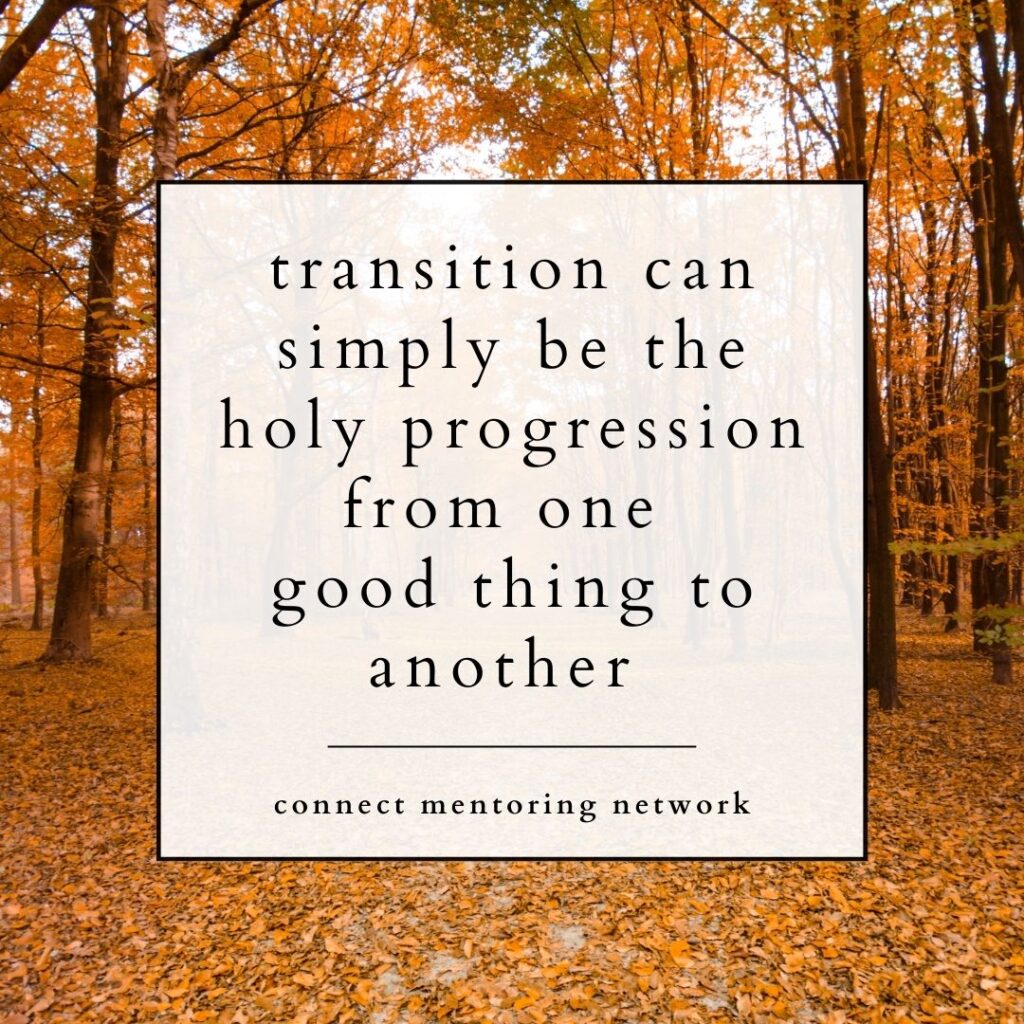
Healthy Ministry Transitions: Starting Before You Feel “Ready”
If you know me, you know I’m not flashy. I’m not trying to be polished. Months ago when I re-launched the blog and podcast, I almost waited because I wanted the “perfect” setup — the right lighting, the right microphone, the right background. However, the Holy Spirit wouldn’t let me give into perfectionism.
Instead, I kept hearing the words from Zechariah 4:10 echoing in my heart: “Do not despise the day of small beginnings, for the Lord rejoices to see the work begin.”
So I began. Not perfectly, not professionally, but obediently.
I think that is the first lesson of any healthy transition: start where you are, not where you think you should be. God rejoices in beginnings — humble, simple, faithful beginnings — because they make space for Him to do what only He can do.
Naming the Season You’re In
Right now, I’m again in one of the biggest transitions of my adult life. After decades of pastoral ministry, last year my husband stepped down from his role as senior pastor. That shift automatically created a shift in my own identity. When he was no longer “the pastor,” I was no longer “the pastor’s wife.” Suddenly I had to ask myself: What does this new season look like for me? Who am I now? How do I steward what God has placed in my hands for this moment?
We didn’t leave hurt. We didn’t leave wounded. We didn’t leave frustrated.
We left loved.
We left whole.
We left on the mountaintop, celebrating everything God had done in our church and believing with full confidence that God has great plans for their next season as well. He loves the church more than we do!
This kind of transition — one from good to good — is often the least talked about and yet the most common. Ministry leaders sometimes feel pressured to treat every transition as a rescue from pain or a response to dysfunction. But often? It’s simply time: time for healthy ministry transitions.
And it’s okay to say that.
Normalizing Healthy Ministry Transitions
One of the reasons transitions feel so emotionally heavy is because we haven’t normalized them. We’ve spiritualized them, dramatized them, or made them synonymous with conflict. However, transitions are normal. Biblical. Healthy. I want to normalize that for you today.
You Don’t Have to Make One Season Bad to Celebrate the Next
Sometimes, in order to justify moving on, people feel they must villainize the past. They highlight what was wrong to explain why they’re stepping into something new.
But you don’t need to do that.
There are seasons in life when both the past and the future are good — and God is in both of them.
You can celebrate where you’ve been and celebrate where you’re going.
Honor Still Belongs in the New Season
As you move forward, the principles that governed relationships in your previous season still matter. If there were loyalties, confidences, or sacred trust — those don’t expire. Honor travels with you. It is never season-specific. Carry it forward.
Transition Is Not Betrayal
This one is big for women in ministry leadership. When you step out of a role, a church, or a position of influence, some people around you may feel abandoned or confused. They may search for a reason or even a villain.
But obedience is not betrayal.
In fact, the real betrayal would be staying somewhere God has asked you to leave.
This truth becomes even clearer when you look at Jonah.
Healthy Ministry Transitions: Learning from Jonah
In Jonah 1, the prophet runs from the assignment God gave him. He boards a ship heading in the opposite direction, and suddenly the sailors find themselves in a life-threatening storm.
They start searching for the source: Who caused this? Who do we blame? Who’s disrupting our peace?
And Jonah finally admits: “It’s me. I’m the one outside of obedience.”
If Michael and I had stayed in our pastoral role after God told us to move on, the storm would have eventually come. Not because God punishes His children, but because disobedience always creates turbulence — spiritually, emotionally, and relationally.
Your obedience affects the people around you.
Your disobedience does too.
If you’re sensing a shift, don’t ignore it. Don’t delay it. Don’t talk yourself out of it because others don’t understand. Stay in step with the Holy Spirit. Obedience is a key aspect of healthy ministry transitions.
Healthy Ministry Transitions: Fixing Your Eyes on What Is Eternal
If you find yourself in that “in-between” place — not fully in the old season and not fully settled into the new one — here are some principles that have anchored me.
Focus on What’s Eternal, Not What’s Immediate
Paul encourages us in Colossians 3:1–2 to: “Set your hearts on things above… Set your minds on things above, not on earthly things.”
When we focus only on what’s immediately in front of us — the changes, the emotions, the unknowns — transition feels overwhelming. But when we lift our gaze to what is eternal, something powerful happens:
We loosen our grip.
We release what isn’t ours to control.
We trust what God is doing in the long view.
And the healthy ministry transitions we pray for become possible.
Jesus Modeled This Too
In Hebrews 12:2, we’re told that Jesus endured the cross “for the joy set before Him.” He wasn’t focused on the pain of the moment but the glory of the outcome — our salvation.
Likewise, in times of transition, it’s powerful to pray:
“Lord, what is the greater good You’re working toward in this?”
Ask for Wisdom — He Gives It Generously
James promises that when we ask for wisdom, God gives it “liberally and without reproach.”
Liberally — more than you need.
Without reproach — without shaming you for not knowing earlier.
If you’re in the messy middle of a transition, God isn’t criticizing you. He is guiding you.
Healthy Ministry Transitions: Trusting God’s Good Plans For You and For Others
One of the most comforting truths in any season of change comes from Jeremiah 29:11: “For I know the plans I have for you… plans to give you a future and a hope.”
Jeremiah spoke those words to people who were in captivity — the ultimate “in-between.” Even there, God had plans. Even there, God had hope.
God’s Plans for You Are Good — Even If the Season Is Hard
You may not see the outcome.
You may not understand the timing.
You may even feel sorrow for what you’re leaving.
But God’s intentions toward you are good.
God’s Plans for the People Around You Are Good Too
This is especially important for leaders.
Sometimes we hesitate to leave a ministry role because we fear what will happen to the people we love. But God loves those people more than we do. He sees their future, their needs, their next shepherd.
He truly does hold the whole world — including your ministry world — in His hands. The healthy ministry transitions that we hope for depend on resting in that knowledge and staying anchored there.
Healthy Ministry Transitions: Releasing What Was to Receive What Will Be
Transition requires open hands.
You release one assignment so you can fully embrace the next.
You celebrate one season while anticipating the new one.
You trust God enough to let go.
This is part of walking in obedience — and obedience is always met with blessing.
Psalm 136 reminds us again and again: “His mercy endures forever.”
You and I may feel discomfort in the moment, but God is playing a long game. His mercy and faithfulness extend far beyond the boundaries of one season.
Healthy Ministry Transitions: Stewarding the Middle Space Well
If you find yourself in the “in-between,” here are principles to hold close:
Don’t Be the Jonah People Are Searching For
Stay obedient.
Stay soft-hearted.
Stay in step with God.
Let your obedience be a blessing to those around you.
Recognize that a key part of healthy ministry transitions is faithfulness and holding each season lightly.
Hold Your Assignments Lightly
What God puts in your hand is for a season, not for your identity.
Hold it with open palms.
Keep Your Eyes Fixed on Jesus
Recognize that He is doing a new thing — just as Isaiah 43:19 reminds us:
“Behold, I am doing a new thing… do you not perceive it?”
Our responsibility isn’t to create the new thing.
It’s simply to recognize it and move with Him.
Healthy Ministry Transitions: What’s Coming Next
Transition is such an important conversation in ministry, and honestly, it’s one we don’t get to see modeled well often enough. Over the next few weeks, I’ll continue to dive into the topic of healthy ministry transitions (healthy life transitions too!) as we talk through different aspects of navigating change with spiritual maturity, emotional intelligence, and biblical faithfulness.
If this conversation resonated with you, I want to invite you to continue this conversation with me on the podcast. Subscribe at @JenniferWSpivey so you don’t miss an episode!
Finally, check out www.connectmentoringnetwork.org for resources and mentorship opportunities - this community is designed for you!
Thank you for joining me today! I’m honored to walk with you as we learn to shift seasons with grace, wisdom, and confidence in God’s goodness. Healthy ministry transitions are a matter of stewardship - let's lean in and gain the tools we need to do it well.
I’ll see you here next Tuesday for the next blog on healthy ministry transitions, and Thursday for the next episode of the podcast. Until then, hold your season lightly, keep your eyes lifted, and trust the One who leads you from strength to strength. Placing your hand in His will be a treasure!