If you’ve been wondering how to set boundaries in a biblical, loving, and practical way, you’re not alone.
Are you saying yes too often? Have you set healthy boundaries that protect you as well as the people around you? Let’s explore boundaries today: what they are, why we need them, and where they apply in order to maintain a balance that brings glory to God in your life.
Your friend wants you to take her child to school every day—what’s the big deal? You’re going anyway with your children. Your pastor wants you to run the coffee bar every Sunday morning—simple, right? Wednesday nights—sure, you can lead a small group. Your daughter’s cheer coach quit mid-season, so could you just step in until football is over? And take them to competition?
These are good things. So why say no?
It’s not much—just four little things. And it feels like a compliment to be asked. If everyone thinks you can handle it, why let them down? It’s fun being Superwoman… until the cape starts to strangle you.
While we are here, let’s add in everything that was already in your schedule: housework, job responsibilities, chauffeuring kids to sports and music lessons, time with your husband or friends, family obligations, church commitments… now add those four little things, and suddenly you’re running on empty.
Maybe it wasn’t so little after all.
Many Christian women struggle with boundaries because they fear appearing selfish or unloving. The result? Feeling drained, overlooked, and disconnected from your own needs. Setting godly boundaries protects your peace, your relationships, and your spiritual growth. Boundaries are not unchristian—they are stewardship over your time, your energy, and your heart.
Proverbs 4:23 offers necessary wisdom: “Above all else, guard your heart, for everything you do flows from it.”
Understanding how to set boundaries begins with recognizing why they matter in your daily life. Let’s begin with the what, why, and where of learning how to set boundaries.
How to Set Boundaries: Understanding What Healthy Boundaries Are
Knowing how to set boundaries helps you protect your emotional, spiritual, and physical well-being. They define what is okay for us and what isn’t, helping us communicate our needs clearly and honor our God-given responsibilities. Healthy boundaries allow us to show love, serve others well, and maintain peace without becoming overwhelmed, drained, or taken advantage of.
Jesus stated in Matthew 5:37, “Let your yes be yes and your no be no”. His brother James echoes the same in James 5:12, “let your “Yes” be “Yes,” and your “No,” “No”. Both of these speak to boundaries. Make the commitments that you can make, and that fall in line with what God has called you to do.
Just as Important: Understanding What Boundaries Are NOT
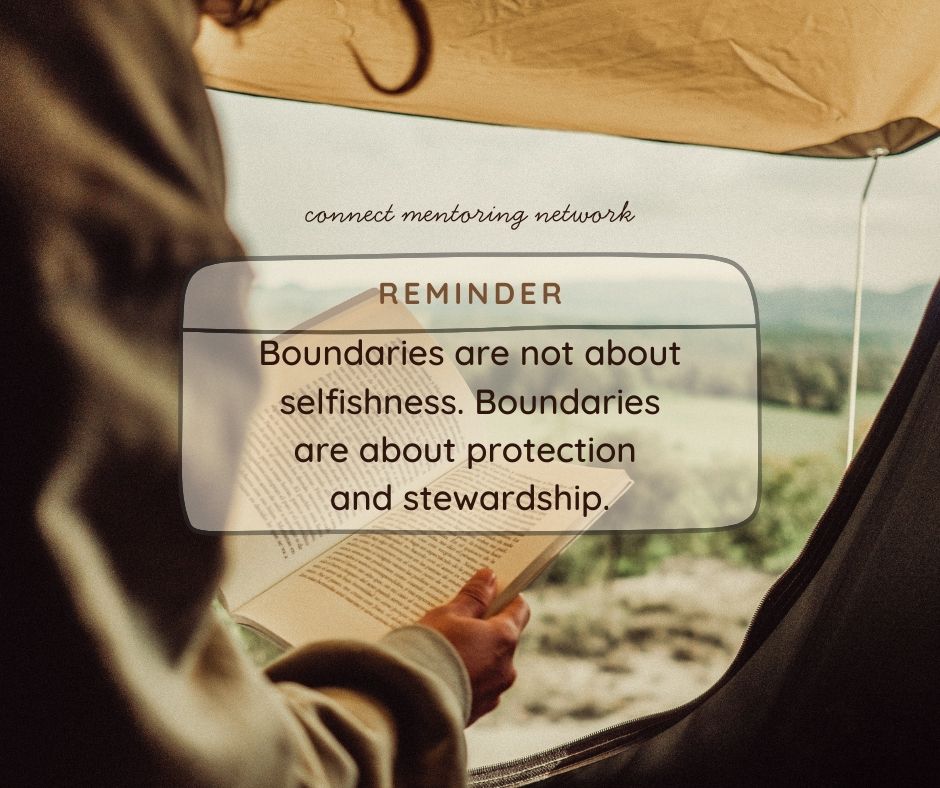
Please hear this: boundaries do not equal selfishness. Boundaries are about protection and stewardship. (Say it louder for the people in the back?)
Here’s a practical example: how about saying “no” to extra responsibilities to maintain family and personal time?
Perhaps my friend wants me to take her child to school every day - as I am going there anyway, it seems an easy ask in her mind. However, she doesn’t know that I use this time with my little captive audience: we pray together, share life lessons, we talk about personal matters, we laugh and we have a peaceful start to our day. She doesn’t know that I always schedule dentist appointments or check-ups early in the morning, which would be an interruption in her routine if I’m the driver.
My friend thought it was a simple ask - I think it is impractical for me based on how I want to use this time. Saying no protects many things: my responsibility to speak godly perspective into my children, our dedicated time together as a family. The boundary even protects my friendship - the inevitable interruptions and changes to her morning routine might be a strain to us.
This is not selfish - this is about being a good steward of what God has entrusted to me. This is about redeeming the time given to us (Eph. 5:15-17, Col. 4:5, Psalm 139:16, Galatians 6:10).
Boundaries vs. Selfishness: A Biblical Perspective
From a biblical perspective, boundaries are not acts of selfishness but expressions of wisdom and stewardship. As Proverbs 4:23 teaches us to guard our hearts, we must understand that this includes caring for our time, energy, and emotional health.
Saying “no” when needed isn’t unloving—it helps us live in obedience to God, give from a healthy place, and love others with sincerity rather than exhaustion.
If you’re learning how to set boundaries as a Christian woman, understanding what healthy boundaries are is the first step toward protecting your peace and relationships. Once you know why boundaries are important, learning how to set boundaries in different areas of life becomes much clearer.
How to Set Boundaries: Recognize Why You Need Them
So, imagine the pastor asked you to run the coffee bar every Sunday or lead a small group every Wednesday (or maybe both). Your pastor thinks highly of you - isn’t that nice? Here’s an opportunity to check your pride at the door: overcommitting, even to church activities, comes with an expense.
Behind the coffee bar, you smile at the people who drink coffee, but the non-coffee drinkers miss your smile (yes, they exist!). You have to clean up before service starts, so you miss some/most of worship.
Wednesday nights? Well, initially you thought that it was only 90 minutes once a week. When you said yes, you weren’t thinking of preparing the lesson, developing discussion points and being prepared if no one participates (that happens - what do you do with a quiet group and a long hour?). Oh yes - there’s the follow-up with visitors and checking in with the regulars who weren’t there for the last two weeks….
How does this line up with your rule of life, with the priorities that God has set for you? Perhaps you should have done one or the another, not both. Perhaps you should have volunteered for once or twice a month in the coffee bar, not every week. Service is part of your Christian walk - I don’t want you to cut it out. I want you to know your priorities and set your boundaries accordingly.
Knowing how to set boundaries will honor God and others.
Common Challenges Christian Women Face
Christian women struggle with setting boundaries for many reasons: guilt, people-pleasing, fear of conflict. What will people think of me if I am not super woman after all? (Wouldn’t it be better if you were super woman in a few key areas rather than worn out in all of them?)
It’s hard to say no, I understand you. However, you only have so many yes’s. You are limited. Encourage yourself with these before we move on:
- Jesus explicitly teaches, “Seek first the kingdom of God and his righteousness, and all these things will be added to you”. Put God’s priorities first, and trust Him with the rest.
- David expresses the same “one necessary thing” focus in Psalm 27:4 - “One thing have I asked of the Lord… to dwell in the house of the Lord… to gaze upon the beauty of the Lord.” David chooses presence over productivity, contemplation over activity - he chooses God’s priorities in his life.
- Paul says everything else is “loss” compared to knowing Christ in Philippians 3:7-14, “I count everything as loss because of the surpassing worth of knowing Christ Jesus my Lord… This one thing I do…” Again, relational pursuit of Christ over all competing concerns.
Overcoming these obstacles in order to set boundaries isn’t easy, but it is valuable.
Scripture on Personal Responsibility and Stewardship
Galatians 6:5 says, “For each one should carry their own load”. It follows, then, that we have an assignment and a “load” to attend to.
Someone just asked, “What about Galatians 6:2? You blogged about that one, too!” (click here) Great question, Bible scholar! I’m proud of you! Let’s talk about why these work in conjunction, not in competition:
You cannot bear another’s burdens if you are worn out yourself. Setting healthy boundaries will help you care for yourself and give you the space needed to care for others.
Recognizing why you need to know how to set boundaries can help Christian women stop people-pleasing and start living intentionally with God’s guidance.
How to Set Boundaries: Where Do You Need to Set Boundaries?
I love this caring instruction from Jesus to His disciples, “Come with me by yourselves to a quiet place and get some rest”. Jesus modeled how to set boundaries in Mark 6:31 when he stepped away to rest and recharge. I think He is saying the same to us today, and it gives me peace. Rest is allowed - even encouraged.
You need to know how to set boundaries in the following areas:
Personal and Emotional Boundaries
Boundaries protect your mental health. Say no to toxic relationships and situations. This does not mean that God won’t call you at times to hard people or hard circumstances - this does mean that God won’t call you to something that will also cause you to be unhealthy. God will protect you where He calls you - if you are saying yes to everything that comes your way, you might be on your own.
Family and Marriage Boundaries
Knowing how to set boundaries as a wife or mother or roommate creates space for healthy communication and peace at home. Delegating responsibilities, protecting marriage and parenting time. Husbands can cook meals or put away laundry (just an example - do what works for you). Children can clean their own rooms or make their own beds (again, do what works for you).
Be open to change and be willing to shift with seasons. Here’s an example: when my husband was working toward his doctorate, I took on more responsibilities at home and at church. God gave me grace for that. When he graduated, the responsibilities shifted again.
Work and Ministry Boundaries
When you understand how to set boundaries in work and ministry, burnout becomes far less common. Serve your family, serve your church, serve your community - but boundaries are not optional.
God Himself commanded a boundary: taking a Sabbath. Exodus 20:8-11 and Deuteronomy 5:12-15 both state very clearly, “Remember the Sabbath day, to keep it holy. Six days you shall labor and do all your work, but the seventh day is the Sabbath of the Lord your God. In it you shall do no work”. You need this rest, the Lord prepared it and blessed it for you as a gift.
In my life: for many years, my husband was a pastor. Sunday was a work day for us, not a day of rest. We had to pick another day to Sabbath. I didn’t realize its importance for many years. When I finally came to understand the need, I realized that I had not set boundaries around this time. As a result, Sabbath was not a priority, and I was worn out.
Over time, the Lord helped me get my schedule back in balance, and now a weekly Sabbath is both a joy and necessity! However, I had to set boundaries (had to say “yes” to the right things as well as “no” to the right things) to make it happen. The Lord will help you as well!
Here’s a blog that may be a help on taking a Sabbath and budgeting time, that’s a means of how to set boundaries as well.
Social Media and Community Boundaries
Part of knowing how to set boundaries today includes protecting your energy online and offline. Consider your time spent on social media and social obligations - these are often overlooked areas where knowing how to set boundaries is needed as well. In my own life, I’ll be honest: social media wears me out, but I find it necessary for certain areas of ministry and relationship. I set a pattern along with a boundary: I schedule out as much as I can in advance (pattern), and I limit the time spent online (boundary).
Time alone is also important to me, so I limit the number of weekly social events so I’m not worn out. Ask the Holy Spirit to reveal to you what boundaries are necessary for your balance - we are all different!
Social media may be necessary in certain seasons, but it can easily drain you. Set patterns and boundaries:
- schedule posts
- limit scrolling
- observe digital “office hours”
With social obligations, know your limits. Early bedtime? Protect it. Need alone time? Schedule it. The Holy Spirit will show you the boundaries that fit your personality and calling.
Exploring these boundaries across different areas of life shows Christian women how to set limits that honor God, nurture relationships, and protect personal well-being.
How to Set Boundaries: Next Steps
Now that we have identified the “what”, ”why” and “where”, let me apologize for leaving you here! I promise next week we’ll get into the actual how to set boundaries that will help you maintain a balance that pleases God and works for your life. That’s the hard part - but achieving that balance will be a treasure! If you’re ready to start learning how to set boundaries, begin with one small step this week. Ask God to guide you as you discern how to set boundaries that honor Him.
We will continue this conversation on the podcast on Thursday - subscribe to @JenniferWSpivey on Youtube so you don’t miss an episode. Check out www.connectmentoringnetwork.org for resources for life and leadership as you follow Christ. I’d love to talk to you about mentorship and its benefits - let’s connect!
Come back next Tuesday at 10am for our next steps on how to set boundaries!
Some days, I feel the weight of everything I carry. Can you relate? As women, we fill many roles, wear many hats, and hold up many people and responsibilities. Our families and households (and everything that entails), our influence in our churches and communities, our friendships and relationships that make life beautiful and full—these are gifts, but they can still be heavy at times. In those times, we can turn to uplifting bible verses for women for encouragement. This is the third in the series if you want to catch up here and here.
I don’t know about you, but I’m often tempted to be a “Martha” in all the busy-ness. I get caught up in the doing and forget about the “better part” Jesus describes in Luke 10:38–42. Family, friends, and work matter deeply, but none are more important than spending time with the Lord and receiving the peace that only He can give.
Even good things can become distractions if we’re not careful. Set your priorities early—first things first. When I become “busy about many things” and allow them to squeeze out the “better part,” my peace is always the first thing to go. But God invites women into His peace and teaches us to trust Him in every circumstance. When we allow Him to set our pace, we receive both the calm our hearts crave and the productivity our lives require.
Uplifting Bible Verses for Women: Finding Peace and Trust in God
Peace can feel far away when life becomes overwhelming, and trust can feel shaky when the future is unclear. Yet God invites His daughters to experience a peace that settles the heart and a trust that strengthens the soul. These uplifting Bible verses for women offer gentle reminders that God is near, attentive, and fully capable of carrying the worries we were never meant to hold alone. If your heart feels restless or your mind anxious, these Scriptures offer a place to breathe again.
The Peace That Guards Your Heart and Mind
“Do not be anxious about anything, but in every situation, by prayer and petition, with thanksgiving, present your requests to God. And the peace of God, which surpasses all understanding, will guard your hearts and your minds in Christ Jesus.” — Philippians 4:6–7
Paul encourages the Philippians—and by extension, you and me—that God doesn’t shame anxiety. Instead, He offers a way to bring it all to Him. God doesn’t stop at “don’t be anxious.” He says, “Here’s how to deal with the anxiety I know you’ll face.” He doesn’t ask you to ignore it or pretend it’s not there. He invites you to bring every concern to Him in prayer.
Jesus understands us. He became one of us and experienced humanity firsthand. Hebrews 4:15 describes Him as our High Priest who sympathizes with every struggle (without sin—a truth we can’t overlook!). We can be as honest as Job and still be confident that we will be heard, loved, and given the peace we desperately need.
And here’s a freeing reminder: the peace that passes understanding comes after bringing our worries to God—not from having perfect control.
How Prayer and Gratitude Bring Calm in Every Situation
I remember a particular season of significant change in my life. I don’t resist change, but I don’t exactly welcome it either. I like my routine! Even though I felt confident in the Lord’s guidance, the process wasn’t easy.
One afternoon, a friend called to check in. When she asked how I was doing, a thought flashed through my mind: “hit the highlights”. Instead of processing the hard parts, I began voicing the praise. To my surprise, the list was long. I even had to shorten it so I wouldn’t waste her time! As I spoke, I encouraged myself without expecting to.
(A quick note: it wouldn’t have been wrong to share the difficulties too—but in that moment, what my heart needed most was gratitude. I’ve returned to that moment many times and been reminded again and again to start with thanksgiving. God’s plans are good, even when we can’t see all the details.)
My friend rejoiced with me, then reminded me of something I had forgotten: “Jennifer, you’re stepping into your God-given dream! Do you remember telling me this vision years ago?” I didn’t—but her words gave me such timely encouragement.
Friend, we can turn worry into prayer and adopt gratitude as a posture of trust.
Releasing Anxiety Through Prayer
The peace that surpasses understanding doesn’t just soothe—it protects. His peace “will guard your hearts and minds in Christ Jesus”. This guarding peace shields both our emotions and our thoughts. Philippians 4:6–7 remains one of the most comforting Bible verses for women navigating anxious moments or overwhelming seasons.
Uplifting Bible Verses for Women: Trusting in the Lord, Even in Uncertainty
“Trust in the Lord with all your heart and lean not on your own understanding; in all your ways submit to Him, and He will make your paths straight.” Proverbs 3:5–6
Let me give you a gentle warning in advance: if you don’t love the next statement, I’m with you! I don’t always love it either. But truth is truth, so here it is: trusting in the Lord requires surrendering our need to understand everything. His guidance, like His Word, is “a lamp to our feet and a light to our path” (Psalm 119:105) — and sometimes all He gives us is the next step.
Trusting God’s Plan, One Step at a Time
This past year, I learned something important about myself: what I want is the entire plan, all at once. A full blueprint. A clear timeline. A step-by-step itinerary. But God knows me better than I know myself. He knows I can only handle smaller pieces at a time — the lamp unto my feet, not the floodlight for the entire road.
Looking back, I realized that the plan unfolded one step at a time, and it gave me yet another reason to be grateful for His wisdom. Emotionally, I couldn’t have handled knowing everything all at once. But steps? Steps were manageable.
That phrase “with all your heart” reminds us that trust is holistic, not partial. My role is to give Him my whole heart, all of my trust. The partial part is this: I only see a piece, but He sees the whole. I have learned that He reveals it little by little, step by step.
H3: Learning to Submit Your Way and Follow God’s Direction
So what happens when we truly trust the Lord? When we give first priority to His wisdom instead of relying on our own limited understanding?
It can feel backward, especially when our natural instinct is to “fix it” ourselves. But here’s the proper order: submitting to God first brings clarity, direction, and peace. Let go of the overthinking. Ask God for His direction in every decision — the big ones and the small ones. Lean into Him even when the path ahead is still blurry.
The truth is, our judgment is limited. We have blind spots. We can’t see what He sees. The Lord knows best, and His Word promises that “all things work together for good” (Romans 8:28) — even the things that don’t seem to make sense.
On days when you feel unsure, Proverbs 3:5–6 is one of the most comforting Bible verses for women who need renewed trust in God’s guidance.
Uplifting Bible Verses for Women: Receiving the Peace Jesus Promises
“Peace I leave with you, My peace I give to you; not as the world gives do I give to you. Let not your heart be troubled, neither let it be afraid. You have heard Me say to you, ‘I am going away and coming back to you.’ If you loved Me, you would rejoice because I said, ‘I am going to the Father,’ for My Father is greater than I. And now I have told you before it comes, that when it does come to pass, you may believe.” John 14:27-29
I cannot think of a better place to end our series than with a red-letter promise, straight from Jesus Himself. He gives this peace to us Himself. He leaves this peace where we can easily access it, in His presence. He tells us Himself that we do not need to be troubled or in fear.
You know what my favorite part here is? When He says, “now I have told you before it comes”. That statement assures me that He knows the end from the beginning, and He does tell us what we need to hear at the very moment we need to hear it.
A Gift of Peace the World Cannot Give
Jesus offers a peace unlike anything the world can give. He is our true source of peace. Worldly peace, the substitute the world offers, is temporary, fragile, dependent on circumstances. Christ’s peace is steady, firm, and with us regardless of how circumstances seem to us. His peace is what we need.
Embracing Christ’s Steady Presence in Fearful Moments
In the midst of fear and uncertainty, we can experience Christ’s peace. Though we may have taken this as a suggestion in the past, moving forward I want you to see this as a command: Jesus tells his followers, “Do not let your hearts be troubled.”
His peace speaks to all the real-life fears women face—worry, insecurity, future unknowns, stress, caregiving, emotional load, and burnout. We experience His peace by staying rooted in relationship with Him. To receive a gift, you have to be close enough to the giver to receive it. In the same way, staying close to Jesus allows His peace to pass from His hand to yours.
If you’re searching for Bible verses for women that offer deep reassurance, John 14:27–29 is a powerful reminder of the peace only Christ can give.
Bible Verses for Women: How God’s Peace and Trust Work Together
Peace flows from trust, and trust deepens as we experience God’s peace. Philippians 4:6–7 and Proverbs 3:5–6 teach us how to pray and place our trust in Him; John 14:27 shows the result: Christ’s steady, unshakable peace. Together, these bible verses for women create a complete picture of peace and trust in God.
Final Encouragement for Women Seeking God’s Peace
As you meditate on these verses, may you feel the steadying presence of God drawing near. His peace is not fragile—it guards, protects, and anchors your heart in every season. His wisdom is limitless—it guides, directs, and straightens your path.
Whatever you are facing today, release it into His hands. Trust that He is working on your behalf, and let His peace surround your heart and mind in Christ Jesus.
If you’re seeking comfort, strength, or encouragement, these Bible verses for women are reminders that God’s presence, wisdom, and peace are always within reach. God is near. God is faithful. God is guiding you. His peace is yours to receive—it is a treasure.
Bible Verses for Women: What's Next?
As we close out this series, I want to encourage you to highlight these bible verses for women in your own bible so you can return to them easily when you need strength or peace. Let's continue the conversation on the podcast - subscribe to @JenniferWSpivey on YouTube so you don't miss an episode! Visit Connect Mentoring Network for the blog, more resources, and to learn about the benefits of a Christian mentor! I'd be so honored to walk alongside you as you grow in Christ. I'm looking forward to connecting with you again soon!
So many women wrestle with questions of identity: Am I enough? Do I have purpose? Does God see me? Yet the Word of God speaks tenderly and powerfully into these very questions. These uplifting bible verses for women reveal a Father who lovingly crafted you, calls you His masterpiece, and treasures the beauty He’s forming within you.
Let the Bible reveal the truth of your God-given identity, worth, and purpose. If you’ve ever doubted your worth or struggled to see yourself through God’s eyes, the Bible is here to steady your heart and remind you who you truly are.
We started this series last week if you want to catch up here: the Bible is full of uplifting bible verses for women and of course all people!
Bible Verses for Women: You Are Wonderfully Made With Intention
“I praise You because I am fearfully and wonderfully made; Your works are wonderful, I know that full well.” Psalm 139:14
Does anyone else struggle to truly believe they are fearfully and wonderfully made - let alone praise God for making them that way? Did you ever look in the mirror and say, “I praise You because I am fearfully and wonderfully made”?
So, moment of truth: I haven’t. I’ve praised Him for nature, fearfully and wonderfully made. I’ve definitely praised Him for my children, fearfully and wonderfully made, oh those beautiful faces and creative minds! I’ve praised Him for friends and iced lattes and Bible study and my little pup, all made with divine purpose. I absolutely believe God is a brilliant, perfect Creator who does all things well!
But the mirror….well, that’s something different. When it comes to ourselves, somehow the narrative suddenly changes.
Psalm 139:14 — Created With Intention and Purpose
The psalmist sets a very clear example here: he praises God because God made him, and he recognizes that he, too, is fearfully and wonderfully made. The Message puts it this way: “I thank You, God—You’re breathtaking! Thank You for creating me with such care and purpose!”
As women, sometimes we worry that acknowledging our own worth is “bragging” or “being self-centered”. Yet the psalmist isn’t boasting—he’s worshiping. He’s expressing gratitude to a God whose creativity includes him. And shifting to that perspective allows us to say the same: “God, You’re breathtaking! Thank You for creating me with such care and purpose!”
Overcoming Insecurity Through God’s Truth
If you are struggling with self-worth or self-image, remember this: just as you look at something you love in wonder, God looks at you in wonder. You are His creation - designed with intention, crafted with purpose, fearfully and wonderfully made.
As you align your heart with Scripture, insecurity and comparison lose their grip. Psalm 139:14 is a favorite of my uplifting bible verses for women! Speak it, journal it, let it sink deep: you are formed by His perfect design, fearfully and wonderfully made!
Bible Verses For Women: You Are God’s Masterpiece, Designed for Purpose
“For we are God’s masterpiece, created in Christ Jesus to do good works, which God prepared in advance for us to do.” — Ephesians 2:10
The word “masterpiece” comes from the Greek poiēma (where we get our English word poem). Biblically, it carries the idea of something intentionally crafted, thoughtfully shaped, beautifully designed. It’s the picture of an artist leaning in, hands steady, heart engaged, creating something that reflects His vision and skill. That’s you. You are God’s intentional work of art!
Ephesians 2:10 — God’s Workmanship in Christ
Intentional. Not accidental. Not random. Not a collection of personality quirks and life experiences thrown together by chance. God designed you on purpose and with purpose. That truth alone can lift the weight of confusion, insecurity, or the pressure to “figure everything out.” Before you ever took a breath, God already had a vision for your life.
But notice something important: your worth is not connected to your productivity or your spiritual “performance.” Your value doesn’t grow when you do more, and it doesn’t shrink when you do less. Your identity is rooted in Christ alone—secure, unchanging, already established by grace.
Look again at the verse: “…to do good works, which God prepared in advance for us to do.”
The order matters.
God creates → God prepares → we walk in it.
He doesn’t ask you to manufacture purpose or strive your way into significance. He simply invites you to step into what He has already prepared. Your calling flows from His workmanship, not your effort. The pressure is off. The invitation is on.
Finding Confidence in God’s Calling
Your responsibility—and privilege—is to cooperate with who God already says you are. You don’t have to reinvent yourself or scramble to become “enough.” God has already equipped you uniquely for the specific calling and purpose He’s entrusted to you.
Ephesians 2:10 is a steadying reminder: You don’t have to compare your journey to anyone else’s. You don’t need to strive or hustle your way into purpose. You simply need to lean into the identity God has already spoken over you—and trust that He knew exactly what He was doing when He made you. This is another favorite of uplifting bible verses for women, as it calls you back to who you already are in Christ.
So take a breath. Release the pressure.
And lean in.
Your life is God’s poiēma—His intentional, purposeful, ongoing work of art.
Bible Verses For Women: True Beauty Comes From a God-Centered Heart
“Your beauty should not come from outward adornment … but from your inner self, the unfading beauty of a gentle and quiet spirit, which is of great worth in God’s sight.”
1 Peter 3:3–4
These bible verses for women are often misunderstood, so let’s clear the air right away: Peter is not banning hairstyles, jewelry, fashion, or anything outward. He isn’t asking you to hide your personality or pretend you live in a neutral-toned prairie dress every day. His point isn’t prohibition—it’s priority.
Peter is reminding believers that outward beauty, while fun and expressive, can never be the source of our value. There is no condemnation here. Get those cute barrel-cut jeans. Rock the peplum blouse. If that darling window-display dress just so happens to have pockets? Absolutely treat yourself. Beauty and style are gifts to enjoy—not idols to serve.
The problem only comes when outward appearance starts climbing into the driver’s seat of the heart. When it becomes a source of identity, confidence, or worth. That’s the moment we need to recalibrate.
After all, once I finish writing this, I’m heading straight to my haircut—and that’s okay! Enjoying outward beauty doesn’t offend God; it just can’t outrank Him. First place belongs to the Lord. And guess what? You can serve Him in a cute outfit—as long as that outfit never competes with cultivating what He calls valuable: gentle and quiet spirit—an inner life shaped by God, at rest in His love, anchored in His presence.
That is the beauty that never fades.
True Beauty Comes From a God-Centered Heart
If outward beauty is expressive, inner beauty is transformative. And it grows the same way anything healthy grows—through intentional nourishment.
Time with God is where gentleness is formed, peace is strengthened, and confidence is rooted. When you sit with Scripture, worship, pray, or simply rest in Him, you’re allowing God to shape your inner world. These practices don’t just “check spiritual boxes.” They cultivate a heart aligned with Him—a spirit that radiates a beauty deeper than cosmetics or trends.
This is why Peter points to the hidden person of the heart. God does His best work there.
1 Peter 3:3–4 — The Unfading Beauty God Values
God values the kind of character that can’t be bought, curated, or filtered:
- Peace that doesn’t crumble under pressure
- Humility that trusts God more than self-promotion
- Gentleness that reflects Jesus’ heart
- Spiritual maturity that stands steady in every season
This is the beauty that doesn’t expire, fade, or go out of style.
Think of Mary in Luke 10:42—choosing the better part at Jesus’ feet, prioritizing presence over performance. Jesus said that what she chose could never be taken from her. The same is true for the inner beauty the Lord cultivates in you.
Your barrel-cut jeans? They’ll eventually fade. That perfect dress with pockets? It’ll wear out someday. But the beauty produced in partnership with the Holy Spirit? Unfading. Eternal. Glorious.
Letting Go of Cultural Pressure and Embracing Inner Strength
This passage frees us—completely—from the exhausting treadmill of cultural beauty standards. When you know that God delights in your heart more than your highlights, you stop living under the weight of comparison.
You stop measuring yourself by airbrushed images, impossible trends, or constantly shifting expectations. You become grounded. Quietly strong. Secure in the kind of beauty that no one can take from you.
1 Peter 3:3–4 isn’t just another one of our encouraging Bible verses for women—it’s a lifeline. It invites you to step off the hamster wheel of external pressure and step into the steady, freeing truth that your truest beauty comes from a God-centered heart.
That beauty is the kind that lasts.
Bible Verses for Women: Living From Your God-Given Identity
As we pull these truths together, take a moment to breathe in what God says about you. You are wonderfully made by a Creator who doesn’t make mistakes. You are uniquely purposed, crafted with intentional detail and woven into a story bigger than your own. You are deeply valued, not because of what you do or how you appear, but because the God of the universe calls you His own.
When we let Scripture—not culture—shape our identity, everything shifts. The loud voices of comparison quiet down. The pressure to perform loses its grip. The constant measuring against trends, expectations, or other people’s achievements begins to fade. Culture will always redefine what it considers beautiful or valuable, but God never changes His definition: you are His masterpiece, designed with purpose and loved without condition.
I want to encourage you to pause and let these three bible verses for women speak personally to your heart:
- Psalm 139:14 — You are fearfully and wonderfully made.
- Ephesians 2:10 — You are God’s intentional masterpiece, created for purpose.
- 1 Peter 3:3–4 — Your truest beauty is found in a God-centered heart.
Maybe spend a few minutes journaling what stands out. Pray through the truths God highlighted. Ask Him to show you where you’ve been believing the world’s version of identity instead of His. These simple practices open the door for real transformation.
Let Scripture become your mirror—let these uplifting bible verses for women be where you look to remember who you are.
Closing Encouragement
As you meditate on these verses, may you be reminded that your worth is not something you earn—it is something God declared over you from the very beginning. You are wonderfully made, intentionally created, and deeply valued by the One who calls you His masterpiece.
Let these truths quiet every lie of comparison, insecurity, and pressure. Let them settle your heart into the confidence that your identity is unshakeable, because it is rooted in Christ alone. That confidence isn’t loud or boastful; it’s steady, peaceful, and deeply freeing.
Your worth is secure because your Creator calls you His masterpiece!
If today’s encouragement blessed you, I’d love for you to continue this journey:
- Join me next week on the blog for the next part of our Uplifting Bible Verses for Women series.
- Continue the conversation with me this week on the podcast.
- Subscribe on YouTube at @JenniferWSpivey for more biblical encouragement.
- If you’re looking for discipleship, support, or mentorship, visit www.connectmentoringnetwork.org to learn how you can benefit from a Christian mentor—I would be honored to walk alongside you!
You are loved, seen, and purposefully designed. Walk in that truth today. Let these bible verses for women - for YOU - quiet the lies of comparison, insecurity, and pressure. The confidence that your identity is unshakeable because it is rooted in Christ? That is a treasure!
In my life, I have moments when faith feels fragile and strength seems far away - perhaps other women can relate? Even in these times, God’s Word reminds us that we are never left to navigate life in our own power. These uplifting Bible verses for women reveal a God who keeps His promises, clothes His daughters with strength, and stays close to us in every season. If you are seeking renewed courage, deeper peace, or reassurance that God is with you, I hope these Scriptures will encourage and uplift you as they do for me. These uplifting Bible verses for women remind us that strength and faith come from God’s promises, His presence, and our identity in Him.
Uplifting Bible Verses for Women: Trusting God’s Promises in Seasons of Waiting and Believing God Will Fulfill His Word
“Blessed is she who has believed that the Lord would fulfill His promises to her.”
Luke 1:45
These encouraging words from Elizabeth to Mary encourage me today. Mary visits a dear friend while she herself was in a season of uncertainty. Elizabeth praises Mary for having faith in advance: “she who has believed that the Lord would”. Look at the tenses here: Mary “believed” (right now, already believing) that the Lord “would fulfill” (He hasn’t fulfilled His promise just yet). Mary hasn’t seen the fulfillment of the promise yet, but has no doubt that He will come through.
Have you ever found yourself in that “in-between” time? Oh friend, I have. The Lord spoke, the Lord gave guidance, the Lord gave assurance through His Holy Spirit - but the evidence of His hand has not yet been revealed in the natural. You know the in-between: a prayer for healing that has not yet come, a prayer for the prodigal who has not yet returned home, a prayer for peace in a time of transition before the next season is fully revealed….
While you are in-between, know that you are blessed in the believing even before the fulfillment! Your God is faithful and the fulfillment of His promise to you is coming! This is the time to lean in to the Scripture, find and confess those uplifting Bible verses for women.
How Faith Strengthens Women Through Uncertainty
I am also encouraged by Mary’s response to Elizabeth’s encouragement (go on and read Luke 1:46-56!). When Elizabeth reminds Mary that there is a blessing to believe the Lord in certainty and uncertainty alike, Mary’s faith is strengthened again. Don’t miss verse 56: “Mary stayed with Elizabeth for about three months and then returned home.” If you need community, find it. Help is not less valuable if you have to ask for it. Friendship is not less valuable if you have to ask for it. In an uncertain time, Mary exercised her faith AND sought out community to strengthen her.
God sees your need. His plans for you are good. He cannot lie. ““Blessed is she who has believed that the Lord would fulfill His promises to her.” Make that statement personal, re-write it with your name. Luke 1:45-56 is a passage of powerful and uplifting Bible verses for women who want to strengthen their faith during seasons of waiting.
Bible Verses for Women: Embracing God-Given Strength and Dignity; Confidence Rooted in Identity, Not Circumstances
“Strength and dignity are her clothing, and she laughs at the time to come.”
Proverbs 31:25
I like how the Amplified translates this: “Strength and dignity are her clothing and her position is strong and secure; And she smiles at the future [knowing that she and her family are prepared].”
The “Proverbs 31 woman” is sometimes comfort and sometimes challenge to me, LOL! In this verse, I am encouraged, and I notice the same future tense that we see in Luke 1:45 - she is smiling during the “in-between”. She is dressed and prepared in advance of the promise fulfilled, smiling at a future that is yet unseen and has not come to pass.
In certain times and uncertain times alike, our Proverbs 31 woman prepares in advance, dresses in strength and dignity in advance, and is able to smile in the in-between. Ask yourself: are you smiling at the future? To be honest, I love when the Lord reveals a new season - and also I feel the in-between keenly. I’m rarely the one to initiate change - I generally get happy where I am and enjoy a routine. However, (I didn’t know I was gonna quote Will Smith, but here we are), “if you stay ready, you ain’t got to get ready”. In a change of season, Scripture is an anchor for us, a place to stand.
In this way, we can live anchored in God’s promises rather than anxious in circumstances. We can carry ourselves with God-given identity. We can face the unknown with a peaceful heart. We can smile at the future, even when the only surety is that God’s plans are good. Again: lean in to the Scripture, find and confess those uplifting Bible verses for women.
Laughing at the Future Because God Holds It
In smiling at the future like our friend in Proverbs 31:25, this uplifting Bible verse for women encourages us to embrace our God-given purpose with confidence - whether or not we know exactly what the future holds! Stay in the Word at all times - stay ready so you don’t have to get ready!
Anchored by God’s Presence When Life Feels Overwhelming; Learning to Rest in God’s Ever-Present Help
“God is in the midst of her, she shall not be moved; God shall help her, just at the break of dawn.”
Psalm 46:5
Before I lose you here, I know that the “she” in this verse refers to a city. However, it works for our purposes and doesn’t damage the integrity of the Word. Psalm 46:5 is a favorite, possibly one of the most comforting Bible verses for women seeking reassurance of God’s nearness and support. God is in your midst! Another favorite verse with that phrase:
“The Lord your God in your midst, The Mighty One, will save; He will rejoice over you with gladness, He will quiet you with His love, He will rejoice over you with singing.” Zephaniah 3:17
Look at all these references to the future: she shall, God shall (Psalm 46:5); He will, He will, He will, He will (Zeph. 3:17). While we are in our in-between, God’s promises stand. His presence is a source of unshakeable strength - if we accept it!
Another point to note: even in chaos, God upholds and steadies. Nothing is uncertain to Him, even when times may feel uncertain to us. One more maybe even more important point to note: “She will not fail” because God holds her, not because she strives harder. (I need to spend more time on this one in a future blog - let’s put a bookmark there for another day!) This is the Lord’s work - trust Him as He cares for you and your in-between.
Walking in God’s Promises Every Day
As you continue reflecting on these uplifting Bible verses for women, remember that spiritual strength grows the same way physical strength does — through consistent, intentional practice. Faith isn’t about having everything figured out; it’s about choosing to trust God in the small moments just as much as the big ones. Whether you’re believing for a promise, navigating change, or simply trying to stay encouraged, God meets you in the everyday places. His Word gives you wisdom for decisions, peace for anxious thoughts, and courage to keep moving forward. When you return to Scripture again and again, you’ll find that God steadies your heart and reminds you of who you are in Him: chosen, loved, and never forgotten.
Strength, Faith, and Peace That Lasts Through Every Season
In every season, God equips His daughters with faith, strength, and courage. His Word anchors your heart and reminds you who you are in Him. As you reflect on these Bible verses for women, may your heart be steadied by the truth that God is within you, strengthening you, guiding you, and speaking His promises over your life. Whether you are waiting, rebuilding, hoping, or simply trying to stand strong, He is faithful. Let His Word anchor your identity and remind you that in every moment, you are held, supported, and deeply loved by the One who calls you His own. Isn’t that a treasure?
Let’s visit again next week with more uplifting bible verses for women - and we can continue this conversation on the podcast this week! Subscribe at https://www.youtube.com/@JenniferWSpivey so you don't miss anything. If you are looking for growth in 2026, consider a Christian mentor! I would be honored to walk beside you - check out the resources and membership here on www.connectmentoringnetwork.org and let's grow together!
We're still thinking about the best way to enter a new year, being reflective rather than making resolutions - you can catch up here and here. I want to be purposeful in 2026 - choosing the better part. Let's continue the conversation with another aspect: slowing down, developing an unhurried faith.
Sometimes I say that I feel “pre-tired” thinking about what “has” to be done. Can you relate to “pre-tired”? Maybe I’m not the only one who feels tired in advance with the pressures of a new year.
January arrives loud, doesn’t it? It comes with planners, promises, hashtags, and the subtle pressure to “start strong”. We feel pressure to decide who we will become: set the goals, map the vision, chase the outcomes. Maybe there’s an unspoken urgency: if you don’t move fast now, you’ll fall behind.
Not physically tired (though sometimes that too) but emotionally and spiritually. We may be carrying the residue of the previous season: unanswered prayers, deferred hopes, lessons learned the hard way. Before the year has fully begun, we’re exhausted by the thought of needing to perform well in it.
What if the invitation of this new year is not to accelerate—but to listen?
What if, instead of rushing forward, God is inviting us to slow down enough to notice where He already is?
Hurry is Costly, Unhurried Faith is Formative
Hurry is more than a packed calendar. It’s the feeling that we must move quickly to secure our place, prove our worth, or keep up with what others seem to be doing effortlessly. Hurry convinces us that stillness is unproductive and waiting is weakness.
But spiritually, hurry is costly.
When we rush, we lose attentiveness. We skim instead of listen. We react instead of discern. We fill our days with good things and miss the right things. Dallas Willard once observed that hurry is incompatible with spiritual formation because God in His great love moves at a slower pace.
Scripture repeatedly shows us that God does some of His deepest work in seasons of waiting:
Israel waited in the wilderness, look at Deuteronomy 8:2. The wilderness forced Israel to slow down and learn daily dependence on God. What looked like delay was actually divine pacing, shaping their hearts before giving them the promise. God was more concerned with who they were becoming than how fast they arrived. Waiting became the place where trust replaced striving.
David waited to be king, look at 1 Samuel 16:13.David was anointed long before he was appointed, and the years in between taught him restraint and trust. He resisted the urge to rush God’s promise, choosing faithfulness in hidden places instead. The slow path shaped his character and deepened his reliance on the Lord. God’s timing proved to be as important as God’s calling.
The disciples waited before ministry was unleashed, look at Acts 1:4. Jesus told the disciples to wait, even after the resurrection, teaching them that readiness is not the same as rushing. Stillness prepared them for power, and obedience positioned them for impact. The Spirit came not through urgency, but through surrender. Waiting aligned their hearts with heaven’s timing.
Waiting is not wasted time in God’s economy—it is formative time. We need an unhurried faith.
Unhurried Faith Helps us be Present With God over being Busy For God
There is a subtle but significant difference between being busy for God and being present with God. You and I have talked about this before - making the continual and conscious shift from employee of God to child of God.
Many of us know how to do things for Him—serve, plan, lead, teach, build. These are good and often necessary. However - busyness, even in ministry, can quietly replace intimacy if we’re not careful. This can definitely sneak in - maybe if you are letting sermon study or small group prep replace your own personal time with the Lord?
Jesus addresses this tension clearly in John 15. He doesn’t say, “Bear more fruit by trying harder.” He says, “Abide in Me.” The fruit comes from remaining, not striving.
When we hurry, we tend to measure our faithfulness by output. When we abide, we measure it by obedience. One asks, “What am I accomplishing?” The other asks, “Am I walking with Him?”
God Is Not Behind Schedule
One of the deepest fears driving our urgency is the belief that time is running out—that if we don’t act now, we’ll miss our moment. January is that month for sure!
But Scripture consistently reminds us that God is not rushed and He is never late.
Ecclesiastes tells us there is “a time for everything.” Galatians speaks of Christ coming at “the fullness of time.” God does not operate on panic-driven timelines. He orders seasons with precision we often can’t see from the middle of them.
Oftentimes, God is doing something deeper than you anticipated—something that cannot be rushed without being ruined.
Formation precedes fruit. Roots grow in hidden places. God is far more invested in who you are becoming than how quickly you arrive. Unhurried faith allows spiritual formation to take its full course.
A Question Worth Carrying
Instead of asking, “How do I get ahead this year?”, what if we asked, “How can I remain with God right where I am?”
That question shifts everything.
It releases us from comparison. It quiets the pressure to perform. It invites us to trust that God is already present in this moment—not waiting for us to catch up.
Remaining doesn’t mean standing still forever. It means moving with God instead of ahead of Him. It means letting His pace set ours.
Beginning the Year Slowly
So as this year unfolds, it may be worth asking:
- Where am I rushing that God may be inviting me to pause?
- What voices are shaping my sense of urgency right now?
- What would it look like to begin this year slowly—with intention rather than intensity?
Slowness is not a lack of ambition. It’s clarity. It creates space to discern what is truly ours to carry and what we were never meant to hold.
An Invitation to an Unhurried Faith
As a simple practice, consider choosing one small, unhurried spiritual rhythm to carry through this month.
Not a long list or a rigid plan.
- Perhaps it’s lingering in Scripture without an agenda
- Perhaps it’s a daily moment of silence before God.
- Perhaps it’s praying the same short prayer each morning: “Lord, lead me at Your pace today.”
Let it be gentle. Sustainable. Faithful. This can be maintained over the course of our new year…. Rather than ambitious, be anchored.
We don’t fall behind by moving slowly; we fall behind when we hurry past what God is doing in us. Rushing often leads us to chase outcomes the Lord never assigned, mistaking speed for faithfulness. A slower pace keeps us aligned, attentive, and present with the God who is already ordering our steps.
You don’t need to hurry into what God is already ordering. He is not asking you to sprint—He is inviting you to walk with Him. That invitation to an unhurried faith is a treasure - and if you can adjust to the pace, eliminating hurry is a treasure as well!
Let's continue this conversation on the podcast this week! Subscribe at https://www.youtube.com/@JenniferWSpivey so you don't miss anything. If you are considering growing into 2026, consider a Christian mentor! I would be honored to walk beside you - check out the resources and membership here on www.connectmentoringnetwork.org and let's grow together!
Still in the first month of the new year, I'm still thinking about a better choice: resolution vs reflection. We started this conversation last week if you want to catch up real quick! Today, I want to highlight another aspect of identity over performance: there is something deeply freeing about coming to this realization: we cannot impress God.
(Want to know a secret? He's already impressed, crazy in love with you!)
I'm not suggesting this because He is distant or unimpressed by faithfulness, but because everything we bring to Him already came from His hand. Every ability, gift, talent, opportunity, and resource we possess was first given by Him. We are not striving to earn God’s approval—we are living from a place of already being loved.
As we step into a new year, maybe you are like me and still feel the quiet pressure to "do" something, prove something, produce something. Make it count. New goals. New plans. New expectations. Even when our intentions are good, it’s easy to drift into performance rather than presence.
But reflection invites us to slow down and ask a different question—not "what more can I do?" but "what is God inviting me to release?"
Resolution vs Reflection: Rather than asking, “What do I want to accomplish this year?” perhaps the better question is, “Who am I becoming in Christ?”
You were never mean to earn God's approval, friend. God is not waiting for us to improve, do anything or prove anything before He delights in us. His love is not dependent on our productivity, our consistency, or our visible fruit. Scripture reminds us that “we love because He first loved us” (1 John 4:19). His love always comes first.
When we forget this order (we love because He FIRST loved us), we subtly shift into a works-based mindset. We begin to believe that if we serve harder, show up more faithfully, or use our gifts more effectively, then God will be more pleased with us. However, the gospel doesn’t call us to prove our worth—it declares our worth through Christ.
I'm not suggesting it's easy - this is a continual battle with my personality that tends toward perfectionism. I'm constantly reminding myself to shift from "employee of God" back to "child of God". He already loves - it's for to operate from a place of "I'm already His" instead of a place trying to be good enough for Him.
Our obedience is not an audition. It is a response. A reminder that God's measure of success is different than ours: "the hidden person of the heart, with the incorruptible beauty of a gentle and quiet spirit, which is very precious in the sight of God" (1 Peter 3:4). Hidden, quiet. This isn't about performance, it's about formation.
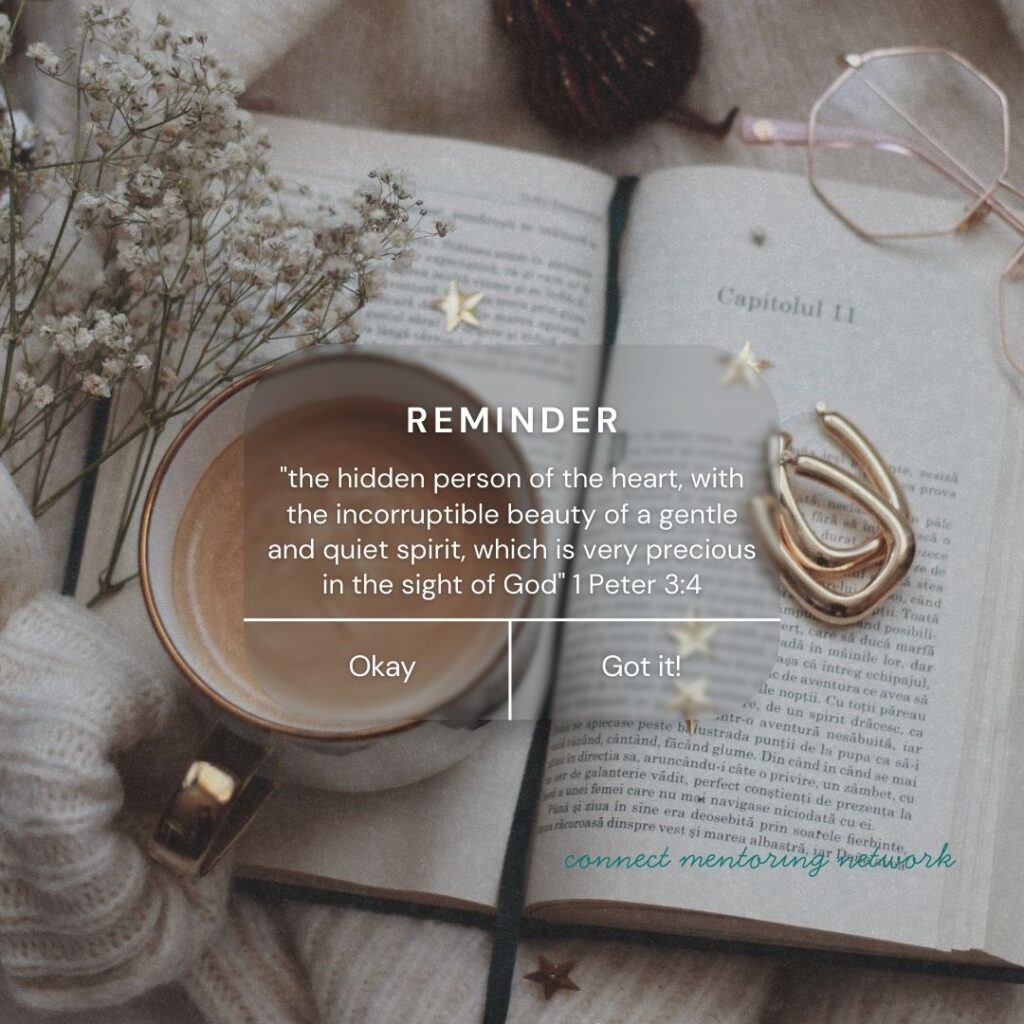
Resolution vs Reflection: As you consider the year ahead, pause and ask: Am I living to earn God’s approval—or from the assurance that I already have it?
One of the beautiful byproducts of resting in God’s approval is freedom from the need to impress people.
So much striving comes from the desire to be seen, affirmed, or validated. We may not say it out loud, but it shows up in comparison, people-pleasing, overcommitting, or discouragement when our efforts go unnoticed.
But our validation does not come from others. It comes from the truth that we are God’s creation, made in His image (Genesis 1:27). That identity is not fragile. It doesn’t need defending or decorating.
When we stop chasing approval, we create space for obedience. We stop asking, “will this be impressive?” and start asking, “Is this faithful?”
Resolution vs Reflection: Where in your life might God be inviting you to lay down the need for validation and rest in your identity as His beloved child?
Rather than beginning the year with a list of resolutions rooted in self-improvement, what if we approached this season with prayerful reflection, a different kind of evaluation?
Not with guilt or pressure, but with humility and openness before the Holy Spirit.
Reflection allows us to examine our stewardship—not to measure success, but to align our hearts. It invites us to ask honest questions about how we are using what God has entrusted to us.
- What gifts or abilities am I neglecting or setting aside?
- What resources am I using primarily for myself?
- Are there areas where my actions look selfless on the outside, but my motives still need refining?
- Where have fear, comparison, or the desire to impress shaped my decisions?
These questions are not meant to condemn us. They are invitations to deeper surrender.
Reflection vs Resolution: Remember that these questions are not meant to condemn us. They are invitations to deeper surrender.
God is not asking us to do more. He is asking us to be faithful with what we already have. This is not about striving - it's about stewardship.
Stewardship shifts our focus from output to obedience. It reminds us that our lives are not platforms for performance, but offerings of worship. Jesus consistently affirmed faithfulness in small things and obedience that went unseen.
When we release the pressure to impress, we discover the joy of availability. We begin to ask, “How can I honor God with what is already in my hands?”
Resolution vs Reflection: In this season, what might it look like to choose faithfulness over visibility and obedience over applause?
As I step into this new year, I don’t want to offer Him parts of my life while keeping others guarded. I want Him to use all of me—my gifts, my limitations, my time, my voice.... I want to walk into this new season with a new level of surrender.
My prayer is not simply that God would bless what I do, but that He would be honored in how I live. In this process, I want others to be blessed—not so that I am seen, but so that they see the goodness of God. Passing these thoughts on, stewarding what He gives well, holding what He entrusts to me lightly, considering my sphere of influence.
You have a sphere of influence as well - and you have gifts entrusted to you. Make it your heart's desire: offer all you already are to the Lord -your gifts, your time, your voice, even your limitations.... Watch the Lord grow you, not because you earned it, but because the He is already pleased with you.
Resolution vs Reflection: As you enter this new year, what parts of your life might God be inviting you to surrender afresh?
The invitation of this season is not to become more impressive, but more surrendered. Reflection over resolution. Identity over performance. Faithfulness over striving. Allowing what is precious to the Lord to become precious to us: "the hidden person of the heart, with the incorruptible beauty of a gentle and quiet spirit, which is very precious in the sight of God" (1 Peter 3:4).
When we stop trying to impress, we become free to live as who we were created to be. In the resolution vs reflection battle, let reflection win. You do not have to impress God - you are already His beloved, purchased with a high price. That's a treasure!
Let's continue this conversation on the podcast this week! Subscribe at https://www.youtube.com/@JenniferWSpivey so you don't miss anything. If you are considering growing into 2026, consider a Christian mentor! I would be honored to walk beside you - check out the resources and membership here on www.connectmentoringnetwork.org and let's grow together!
This year, what if we chose something deeper? Let's take a look at reflections vs resolutions.
As we step into 2026, many of us feel the familiar pull of a new year—the clean slate, the fresh start, the pressure to decide who we will become in the next twelve months. I was ready to let go of 2025, and I'm excited for a new day in 2026 - check in here if you missed my last blog.
If you are like me, "resolutions" seem to come to mind at the same time we think of a new year: goals to be thinner, stronger, more productive, more organized, more disciplined. While there is nothing inherently wrong with resolutions and goals that gear toward growth or intentionality, the danger is that our focus so easily drifts toward self-improvement while quietly neglecting soul formation.

Psalm 65:11 declares, “You crown the year with Your goodness, and Your paths drip with abundance.” This is not a picture of us striving to make the year good - it's a picture of God Himself placing a crown of goodness upon it. The year ahead is not crowned by our resolve, our willpower, or our perfectly executed plans. It is crowned by the goodness of God. That truth invites us to begin the year not with pressure, but with trust. That truth may lead you to make reflections vs resolutions.
Reflections vs Resolutions:
Rather than asking, “What do I want to accomplish this year?” perhaps the better question for 2026 is, “Who am I becoming in Christ?”
Where have I been tempted to trust my own effort more than God’s goodness as I look ahead?
Scripture consistently calls us away from frantic striving and toward faithful abiding. In Isaiah 43:18–19, the Lord says, “Remember not the former things, nor consider the things of old. Behold, I am doing a new thing; now it springs forth, do you not perceive it?” God is not merely interested in helping us refine old patterns—He is inviting us into something new altogether. New depths of trust. New ways of walking with Him. New levels of surrender that cannot grow in soil cluttered by yesterday’s disappointments or successes.
However - perceiving the “new thing” God is doing requires space. Stillness. Souls that are not overcrowded by noise, hurry, and self-imposed expectations.
Reflections vs Resolutions:
Rather than asking, “How can I improve on last year?” perhaps the better question for 2026 is, “Who am I becoming in Christ as He does something new in me?”
What former things might God be inviting me to release so I can perceive what He is doing now?
We live in a world that rewards hustle and measures worth by output. Even within Christian spaces, we can quietly absorb the belief that spiritual maturity is proven by how much we do for God. Yet Scripture reminds us that transformation flows from identity, not activity. “Therefore, if anyone is in Christ, he is a new creation. The old has passed away; behold, the new has come” (2 Corinthians 5:17).
This is not a future promise—it is a present reality. In Christ, we are already made new. Growth in the Christian life is not about earning a new identity, but learning to live from the one we have been given. When we forget this, our faith becomes performance-driven, and intimacy with God slowly gives way to pressure.
Reflections vs Resolutions:
Rather than asking, “What spiritual habits should I add this year?” perhaps the better question for 2026 is, “Who am I becoming in Christ as I live from my new identity?”
Where might I be striving to prove my faith instead of resting in who I already am in Him?
Tending a soul is slow, intentional work. It looks like lingering in Scripture instead of rushing through a plan. It looks like prayer that is honest rather than polished. It looks like creating margin to listen, repent, trust, and return—again and again. Soul care is not flashy, but it is where intimacy with God is cultivated.
Jeremiah 29:11 reminds us, “For I know the plans I have for you, declares the Lord, plans for welfare and not for evil, to give you a future and a hope.” These words were spoken to people in exile—people living in the tension between promise and fulfillment. God’s good plans do not eliminate hardship, but they anchor us in hope and faithfulness while we wait.
Reflections vs Resolutions:
Rather than asking, “How can I control what happens this year?” perhaps the better question for 2026 is, “Who am I becoming in Christ as I trust His plans?”
What would it look like to tend my soul instead of trying to manage every outcome?
As we enter 2026, many of us carry unseen burdens from the year behind us—losses, unanswered prayers, fatigue from doing all the “right things” without seeing fruit. Choosing intimacy with Christ does not ignore those realities, but it reframes them. Faithfulness is not measured by visible success, but by quiet obedience, daily surrender, and continued trust.
We can be confident of this: as we are faithful to God, He will surely be faithful to us. He always has been. He always will be.
Perhaps this year, we release the pressure to reinvent ourselves and instead choose abiding over striving. We choose depth over distraction. Faithfulness over frenzy. Formation over performance. Reflections vs resolutions.
May 2026 be a year crowned with His goodness. May your soul be tended with care. And may your greatest growth be found not in what you accomplish, but in who you are becoming in Christ. What a treasure that would be!
Let's continue the conversation on the podcast! Join me on Thursday at 10:00 - subscribe here: https://www.youtube.com/@JenniferWSpivey
Want help achieving your resolutions in 2026? A new cohort is forming now at wwww.connectmentoringnetwork.org. All kinds of resources, all at your fingertips and all at your schedule. A Christian mentor can make all the difference - let's connect and grow together in 2026!
This one is different, I just wanted to reflect on my year, record it, save it so I can look back. Today I think I could never forget 2025, but time always seems to move on.... I also left this one at www.jenniferwspivey.org, that site has always been more personal. Thanks for hanging with me - maybe you had a 2025 too, and can relate. I'm glad we're connecting today:
2025 was that year for me.
I don’t think I realized how much 2025 took out of me until I finally paused long enough to look back. It was a year of so many changes—some expected, some sudden, some welcome, some unwelcome. A year where my mental, spiritual, and physical reserves were stretched in ways I never anticipated. In the same twelve months, grief can sit beside joy, loss can hold hands with gain, and exhaustion can coexist with wonder. That was the paradox, the tension, the beauty of this year.
Some years ask more of us than others. Some years feel like an uphill climb. Some years stretch us until we’re not sure how much more we can give. 2025 was that year for me.
Some years give more than we ever expected. Some years feel like a downhill run with the wind at your back. Some years fill you until you’re not sure your heart can hold any more gratitude. 2025 was that year for me.
All the changes—good ones, hard ones, and everything in between—pulled at my mental, spiritual, and physical energy. There were days I handled it with grace, and days I handled it with grit.
And then there were days I handled it only because God held me together. (Can anyone else relate to “fake it ‘til you make it”? Those 29 years of “pastor’s wife frozen smile and I’m fine” came in handy on some days…. )
Some things this year turned out exactly as I had hoped or envisioned. Those were the moments that felt like fresh air—like God placing a gentle hand on my shoulder and whispering, “See? I’m working.”
Other things turned out so differently I had to fight to keep my footing. I had to remind myself to breathe, to pray, to steady my heart.
Some things came to such an abrupt halt that it made my head spin. Change that sudden can be jarring, even when we know God is sovereign.
And then—right alongside the hard—there were moments so full of joy I could hardly contain them. Laughter that surprised me. Blessings that overwhelmed me. Grace that arrived at the perfect moment.
This year, seasons ended. New seasons began. Some doors closed quietly, others slammed shut. Some opened gently, and some burst open wide with opportunity.
Joy and grief sat in the same room.
Consolation and celebration shared the same table.
Loss and gain held hands.
I learned—again—that life rarely separates its emotions neatly.
2025 was that year for me.
Yet through every part of it, God was in it all: not just at the points of triumph, not only in the moments of clarity. He was present in the chaos, the confusion, the uncertainty, the exhaustion.
He was faithful when I felt strong.
He was faithful when I felt undone.
He celebrated when I celebrated.
Some days, He showed me the entire picture—how things fit together, where He was leading, how the pieces connected, how the dark was overcome by the light.
Other days, all I could see was the dark contrast. I couldn’t trace the outline. I couldn’t see the movement. I just had to trust that the dark would work with the light, that His hand was still shaping something good, that tomorrow would bring the illumination I lacked today.
2025 was that year for me.
I remembered an old song, and as the lyrics flooded back with all the memories that came along with it, I couldn’t stop the tears:
Tears and fears and feeling proud to say, "I love you, " right out loud
Dreams and schemes and circus crowds, I've looked at life that way
But now old friends, they're acting strange; they shake their heads, tell me that I've changed
Well, something's lost, but something's gained in living every day
I've looked at life from both sides now, from win and lose and still somehow
It's life's illusions I recall, I really don't know life at all
The gift is that I don’t have to know life at all - I have to know the One who holds all the days that string together to make a life. I’m so grateful He holds this for me.
I think that’s one of the hidden gifts of a hard year, a blessed year, a growing year, a year that was all things at once: it teaches us to trust God not only when we understand Him, but also when we don’t. It teaches us that His goodness is not dependent on our clarity, and His faithfulness is not limited by our strength or our weakness.
Looking back, I can say this with certainty:
- God did not waste a single moment of my 2025.
- He used every joy, every shock, every ending, every beginning.
- He held every tear and strengthened every step.
- He stayed close when my world felt unsteady
- He celebrated with me when new life blossomed.
And as I step into a new year, I’m carrying these truths with me:
- Even when something is lost, something is gained.
- Even when the scene changes, God remains.
- Even when I can’t see the full picture, His hands are already framing the next chapter.
And the next chapter is good - it will be good for you, too. As the psalmist said in 65:11, “You crown the year with Your goodness , And Your paths drip with abundance." He did that in 2025 - 2025 was that year for me, His goodness, His abundance, exactly what I didn't know to ask for. He’ll do it again in 2026, in 2027, in 2028, and so on until Jesus Christ returns. We are assured of that too, that “He who has begun a good work in you will complete it until the day of Jesus Christ” (Phil. 1:6).
I don’t know what the coming year will bring, but I do know this—I will walk into it with the same God who faithfully carried me through this one. His faithfulness and steadfast love is always the treasure <3
How was your year? What are you looking forward to next year? I'd love to walk with you - check out Connect Mentoring Network and see how a Christian mentor can be a benefit - this community is created for you!
All believers find themselves here at some point: in the middle, doing the hard work of trusting the faithfulness of God. Not the beginning of the storm when everything changes, and not the ending where everything is restored, but the long stretch in between. As we close this series, you can catch up here.
"In the middle".... This is the space where:
- your prayers feel unanswered,
- your heart feels tired,
- your faith feels stretched,
- and your circumstances refuse to move.
It’s the place where Job sat—in the ashes, with more questions than answers, holding onto a God he didn’t fully understand but fully trusted. In the space where he could discover once again the faithfulness of God.
If you’re in that middle place today, hear this: you are not stuck. You are being shaped.

What God Does in the Middle
The middle seasons are not wasted seasons. They are the places where God does work you cannot see yet—steadily, faithfully, intentionally.
In the middle, God teaches you to:
- see honestly — not pretending the pain isn’t real, but also not letting it define everything.
- listen deeply — letting His voice guide you more than your emotions or fears.
- receive humbly — allowing Him to correct, comfort, and shape your heart.
- trust steadily — believing His promises more than your present circumstances.
- stand expectantly — knowing He restores before you even feel restored.
This is the path of spiritual maturity.
This is the path Job walked.
This is the path Jesus walked in His own hours of sorrow.
This is the path God walks with you.
Between Brokenness and Wholeness
The middle is an uncomfortable place because it lives between what was and what will be.
Between:
- brokenness and wholeness,
- loss and rebuilding,
- ashes and restoration,
- lament and praise.
But it is also the place where God’s faithfulness shines brightest.
You may not see the finished house yet—but the Builder is already at work.
Just as your illustration shows: the insurance has called, the check is in the mail, the rebuild is guaranteed. But today you’re standing in the ashes. The promise is sure, but the process is still unfolding.
And God is faithful in both places—the promise and the process.
The Faithfulness of God in Your Middle
Job discovered something profound:
- That same God is faithful to ou.
- He does not abandon you in the ashes.
- He does not forget you in the waiting.
- He does not overlook you in the confusion.
- He is forming, strengthening, comforting, and preparing you—even now.
God was not only faithful at the end when everything was restored—He was faithful in the middle when nothing made sense.
Scriptural Foundations for God’s Character in the Middle
1. God sees and knows your heart
- Job 1:8 – “Then the Lord said to Satan, ‘Have you considered my servant Job? There is no one on earth like him; he is blameless and upright, a man who fears God and shuns evil.’”
- Psalm 139:1–4 – God knows our thoughts, our paths, and even our words before we speak them.
2. God is present even in suffering
- Job 2:9–10 – Job acknowledges his suffering but still maintains his trust in God.
- Isaiah 41:10 – “So do not fear, for I am with you; do not be dismayed, for I am your God. I will strengthen you and help you; I will uphold you with my righteous right hand.”
- Psalm 46:1 – God is our refuge and strength, an ever-present help in trouble.
3. God corrects with love and for our good
- Job 42:1–6 – Job responds to God’s correction with humility, acknowledging God’s wisdom and repenting.
- Hebrews 12:5–11 – God disciplines those He loves, not to punish, but to train us in righteousness.
4. God restores and rebuilds
- Job 42:10–17 – God restores Job’s fortunes, health, and family after the trial.
- Joel 2:25–26 – God restores the years that the locusts have eaten.
- Psalm 23:3 – God restores our soul and leads us in paths of righteousness.
5. God’s faithfulness is unshakable
- Lamentations 3:22–23 – “Because of the Lord’s great love we are not consumed, for His compassions never fail. They are new every morning; great is Your faithfulness.”
- 2 Timothy 2:13 – If we are faithless, He remains faithful.
- Job 1:21 – Job worships even in loss: “The Lord gave and the Lord has taken away; may the name of the Lord be praised.”
6. God invites us into trust and dependence
- Job 13:15 – “Though He slay me, yet will I hope in Him.”
- Proverbs 3:5–6 – Trust in the Lord with all your heart and lean not on your own understanding; He will make your paths straight.
7. God provides perspective beyond circumstances
- Job 38–41 – God responds to Job’s questions by revealing His majesty, wisdom, and sovereignty over creation.
- Romans 8:28 – “And we know that in all things God works for the good of those who love Him, who have been called according to His purpose.”
So What Do You Do in the Middle?
You stay close, keep listening, keep surrendering, keep trusting.
You keep showing up with your whole heart—even when it’s tough, even when you are looking at the ashes and waiting for the check to come in. Let God meet you there - not only to bring you out, but to transform you.
Even in the middle.
Join me next week for a new discussion on the blog and on the podcast - and visit connectmentoringnetwork.org for more resources!
Trust in God - this can be a bigger step than most of us want to admit. There is a holy mystery in the way God works during the “middle” seasons of our lives. We often want the ending—the restoration, the rebuilding, the clarity. But God often does His deepest, most transformative work before the restoration arrives. If you need to catch up, you can find "In the Middle" 1, 2, and 3 here.
Job’s story teaches us this: sometimes God changes us long before He changes our circumstances. The middle is where God strengthens, steadies, restores.
Job’s Turning Point: An Encounter, Not an Explanation
Job spent chapter after chapter asking God why. He wanted answers, explanations, and clarity. His friends tried to offer reasons and explanations, but those fell short for sure.
When God finally spoke, He didn’t give Job reasons - He gave revelation. God revealed His greatness, sovereignty and wisdom. He reminded Job of His intimate care over all creation. When Job answers the Lord, his response is so beautiful and shows growth and understanding that he did not have before:
Job answered the Lord and said:
“I know that You can do everything,
And that no purpose of Yours can be withheld from You.
You asked, ‘Who is this who hides counsel without knowledge?’
Therefore I have uttered what I did not understand,
Things too wonderful for me, which I did not know.
Listen, please, and let me speak;
You said, ‘I will question you, and you shall answer Me.’
I have heard of You by the hearing of the ear,
But now my eye sees You”. (Job 42:2-5)
“I had heard of You…but now my eye sees You.” (It's not a psalm, but still a great place for a selah - pause and think of that!)
Sometimes the “next step” in your healing is not the restoration you were hoping for in the natural - sometimes the next step is a clearer vision of who God is. Before anything in Job’s life was rebuilt, Job himself was restored. Hang in there - the restoration is coming for Job!
From the Wounding Came Faithful Healing
The enemy meant to destroy Job, but God had a greater plan: pruning, not punishment; refining, not rebuke.
God’s faithfulness throughout our in-the-middle days leads to:
- deeper dependence
- stronger trust
- clearer vision
- a steadier heart
This is the kind of trust that isn’t shaken by circumstances because it wasn’t built on circumstances. This is how God restores us “in the middle”—not with explanations, but with formation.
Job’s Restoration and His Trust in God: A Biblical Example
Job’s story doesn’t end with unanswered questions—it ends with restoration that reflects God’s faithfulness and the fruit of His work in the middle. Scripture tells us:
- Restored possessions and family: “The Lord blessed the latter part of Job’s life more than the former. He had fourteen thousand sheep, six thousand camels, a thousand yoke of oxen, and a thousand donkeys.” (Job 42:12)
- Restored family relationships: God gave Job seven sons and three daughters, and even the text notes the daughters were especially beautiful. (Job 42:13–15)
- Job’s response: Job prayed for his friends, demonstrating the humility, mercy, and wisdom he gained through his middle season. (Job 42:8–9)
- God’s faithfulness and vindication: Job’s health, reputation, and relationships were fully restored—not as if the pain never happened, but as a testimony of God’s faithfulness through the trial.
Job’s restoration shows us several truths for our own middle seasons:
- God restores what the middle has refined. The restoration comes after the heart has been shaped and trust deepened.
- Our response matters. Job prayed for those who had failed him, showing that restoration flows through humility, obedience, and mercy.
- God’s faithfulness is unwavering. Even when life seemed shattered, God had a plan to restore fully and abundantly.
By looking at Job, we see that restoration is not only about circumstances—it’s about transformation. God works on our hearts first, preparing us to receive and steward His blessings well.
Recognizing When God Is Leading You Into the “Next Step”
Restoration rarely arrives all at once. More often, it comes in quiet markers—holy hints that God is moving you forward:
- Clarity begins to rise out of confusion. It doesn’t mean everything makes sense—just that something does.
- Peace slowly pushes out panic. Not because the situation has changed, but because God has strengthened your heart within it.
- Obedience becomes easier than resistance. Surrender feels less like loss and more like relief.
- You sense God inviting you toward something new. A next step or new habit or a release - these are signs of God’s hand restoring you from the inside out.
God Restores Before He Rebuilds
By the time Job’s circumstances were restored, Job was already different - more grounded, more trusting, more surrendered, more whole. That is what God does in the middle. He prepares you for the blessing He’s already prepared for you. He strengthens the foundation before He erects the new walls. He restores your heart before He restores your home. Let's trust in God as He works, before we see His intended end.
Let’s finish this up next week - join me on the blog and/or the podcast! Visit www.connectmentoringnetwork for more resources. I can’t wait to connect with you again soon!