There is a unique kind of heaviness that settles over the heart when you are “in the middle” of a difficult season. You know God is faithful. You know restoration will come. You know the end of the story will be good because the Author is good. That doesn’t mean that today isn’t tough. That doesn’t mean that being “in the middle” isn’t a hard place. Check out the first and second in this "in the middle" series and let's get started!
I was trying to explain this to a friend the other day, about my own “in the middle” moment. Imagine it this way: your house has just burned down. You are sitting on your knees across the street looking at the ashes and rubble. You’ve already been told the insurance will cover everything. You know a rebuild is coming. However, at this moment, you are grieving. You liked that house. You liked that stuff. Better is coming, but for now you’re living in the space between the loss and the restoration, between the breaking and the rebuilding. The insurance agent has promised: the check is in the mail. That’s a valid spot to be in, an emotional spot to be in, even when you know it’s going to be okay, between looking at ashes and cashing that check.
In that vulnerable middle place, God can begin to correct, shape, and grow us. His heart is always for our best, even on days that feel hard in our limited judgement (and our judgement is limited - let’s put a bookmark there and talk about this on another day).

Why God’s Correction Feels Threatening
Even when we believe God is good, His correction might feel sharp when we’re already hurting. Job experienced this. In the midst of unimaginable loss, he wrestled with big questions and deep frustrations. When God finally spoke, His words didn’t condemn—but they did confront.
Correction can feel threatening for a few reasons. Maybe we fear that it means we’ve done something wrong. Maybe we worry God is disappointed in us. Maybe in this moment, we’re already fragile, and anything that feels like pressure can feel overwhelming.
Hear His heart for you. God is not angry, God is not disappointed, God is not done with you. He loves those He corrects, remember? (Hebrews 12:6-11) When God speaks, let’s lean in.
Listening Without Defensiveness
One of the most sacred disciplines in the middle season is learning to listen to God without defending ourselves. Pain often makes us want to justify ourselves - but God, in His kindness, invites us to open our hands and hearts instead.
Job shows us what this looks like. Even in his grief, he asked God honest, raw questions:
- “Why did I not perish at birth?” (Job 3:11)
- “Why is light given to those in misery, and life to the bitter of soul?” (Job 3:20)
- “Why do You hide Your face and count me as Your enemy?” (Job 13:23)
- “Why do the wicked live on, growing old and increasing in power?” (Job 21:7)
- “How can a man be righteous before God?” (Job 4:17)
- “If a man dies, will he live again?” (Job 14:14)
- “Oh, that I knew where I might find Him, that I might come to His seat! I would present my case before Him…” (Job 23:3–4)
God didn’t shy away from Job’s questions. In chapters 38–41, He responds. He doesn’t condemn, He reminds Job of His power, wisdom, and the larger story beyond Job’s understanding. God’s answers are gentle yet firm: trust His design, lean on His wisdom, and recognize His sovereignty even in the middle of confusion and pain.
Humility in the middle doesn’t mean silence. It means asking hard questions, listening carefully, and allowing God’s correction and guidance to shape us—even when we don’t see the full picture yet.
Responding Practically When God Brings a Hard Truth
Sometimes God’s correction comes through Scripture, prayer, or through the Holy Spirit’s gentle conviction.
Here are a few ways to respond:
- Pause before reacting, because correction is not rejection. Let God finish the sentence before you jump in to defend or excuse.
- Surrender instead of resisting, because correction is not condemnation. Say to God, “If this is from You, I will yield to it”.
- Stay rooted in grace, because correction is one of the ways God shapes us for the restoration He has already planned.
Reflection Questions for Your Middle Season
There are a couple of questions I love to ask the Lord in my own in-the-middle seasons or on my tough days:
“What aspect of Your character do You want to reveal to me in this?”
“What is it that You want to be for me today that You were unable to be to me yesterday?”
Not that there was ever a moment when God was limited - but perhaps I didn’t know what I needed. I didn’t know I needed a provider until my need was revealed. I didn’t know that I needed a healer until I had the negative diagnosis. I didn’t know I needed a shepherd until I felt lost. When those missing pieces were exposed, God’s character was revealed and I grew closer to Him. From that perspective, the in-the-middle moments are so valuable to our growth.
God answers those questions so faithfully every time. He is right there in the middle with me. He is right there in the middle with you.
Once again, we are leaving Job in the middle! Let’s continue this conversation again next week on the blog and on the podcast - I hope you’ll join me for this conversation next week as we continue talking about the value of our own in-the-middle days. It’s such a joy and honor to connect with you!
I hope I didn’t present Job’s friends as the picture of healthy godly friendships – they made some mistakes, as we all do. However, Job did keep them around. That’s a lesson in itself, isn’t it? We don’t get “done” with people, even though seasons may change. We can learn a lot of lessons from Job's friends. (you've heard the saying, "Sometimes there's a blessing, sometimes there's a lesson" - let's take the lesson from Job's friends today!)
If you didn’t read last week’s blog post, better catch up here. Come right back after you read it and let’s continue this conversation!
Job’s friends get a bad rap, but I honestly think that they meant well, and there are even lots of words they say that are true –
“God is famous for great and unexpected acts; there’s no end to His surprises” 5:9
“what a blessing when God steps in and corrects you” 5:17
“Does God mess up? Does God Almighty ever get things backward?” 8:2
“God will set everything right again, reestablish your fortunes” 8:6
“God is far higher than you can imagine, far deeper than you can comprehend” 11:7
I do think the friends mean well, but it is almost as if they are speaking without the experience of deep pain. They want to point out God’s goodness, but then immediately connect Job’s troubles to Job’s behavior. They cannot seem to understand why these things would happen when a God whom they know as good is on the throne. They’ve got to explain it away by calling Job’s test a punishment. It’s as if they want to plug God into a “if you’ll do this, He’ll do that” formula, but life isn’t that simple.
This is my opinion, but I wonder if Job’s friends tried to explain God in this way to protect themselves. Their theology did not leave space for struggle or grief. In their experience, if you were “good”, then God protected you and these things didn’t happen. Seeing Job in this situation had to punch a hole in that for them - “if this could happen to Job, it could happen to us… No, it must be that Job did something wrong and made God angry…. Job, just repent and get your life back….” That was the “safer” explanation.
We make these same mistakes in our ministry, leadership and friendships today sometimes. Job’s friends do a few things wrong here:
- they jumped to conclusions without considering the full scope or hearing the whole story - their conclusion was that Job must have sinned, and that his present circumstances were a punishment
- they over-spiritualized Job’s pain, turning a moment that called for compassion into a lecture on morality
- they assumed insight without asking questions, without asking clarifying questions or seeking to understand his experience
What was needed in the moment for Job was presence. He needed the comfort of a friend more than he needed answers or solutions for his situation, and they moved too quickly.
There’s a reason Scripture calls us to “weep with those who weep” (Romans 12:15). It’s not just about sympathy—it’s about entering someone’s sorrow long enough to reflect the compassion of Christ. Sometimes the most spiritual thing we can do is simply sit still beside someone who’s hurting. When we show up with listening ears and a soft heart, we mirror the gentleness of Jesus, who never rushed people through their pain but met them right in the middle of it.
In leadership and ministry, this takes humility. It’s not easy to resist the urge to fix, explain, or quote a verse that ties everything up neatly. But real friendship and godly care don’t demand resolution—they offer presence. When we slow down long enough to listen, we are communicating, “You’re not alone. I don’t have all the answers, but I’m staying.” That kind of love ministers more healing than any well-meaning advice ever could. Job's friends did stay - let's give them credit for that!
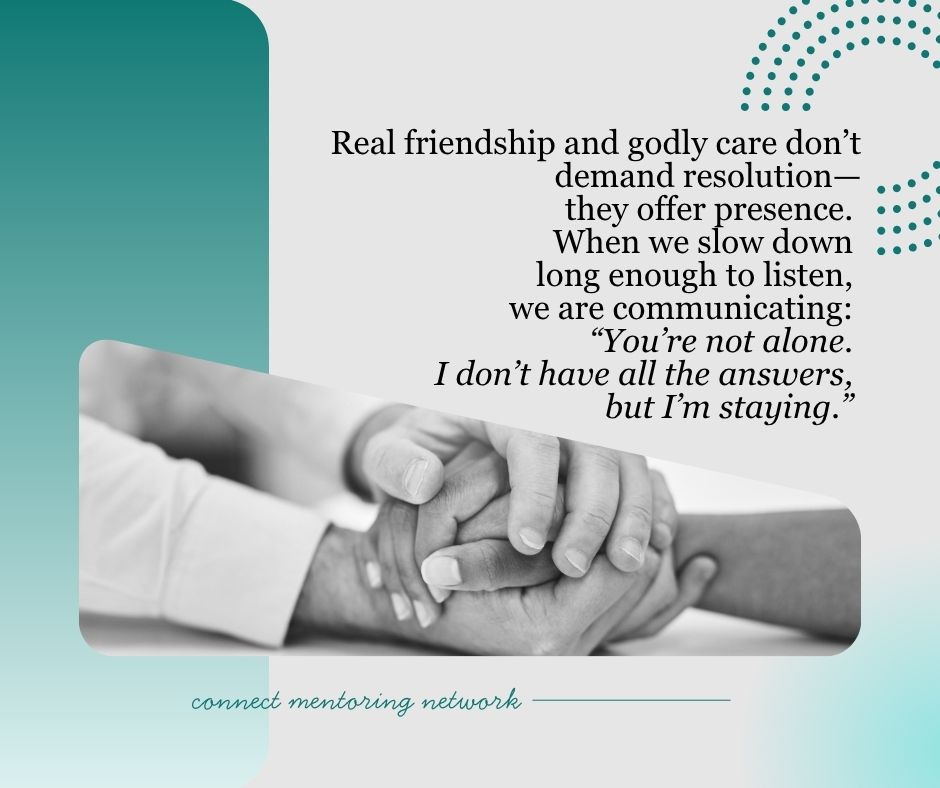
When leaders move too quickly, we risk replacing empathy with advice, and presence with analysis. True ministry begins with careful listening, humility, and the patience to let God’s truth unfold rather than rushing to conclusions. Job’s friends missed an opportunity to minister peace to Job in his troubles. How painful it must have been for Job to listen to this as he grieved.
Sometimes friends are trying to help, and don’t know how to do it – forgive them. Sometimes friends don’t know how to help, so they ignore the situation (and possibly you) altogether – forgive them. Don’t shy away from relationship, using past hurts as an excuse. Trust that the relationship will give you the opportunity to grow, and the Lord will fill in the blanks. Even when there must be a loss of relationship (sometimes it must be), trust Jesus to give you the continuity of community that you desire.
For now, Job is still in the middle. I want to hang out until we see his restoration, don’t you? Let’s come together on Thursday as we continue this conversation on the podcast, and come back to the blog next week as we continue this series on the blog!
I wrote this blog post about 7 years ago, but today I wanted to re-visit and add to it. I think we'll have a little series on the "in the middle" times that we all face in life. I'm in an "in the middle" myself - hard things happen, and also I know that God has a great plan. I'm in the middle of it! Maybe you can relate!
I know it's strange to say, but Job really is one of my favorites. 🙂 I was thinking this morning about how LONG the dialogue between Job and his friends continued. Maybe I should rephrase: Job allowed his friends' diatribe against him to go on for a really long time (chapters and chapters and chapters!). Not sure I would have sat there for that (I would have struggled, I'm sorry to admit!). However, Job didn't end the relationship with his friends. Since he allowed them a front row seat to his troubles, they also had a front row seat to his restoration. What a gift it must have been, to be able to see that season come full circle. If you are a ministry leader, invited trusted friends in may feel risky - but it positions you for greater restoration and depth.
Job could have left his friends at their first criticism and no one would have blamed him. But he stayed. Because we often don't know how to handle confrontation, we often run at the first cross word. However, this is oftentimes a wrong response. Here's my balancing comment: for the next little bit, please understand that I am talking about close friendships with like-minded people.

A true friend is someone who should have the earned privilege of speaking truth into your life - and you should have the earned privilege of speaking truth into theirs. Relationship gives you the opportunity to let "iron sharpen iron" (Proverbs 27:17), a mutual benefit to godly relationship. King David insists that correction from a friend is a kindness: “Let the righteous strike me; it shall be a kindness. Let him rebuke me; it shall be as excellent oil; let my head not refuse it” (Psalm 141:5). To be honest, correction is not optional—it’s a gift when given and received well.
Please make this important distinction: a difference of opinion doesn’t mean disloyalty; it means growth when handled with grace. There are times when correction is necessary, even helpful. David even considered correction an act of loyalty. There are times when friends disagree - and that's okay. When I was the pastor's wife in our church, I watch it happen time and again: friends disagree, and rather than hanging in there together, they allow a difference of opinion to drive a wedge. Couldn't you have a difference of opinion, discuss, continue to respect each other, and continue to move forward? Most of the time we can; but most of the time we don't.
Grace is required to give godly correction - even more grace is required to receive godly correction. By allowing a wedge form over a correction, you are also cutting yourself off from the wisdom and opportunities for growth that the Lord means for your godly friendship. The Bible says that "the wounds of a friend are faithful" (Proverbs 27:6), meaning that truth from a friend is to be desired, even if it hurts at first.
You cannot be EFFECTIVE in relationships without being AFFECTED. Feel all the feels - but don't let a godly relationship (and the growth that can come from it) end unnecessarily. Don't shy away from relationships, using confrontation as an excuse. You cannot lead or influence in ministry without being changed yourself. Let the wounds of a friend be faithful in you.
A new thought: Job's friends were harder on him than they had to be. There's a reason for it, there's a grace for it, and you and I are going to visit about them next week. While we wait for part two, maybe a little thought: sometimes you are the one who is "in-between", maybe it's your friend who is "in-between". Sometimes what is needed is someone who will simply sit in the ashes with you and say, "Man, it's tough, huh? I love you and I'm praying. What kind of day is today? Do you need a faith-filled-hype-speech (because I have one!) or do you need a gentle and quiet arm wrapped around your shoulder (because I can do that too!)?" Be sensitive to the leading of the Holy Spirit and to the heart of your friend. Hopefully they will be sensitive to you in return, when you are the one who is "in-between".
Learning that you can go through it and grow through it together is a treasure. I'm praying that you have and maintain these kind of blessing friendships in your life <3
Job's friends are a whole 'nother story - let's visit about them next week and get a little more balance to this conversation! Join me on the podcast on Thursday, and join me again on the blog next Tuesday - let's review together and add a little new insight for a new day as well! Love y'all!
Jennifer 🙂
Have you ever heard someone say things like:
- “Just saying.”
- “No offense, but…”
- “Don’t shoot the messenger.”
- “Somebody had to say it.”
These often come after a blunt or critical comment. It’s a signal to the listener: “I know this might sound harsh, but I’m not taking responsibility for how it lands”.
How about any of these:
- “I’m just being real.”
- “It’s real talk.”
- “Just being honest.”
These sound authentic but can hide a pride in bluntness — as if harsh honesty is more righteous than gracious speech.
How about these:
- “I’m speaking the truth.”
- “I call it like I see it.”
- “I’m speaking the truth in love.”
Maybe these can sound biblical or courageous, but often this form of "truth" becomes a weapon instead of a witness when love and humility are missing.
We like to say we’re “just speaking the truth in love”. It sounds spiritual, doesn’t it? But far too often, what we call truth is really just our opinion, our frustration, or even our insecurity dressed up in spiritual language.
When you look closely, each of these phrases reveals something about the heart behind the words. Sometimes what we call “honesty” isn’t really about helping others — it’s about protecting or possibly promoting ourselves.
Biblical truth-telling always begins with humility and love. When Jesus spoke truth, it wasn’t to win an argument or prove a point — it was to heal, restore, and redeem. Real truth-telling isn’t about getting something off our chest; it’s about getting Christ’s heart into the conversation.
Here’s the thing — if our words don’t lift someone up, point them back to Jesus, or remind them of who they are in Christ, we’re not actually speaking truth. Truth isn’t harsh or condemning.
When Paul talked about “speaking the truth in love” (Ephesians 4:15), he wasn’t giving us permission to correct others harshly. He was reminding us to call one another up — to remind each other of the reality of who we are as sons and daughters of God.
Here’s the truth:
- We are a new creation in Christ (2 Corinthians 5:17).
- We are chosen, holy, and dearly loved (Colossians 3:12).
- We are God’s workmanship, created for good works He prepared in advance for us (Ephesians 2:10).
Truth spoken in love calls others up into their identity. It reminds them of who they are — chosen, redeemed, and dearly loved. If what we’re saying to someone else doesn’t lift them toward Christ or reflect their identity in Christ, then we are not speaking the truth in love.

When we “speak the truth in love,” it should sound like the heart of Jesus. He never used truth to shame or silence people. He used truth to set them free, to restore dignity, and to remind them of their worth in the Father’s eyes.
When we carry this same heart into our ministry, our words begin to heal instead of harm. Our presence becomes safe instead of stressful. Our leadership reflects Christ instead of competing for attention.
Why is this important? What does this have to do with not competing?
When we’re rooted in our identity in Christ, competition loses its grip.
When competition loses its grip, we are empowered to celebrate/support the giftings of those around us without fear. When competition loses its grip, we are empowered to speak the actual truth to others without fear of lack for ourselves.
Serving From Insecurity
When we serve from insecurity, everything starts to feel like a competition. We notice who’s being recognized and who’s not. We feel threatened by others’ gifts or intimidated by their confidence, but our calling is not a contest.
We have an unfortunate biblical example of this in Haman, from the book of Esther. Let’s not skip the history lesson today, want to come along with me? Here we go:
In Esther 5, Haman is invited to dinner with Queen Esther and King Ahasuerus, so:
“Haman went out that day joyful and with a glad heart” 5:9a
However, his good mood wasn’t to last - as soon as he begins his walk home, he sees Mordecai:
“but when Haman saw Mordecai in the king’s gate, and that he did not stand or tremble before him, he was filled with indignation against Mordecai.” 5:9
Why? Why is Haman “filled with indignation” against Mordecai? Haman has been invited to the palace for an intimate dinner with the king and queen, what does Mordecai have to do with this? Haman is being honored, and another man is adjacent. Why can’t Haman let it go? Why did Haman even take notice and waste mental energy on a Jew sitting at the king’s gate? The definition of indignation is “anger or annoyance provoked by what is perceived as unfair treatment”, which makes this make even less sense.
“Nevertheless Haman restrained himself and went home and he sent and called for his friends and his wife Zeresh. Then Haman told them of his great riches, the multitude of his children, everything in which the king had promoted him, and how he had advanced him above the officials and servants of the king. Moreover Haman said, “Besides, Queen Esther invited no one but me to come in with the king to the banquet that she prepared; and tomorrow I am again invited by her, along with the king. “ 5:10-12
We aren’t surprised that Haman makes this story all about himself, to be honest, I’m a little relieved that he didn’t even mention Mordecai. He had a great opportunity to take the high road and leave his “indignation” behind here. Just drop it, Haman, this has nothing to do with you.
Not so fast - here’s where Haman goes south:
“Let all this avails me nothing, so long as I see Mordecai the Jew sitting at the king’s gate.” 5:13
So, all of this is worthless because Mordecai exists? A little dramatic, don’t you think? Hopefully his wife will help him out:
“Then his wife Zeresh and all his friends said to him, ‘Let a gallows be made, fifty cubits high, and in the morning suggest to the king that Mordecai be hanged on it; then go merrily with the king to the banquet’. ” And the thing pleased Haman; so he had the gallows made.” 5:14
Or maybe she won’t…..
They say bad company ruins good morals, but Hamam was already at the bottom of the barrel here. His wife and friends push him down further. Take Mordecai down, they say. You know how I interpret this advice? I think this is Haman’s wife saying to him, “Haman, you’ve gone as high as you can go. You can’t grow, you can’t go any higher, you have reached your capacity. The only way to make yourself look good is to make others look bad. If anyone comes close to you, kick them down - then at least you’ll still look like you are on top.”
How’s that for “just saying” or “I’m just being real” or “don’t shoot the messenger” or “I’m just speaking the truth in love?”
To be honest, it’s sad, and led Haman to a dark place. When you come to a point where you cannot celebrate others, where you feel indignation that someone else is “in your space”, you’ve come to a dangerous spot. Run, don’t walk, back to the Cross. These things are heavy: competition, indignation, jealousy, comparison. You aren’t meant to carry them. Don’t waste your energy on these. You are better than that.
The truth is, we were never meant to compete with one another. God didn’t call us to run against each other; He called us to run with endurance in the race He’s specifically marked out for us (Hebrews 12:1).
The Truth That Frees
Let’s speak the real truth — the kind that builds the Body of Christ. Let’s be women who remind each other:
“You are chosen.”
“You are equipped.”
“You are loved.”
“You are enough in Him.”
That’s what “truth in love” sounds like.
When we serve from that truth, competition loses its power, comparison fades, and insecurity melts away. We become free — free to serve, free to love, and free to see others succeed.
In the Kingdom of God, her win is your win. Her growth strengthens your ministry. Her obedience advances the same mission you’re living for.
Let’s close this series right where we began — with a heart fully surrendered to Jesus, secure in who He says we are, and committed to building others up instead of tearing ourselves down through comparison. If someone else is growing/succeeding/winning, that doesn’t take anything away from your growing/succeeding/winning!
You can catch up here if you want to take a look at the first, second or third in the series!
Ministry without competition begins and ends in Christ. When we know who we are, we can cheer others on - and truly speak the truth in love the way Paul intended, truly speak the truth in love in a way that honors Christ. What a treasure!
Join me on the Connect Podcast on Youtube and let’s continue this conversation on Thursday!
Freedom from condemnation - this is an attainable goal, y'all! Let's do it! We were never meant to live under condemnation or pressure to perform. God didn’t design ministry to be a checklist: He designed it to flow from a relationship with Jesus Christ. When we really understand that, everything changes — our peace, our purpose, and the way we serve others. Here's the first and second in the "ministry without competition series" if you want to catch up! (But you don't have to - this will stand alone!)
We have a choice - we can live out of our love relationship with Jesus, or we can live out of law. When I live out of relationship, I’m responding to what’s already been freely given. When I live out of law, I feel like I’m striving, trying to earn something from God. (I really really really want to go to the Old Testament right now for a history lesson, but I’ll save it for another day!)

Law says, “I have to.” Love says, “I want to.”
Let’s look at the Word:
Romans 8:1-2 tells us,
“There is therefore now no condemnation for those who are in Christ Jesus, who do not walk according to the flesh but according to the Spirit. For the law of the Spirit of life in Christ Jesus has made me free from the law of sin and death.”
That word free is powerful. It’s not partial freedom or even freedom with conditions. It’s complete release from sin, striving, and the constant pressure to perform for God’s approval.
There’s a benefit to the law, we’re not throwing it out altogether. The law shows us what we can’t do on our own. Galatians 3:24 says,
“The law was our tutor to bring us to Christ, that we might be justified by faith.”
The law is a starting place, not a destination. It points us to Jesus, who fulfilled the law completely and then invited us into relationship. Once we step into that relationship, the “have to’s” turn into “want to’s.” We’re no longer trying to measure up - we’re resting in the One who already did.
When I live out of law, my walk with God becomes rigid and mechanical. It’s about what I have to do rather than what I get to do. It’s about checking the boxes — read 10 chapters in my Bible: check. Pray for thirty minutes: check. Attend church, check. Serve at the coffee bar at church, check. Then moving on with my day and hoping I’ve done enough to earn a little approval from God.
But when I live out of relationship, it’s different. Maybe I’ll read 10 chapters in my Bible - maybe I’ll read 1 verse. My heart leans in because I love Him. I want to spend time in His Word. I want to talk to Him in prayer. Maybe I’ll pray for 10 minutes, maybe I’ll pray all day as I’m breathing. I want to serve His people because I know how deeply He loves them, maybe that looks like serving that cup of coffee, but maybe that looks like a hug or prayer for a friend who is discouraged.
The difference is motivation. The actions might look the same on the outside, but the result is infinitely different! (Are you wondering what this has to do with competition? Hang with me, friend!)
Freedom From Condemnation, Competition, Bondage
When you’re living out of the law, there’s always a voice of condemnation whispering, You didn’t do enough. You should be better. You should be more like her.
But Romans 8:1 reminds us: there is no condemnation for those who are in Christ Jesus. None.
Without condemnation, there’s no competition.
Without condemnation, there’s no comparison.
Without condemnation, there’s freedom.
Without condemnation, there’s peace.
When we truly accept that God loves us — right now, as we are — we stop striving to earn His love and start living from it. That’s where freedom begins and competition stops.
Freedom Changes How We See Ourselves
Competition is rooted in insecurity. When I don’t know who I am in Christ, I’ll always feel the need to prove myself: to God, to others, or even to myself. When I understand that I am fully loved, completely accepted, and totally free in Jesus, I no longer need to compete or compare.
I can celebrate someone else’s success because it doesn’t diminish mine. I can honor another person’s calling without questioning my own. I can rest in my assignment and trust that God is faithful in theirs, too.
Living in freedom means recognizing that God’s kingdom is not a competition — it’s a collaboration. We’re all on the same team, working toward the same goal: glorifying Jesus Christ.
Freedom Changes How We Serve
Serving from law says, I have to do this because it’s my duty.
Serving from relationship says, I get to do this because I love Jesus.
When we serve from freedom, our hearts stay full. Ministry isn’t draining; it’s fulfilling. It’s not about earning favor but about expressing gratitude.
Think about it this way: when a child does chores to earn love, the relationship becomes transactional. When that same child knows they’re already deeply loved, their acts of service come from joy. That’s exactly how our Heavenly Father wants us to live — not trying to earn His love, but responding to it.
That’s the beauty of living in Christ. We serve, give, and lead from a place of fullness, not emptiness.
Freedom Frees Us to Love Others Well, No Fear of Competition
When I’m trapped in law, I’m focused on myself — my performance, my image, my “spiritual report card.” When I live in freedom, I’m focused on others. My eyes are open to the people around me, and I can genuinely celebrate what God is doing in their lives.
Competition fades when love takes center stage in my life to a point where I can walk it out toward myself first and then others. I’m not trying to love Jesus - I’m trying to accept His love for me. See that little shift there?
When we walk in freedom, we no longer feel the need to be the best, the first, or the most visible. Instead, we find joy in helping others rise. We can cheer on a sister in ministry without comparing platforms. We can pray for her success without feeling threatened. Because love doesn’t compete, it completes.
Freedom Produces Peace and Fruitfulness
When the weight of performance is lifted, peace settles in. That peace becomes the foundation for true fruitfulness.
Jesus said,
“I am the vine; you are the branches. If you remain in Me and I in you, you will bear much fruit; apart from Me you can do nothing.” John 15:5
Notice that fruit doesn’t come from striving — it comes from abiding. The more we rest in Him, the more fruit our lives produce naturally.
Freedom allows us to flourish because we’re not exhausted from trying to prove ourselves. We’re simply connected to the Source, drawing strength, wisdom, and joy from Him.
It’s not about perfection — it’s about connection.
Every morning becomes an opportunity to meet with Jesus, not a task on the to-do list.
Church becomes a celebration of His goodness, not an obligation to fulfill.
Ministry becomes an overflow of His love, not a competition to win.
When we live in that kind of freedom, we reflect Jesus more clearly. The world doesn’t need more people who are busy proving their worth — it needs people who are free in Christ and overflowing with His love.
You Have a Choice: Law or Love, Competition or Freedom
Every day, we have a choice:
Will we live in law or in love? Sriving, performing, striving, earning, checking boxes — or resting, abiding, receiving, responding to grace?
One produces exhaustion.
The other produces joy.
One focuses on what we do for God.
The other focuses on what God does in us.
The same actions can come from two completely different places — and only one leads to freedom from competition, freedom from condemnation, freedom.
When we live in that freedom, comparison fades, competition ends, and ministry becomes what it was always meant to be — a reflection of the love of Jesus.
Let’s stop trying to earn what’s already ours. Let’s live from freedom, from relationship, from love.
Because when you live from freedom, you’re finally free to be you. You are finally free to let others be who they are in Christ as well. We’re a team - and finding out that the Body of Christ is for you and you are for them? That’s a treasure!
Let’s continue the conversation on Thursday - join me at my Youtube channel and like/subscribe so we can stay connected!
Right after Moses and Joshua team together to get the children of Israel out of slavery and into their Promised Land (no small feat!), we have a sad commentary. The very next generation is described in the Book of Judges:
“And there arose another generation after them who did not know the Lord nor the work which He had done for Israel.” Judges 2:10
That one sentence describes the tragic result of a generational breakdown. They left a gap.
A people who had seen God’s miracles firsthand. FIRSTHAND. Can you imagine some of the miracles they experienced? They had walked through the Jordan River on dry ground. They were there and watched Jericho’s walls crumble. They experienced victory after victory under Joshua’s leadership. How had they failed to pass on their faith to their children? The next generation grew up disconnected from the stories, the power, and the presence of God.
(How were these stories not told? Y’all, we brag if we find a great sale. We post pictures of the dinner we made last night. Just saying…..)
The next generation didn’t know Him. Because they didn’t know Him, they didn’t follow Him. It took ONE GENERATION for this loss to occur.
This wasn’t a failure of programs or passion; it was a failure of discipleship. The older generation neglected their divine mandate to diligently teach, model, and live out their faith before the next.

The Failure of the Older Generation
Joshua’s generation experienced God in powerful, tangible ways. They saw the impossible made possible, but somehow, they failed to ensure that their children personally knew the God who had delivered them.
The next generation didn’t reject God—they simply didn’t know Him. That’s a critical difference. My grandmother used to say, “there’s enough blame to go around, so let’s start with you.” We can pinpoint the failure here. We see when and where the gap was left.
To “not know the Lord” wasn’t a lack of information; it was a lack of relationship. It means they had no personal encounter, no firsthand faith, no living memory of His faithfulness. Maybe these parents talked about God, but they didn’t lead their families to walk with Him. Surely they remembered His works, but they didn’t reproduce His ways.
When one generation stops experiencing God, the next stops believing He’s real. (Say that louder for the people in the back. No - wait a minute, let’s say that louder for the people in the FRONT, the MIDDLE and the back). Catch the first in this series of ministry without competition here
Let's talk about what it means to "not know":
1. Lack of Personal Experience: Those in the Gap
The new generation hadn’t personally seen God’s power. Their parents had walked across the Jordan, but they hadn’t. Their parents had watched walls fall and enemies flee, but they hadn’t. Faith stories are meant to be shared, but they’re also meant to be continued. When faith becomes only historical—something that happened “back then”—it loses its power to transform “right now.” God desires for each generation to have their own testimony, not just an inherited history.
Perhaps this previous generation became lazy. Perhaps they became complacent. Perhaps they thought they had “earned” a rest or reprieve from the hardships they had endured along with the miracles they experienced. After all, they had worked hard. They had been through a great deal. This was their time to sit back and finally relax (you see what I am doing there? Self care is great - but it can become selfish really easily if we don’t watch it. That’s another subject for another day). Somewhere along the line, the testimony was lost, and the cost would be great. An entire generation. A huge gap in a huge legacy of faith.
2. Spiritual Ignorance: Those in the Gap
Because they lacked experience, they also lacked understanding. They didn’t know God’s character, His authority, or His faithfulness. Without that foundation, they were easily swayed by the gods of the surrounding nations.
We see the same danger today—when biblical literacy fades, spiritual compromise follows. If we don’t teach our children the truth, culture will gladly fill the gap with imitation wisdom.
3. Consequences: A Cycle of Decline from the Gap
Judges describes the painful cycle that repeats over and over:
- The people forget the Lord.
- They turn to idols.
- God allows oppression.
- They cry out for deliverance.
- God raises up a leader.
- Peace returns for a time… until the cycle starts again.
At the root of it all was one missing link: discipleship.
When one generation fails to pass on the faith, the next is left spiritually unanchored—and the enemy never wastes a gap.
4. Loss of Identity: Those in the Gap
When Israel forgot God, they forgot who they were. They lost sight of their purpose as God’s chosen people and began to blend into the nations around them.
That’s what happens when faith isn’t transferred intentionally. We don’t just lose knowledge—we lose identity.
Our Mandate: Don’t Leave a Gap
God never designed faith to fade from one generation to the next. His plan is continuity—truth flowing like a river from parent to child, mentor to mentee, leader to follower.
“And these words which I command you today shall be in your heart. You shall teach them diligently to your children, and shall talk of them when you sit in your house, when you walk by the way, when you lie down, and when you rise up.” Deuteronomy 6:6–7
Faith (and the accompanying behavior, speech and example that comes along with being a person of faith) isn’t meant to be private (kept to yourself) or passive (without action). Faith is meant to be lived out loud and passed on deliberately. The Lord’s instruction isn’t to occasionally mention Him, but to weave His truth into the rhythms of daily life - in our lives, in our children’s lives. As much as we are able, in the live of those we influence. When we rise up and when we lie down, when we sit in our homes and when we walk along the way—He should be part of every moment.
Psalm 145:4 captures this beautifully:
“One generation shall praise Your works to another, and shall declare Your mighty acts.”
Our worship should echo through generations. What God has done for us must be shared with those coming after us, so they too can know His goodness and power.
To Teach the Word, You Must Know the Word
You can’t pass on what you don’t possess. If we want to raise a generation that loves the Lord, we must love Him deeply ourselves. If we want them to treasure the Word, we must be people of the Word.
“Study to show yourself approved unto God, a workman that needeth not to be ashamed, rightly dividing the word of truth.” 2 Timothy 2:15
An effective discipleship tool is example. The next generation learns what we live as much as or more than what we say. They need to see faith in action—real, humble, steadfast faith that stands through storms, rejoices in trials, and trusts God’s promises even when life doesn’t make sense. Use your words and use action. Use everything, honestly. Every gift that God has given to you, every tool in your toolbelt - be passionate about standing for God before the gap is even created.
Preparing the Next Generation Is Ministry Without Competition
This is where “ministry without competition” becomes essential. Preparing the next generation isn’t about building our name—it’s about building His Kingdom. When we live out the gospel authentically, we hand the baton of faith to those behind us. We don't leave a gap.
Joshua’s generation made the mistake of keeping the focus on what they had done: their victories, their faith stories, their leadership. They left no room for new leaders to grow, no opportunity for the next generation to encounter God for themselves.
But true ministry is never territorial. It doesn’t guard influence—it gives it away.
When we disciple others, when we pour into those coming behind us, when we intentionally prepare young believers to lead, we’re saying: “This isn’t about me. This is about the Body of Christ being strong long after I’m gone.”
That’s ministry without competition.
It’s recognizing that the Church is not a platform—it’s a people. And every believer, young or old, is part of that divine design. When we see our role as stewards rather than owners, we stop comparing and start multiplying. We stop protecting our “place” and start preparing others for theirs.
Your Legacy Is Not What You Keep — It’s What You Give
Refusing to compete means refusing to cling. It means being willing to teach, train, and release others—even if they someday lead in ways that look different from us. It’s not about who gets credit. It’s about who continues Christ’s work.
When we invest in others, we extend Kingdom impact beyond our own lifetime. We ensure there will not arise “another generation who does not know the Lord.”
Every child taught to pray, every young woman mentored, every believer equipped—that’s another link in the unbroken chain of faithfulness stretching from one generation to the next.
Don’t Leave a Gap
This story in Judges doesn’t have to be repeated in our time. We can choose differently. We can be the generation that does pass on the faith. We can be the ones who refuse to compete and instead collaborate—who live with open hands, open hearts, and open Bibles. Let’s pour into others not for our own recognition, but for God’s glory. Let’s strengthen the Body of Christ by making sure every generation knows His truth, feels His presence, and walks in His power.
Refuse to compete. Refuse to keep the truth that God reveals to you to yourself - He revealed it to you so you can shout it to others! Don’t leave a gap. Let your faithfulness close the gap.
The next generation is watching—and waiting—for you to show them what faithful looks like. It’s not only a treasure for you - faith in God is a treasure for them, too.
Let’s continue this conversation on Thursday’s podcast - join me at https://www.youtube.com/@JenniferWSpivey
From Jethro to Moses, Moses to Joshua, Elijah to Elisha, and Paul to Timothy, we see a pattern: God’s work advances when leaders pour into others. Mentoring is not about competition—it’s about multiplication. When we invest in someone else, we’re extending Kingdom impact far beyond ourselves. You must participate in ministry without competition within the Body of Christ if you are to be successful!
Over the past few weeks ("Activate Abundance" series, choose any of those 4 posts), we’ve seen how unity in the body of Christ grows stronger when we pray for one another, encourage one another, celebrate one another, and refuse to compete with one another. I want to look at another way to build unity: mentoring. Scripture shows us again and again that God’s work thrives when one generation invests in the next, not as rivals, but as partners in Kingdom purpose.

Psalm 145:4 states, “One generation shall praise Your works to another, And shall declare Your mighty acts”. This is a powerful reminder to us that faith is not meant to be kept private. Your gifts are not to be contained within a single lifetime. It’s a sacred responsibility — each generation carries the testimony of God’s goodness, passing it on so the next can run their own race with faith and confidence. When we share our stories of God’s faithfulness, we give our children and spiritual sons and daughters a foundation. Every praise we speak, every miracle we recall, every moment we testify of God’s grace becomes a seed of faith in the next generation—ensuring that His glory is never forgotten.
Let’s look at a few examples of mentorship in the Bible, examples where ministry without competition was chosen:
Jethro and Moses – Wisdom for Leadership
“Moses’ father-in-law said to him, “The thing that you do is not good. Both you and these people who are with you will surely wear yourselves out. For this thing is too much for you; you are not able to perform it by yourself. Listen now to my voice; I will give you counsel, and God will be with you” Exodus 18:17-19)
When Moses was overwhelmed with leading the people, his father-in-law Jethro stepped in—not to take over, but to mentor him in wise leadership (Exodus 18:13–24. Oh, how I desperately want to go into a lecture on over-functioning right now, but I’ll demonstrate some self control and stay on track!). Jethro taught Moses to delegate, raising up other leaders so he wouldn’t burn out and so that more people could receive the wisdom and guidance that they needed so badly. This moment of mentoring multiplied effectiveness and preserved Moses’ strength for the long haul.
Moses and Joshua – Preparing the Next Leader
“the Lord said to Moses: ‘Take Joshua the son of Nun with you, a man in whom is the Spirit, and lay your hand on him; set him before Eleazar the priest and before all the congregation, and inaugurate him in their sight. And you shall give some of your authority to him, that all the congregation of the children of Israel may be obedient” Numbers 27:18-20
Moses invested in Joshua by bringing him close, letting him witness leadership firsthand, and commissioning him publicly (Numbers 27:18–20; Deuteronomy 31:7–8). Moses didn’t treat Joshua as competition, but poured into him so Israel could move forward after his time was done. Look at this phrase: “that all the congregation… may be obedient” (27:20). This mentorship, one on one, would create a huge, far-reaching impact - and we still feel this today! Joshua’s success was in large part due to Moses’ intentional mentoring. Ministry without competition - Moses wanted Joshua set up for success.
Elijah and Elisha – Passing the Mantle
“Elijah said to Elisha, “Ask! What may I do for you, before I am taken away from you?” 1 Kings 2:9
Don’t miss this: Elijah initiated the question. Knowing that his time on earth was short (1 Kings 2:1 tells us that the Lord was about to take Elijah up to heaven), he wants to make sure that Elisha is equipped to continue the work. Feel the weight of this: Elijah has literal minutes left on earth. We put a big emphasis on “final words”, don’t we? These words create legacy, these words would be remembered, and Elijah uses this time to find out what else he can do for Elisha. That’s powerful.
Elisha followed Elijah closely, serving him and learning from him before stepping into prophetic ministry himself (1 Kings 19:19–21; 2 Kings 2:9–15). Elijah modeled bold faith and obedience in front of Elisha. Elisha asked for and received a “double portion” of his spirit. The mentoring relationship multiplied prophetic impact across generations. Look at the example: because Elijah refused to compete, Elisha had space and grace to grow into a prophetic ministry - which literally was double the impact of Elijah’s ministry. We talk a lot about the “double portion”, that’s a familiar phrase - but don’t overlook the fact that Elijah initiated this conversation and made space for Elisha’s request.
Elijah paved the way for Elisha’s ministry, and shares in the legacy created here. That’s a win-win! That's ministry without competition.
Paul and Timothy – Spiritual Sonship
“For all seek their own, not the things which are of Christ Jesus. But you know [Timothy’s] proven character, that as a son with his father he served with me in the gospel” Philippians 2:21-22
Paul calls Timothy his “true son in the faith.” He discipled him, trained him in doctrine, entrusted him with leadership assignments, and encouraged him to be bold despite his youth (2 Timothy 1:2–6; 1 Corinthians 4:17; Philippians 2:19–22). Timothy carried on Paul’s work, not as a copy, but as a faithful leader shaped through intentional mentoring. In sending him to the Philippians, he gives such a powerful compliment and recommendation: “you know his proven character”. This didn’t take anything away from Paul - Paul’s ministry was so vast and so fruitful. Can you imagine if Paul did not refuse to compete? Can you imagine if Paul insisted on doing all the work himself, in an effort to keep all the glory for himself?
"Refuse to Compete" Mentality in Action
Careful, please….. “in an effort to keep all the glory for himself”. Can you think of any other reason we would have to engage in competition with any of our brothers and sisters in Christ? We have to start living and operating as if John 10:10 is absolutely unequivocally true: “I have come that they may have life, and that they may have it more abundantly”. That means abundance for me, abundance for you, abundance for all of us - there is no lack in God.
Let’s circle back really quickly to Psalm 145:4 before we close up for today - “ “One generation shall praise Your works to another, And shall declare Your mighty acts”. Shall - we don’t have to look at that up in the Strong’s, do we? It’s not a suggestion like “we could praise God’s works to the next generation” or an encouragement like “we should praise God’s works to the next generation”. It’s a command - we shall.
Unfortunately, we have a biblical example of a generation dropping the ball: “And there arose another generation after them who did not know the LORD nor the work which He had done for Israel" (Judges 2:10). One generation shirked the responsibility and the very next generation did not know the Lord. Okay, so for this blog that’s a rabbit trail - but it’s a great place to start next week! If you haven’t joined the mailing list yet, do that today!
Mentoring builds unity and ends competition - and God’s kingdom is expanded exponentially! Choose collaboration, choose mentorship, choose ministry without competition. That’s a treasure we can enjoy together!
Join me on the Connect Podcast on Youtube and let’s continue this conversation on Thursday!
In the last few posts, we’ve talked about the power of lifting others up—through prayer, through encouragement, and through collaboration. All of these flow from a heart that values unity in the body of Christ. We’ve got one more obstacle we have to be on guard against if we’re going to walk in true unity: the spirit of competition. Nothing derails teamwork faster than rivalry, jealousy, or the need to “outdo” someone else. You cannot compete with a member of your own team and win: we are in this together! You must refuse to compete within the Body of Christ.

Paul started encouraging the believers in this a long time ago, this is not a new concept at all. He wrote to the Corinthians, “There is one body, but it has many parts. But all its many parts make up one body. It is the same with Christ. We were all baptized by one Holy Spirit. And so we are formed into one body. It didn’t matter whether we were Jews or Gentiles, slaves or free people. We were all given the same Spirit to drink. So the body is not made up of just one part. It has many parts” (1 Cor. 12:12-14).
He didn’t stop there - he went on to a rather lengthy explanation of what we probably consider an elementary concept: the body needs eyes, nose, ears, feet, hands - one cannot leave the body to work on its own and they all need each other for the body to work properly. (I wonder if the Corinthians thought as they listened, “Really, Pastor? I think we are beyond this!” - but Paul knew differently! They needed the lesson again - and so do we!)
Competition Steals Joy and Kills Collaboration: Refuse to Compete!
God’s call on your life is unique—you’re not running someone else’s race, you’re running your own. Let’s learn how to silence the voice of comparison, embrace our God-given assignments, and celebrate abundance in the body of Christ.
Competition often comes from insecurity and fear of losing what we think belongs to us. That’s what we have called “scarcity mentality” throughout this series (link here). I’ll say it louder for the people in the back: there is no room for scarcity mentality in the Body of Christ! Please remember: in the Kingdom of God, there’s no scarcity—only abundance. The Bible gives us sobering examples of where jealousy and competition destroyed lives, relationships, and even nations.
Jealousy & Competition in Scripture: A Trail of Destruction
Saul and David
1 Samuel 18:7–9 – “As they danced, they sang: ‘Saul has slain his thousands, and David his tens of thousands.’ Saul was very angry; this refrain displeased him greatly. ‘They have credited David with tens of thousands,’ he thought, ‘but me with only thousands. What more can he get but the kingdom?’ And from that time on Saul kept a close eye on David.”
- Saul’s jealousy of David turned celebration into suspicion.
- Instead of mentoring the next leader, Saul spent years trying to destroy him.
- Competition blinded Saul to the bigger picture—God’s kingdom was advancing.
David and Absalom
2 Samuel 15:6 – “Absalom behaved in this way toward all the Israelites who came to the king asking for justice, and so he stole the hearts of the people of Israel.”
- Absalom wasn’t content to support his father’s throne; he wanted it for himself.
- His ambition divided the kingdom, caused war, and ultimately led to his death.
- Competition drove him to manipulate people rather than serve them.
Mordecai and Haman
Esther 5:13 – “But all this gives me no satisfaction as long as I see that Jew Mordecai sitting at the king’s gate.”
- Haman had wealth, power, and influence, but envy consumed him.
- His jealousy led him to plan genocide against an entire people.
- Competition with Mordecai revealed the emptiness of his heart.
Warnings from Scripture About Envy & Jealousy
Grab your bible and your highlighter, here we go:
James 3:14–16 “But if you harbor bitter envy and selfish ambition in your hearts, do not boast about it or deny the truth. Such ‘wisdom’ does not come down from heaven but is earthly, unspiritual, demonic. For where you have envy and selfish ambition, there you find disorder and every evil practice.”
- Jealousy is not a minor flaw; it opens the door to evil.
- It breeds chaos, division, and destruction.
Galatians 5:19–21 “The acts of the flesh are obvious: sexual immorality, impurity and debauchery; idolatry and witchcraft; hatred, discord, jealousy, fits of rage, selfish ambition, dissensions, factions and envy; drunkenness, orgies, and the like. I warn you, as I did before, that those who live like this will not inherit the kingdom of God.”
- Paul puts jealousy and envy in the same list as idolatry and immorality.
- Competition is not harmless—it is a barrier to the Kingdom of God.
Proverbs 14:30 “A heart at peace gives life to the body, but envy rots the bones.”
- Envy corrodes us from the inside out.
- Jealousy doesn’t just damage relationships—it destroys the person holding it.
Honestly, I can keep this up all day - let me stop there before I wear both of us out. Thanks for staying with me!
Shifting the Lens: The Beauty of Collaboration & Teamwork
Not all stories end in rivalry—many show the fruit of unity and partnership. Where competition kills, collaboration brings life and multiplies impact. Look at the flip side with me:
David and Jonathan
1 Samuel 18:3–4 – “And Jonathan made a covenant with David because he loved him as himself. Jonathan took off the robe he was wearing and gave it to David, along with his tunic, and even his sword, his bow and his belt.”
- Jonathan could have seen David as a rival for the throne.
- Instead, he laid down his own claim to stand beside God’s chosen king.
- Collaboration in friendship preserved David’s life and secured Israel’s future.
Paul and Timothy
Philippians 2:19–22 – “I hope in the Lord Jesus to send Timothy to you soon, that I also may be cheered when I receive news about you. I have no one else like him, who will show genuine concern for your welfare. For everyone looks out for their own interests, not those of Jesus Christ. But you know that Timothy has proved himself, because as a son with his father he has served with me in the work of the gospel.”
- Timothy wasn’t in competition with Paul—he served alongside him.
- Their collaboration was marked by mutual trust and shared mission.
- This partnership advanced the gospel across the world.
The Early Church
Acts 2:44–47 – “All the believers were together and had everything in common. They sold property and possessions to give to anyone who had need. Every day they continued to meet together in the temple courts. They broke bread in their homes and ate together with glad and sincere hearts, praising God and enjoying the favor of all the people. And the Lord added to their number daily those who were being saved.”
- Collaboration wasn’t optional—it was the way the church survived and thrived.
- Unity led to generosity, joy, and exponential growth.
Choosing Abundance over Competition
Competition, the scarcity mentality says: “There’s not enough room for both of us”, “If you are loved, it must be that I am unloved”, “if you are talented/successful, it must mean that I am not talented/succesful”, you see how the downward spiral goes.
I want to return to Haman and Mordecai for a minute, this is such a powerful and sobering example of the scarcity mentality. Look at this:
“That day Haman was happy. So he left the palace in a good mood. Haman called together his friends and his wife Zeresh…. He bragged to them about how rich he was. He talked about how many sons he had. He spoke about all the ways the king had honored him. He bragged about how the king had given him a high position. It was higher than the position of any of the other nobles and officials. “And that’s not all,” Haman added. “I’m the only person Queen Esther invited to come with the king to the feast she gave. Now she has invited me along with the king tomorrow. But even all of that doesn’t satisfy me. I won’t be satisfied as long as I see that Jew Mordecai sitting at the palace gate.” Esther 5:9, 11-13
Don’t miss this: Haman recognizes that Mordecai’s presence has absolutely nothing to do with him. Even when Mordecai was honored, there was no loss or demotion to Haman in any way. Somehow, the enemy twisted it in his mind - he adopted an imaginary offense and a scarcity mentality. Being afraid that he had risen as far as he could go, he decided that the only option was to kick others down in order to make himself look good. Read this book (the Bible) or this book (my commentary on Esther), the scarcity mentality will bring you down.
Teamwork says: “There’s more than enough in the Kingdom of God.” Refusing to compete puts us in line with Christ’s promise of an abundant life in John 10:10, :I have come that they may have life, and that they may have it more abundantly”. Envy robs us, but unity multiplies blessing.
Is there someone else in your field? Rejoice because more work is being done! Is another minister preaching the Word? Was your church preaching the Word while the church parking lot down the street was also full? Celebrate that neighbor pastor - Jesus is being glorified! If your co-laborer is winning, friend, guess what? You are winning too!
Lay down competition, refuse to participate in jealousy. When we work together, we activate God’s abundance - and receiving His promise, actually living the abundant life that Jesus promises is a treasure that you won’t want to let go!
Let's continue the conversation on the podcast this Thursday! Subscribe at https://www.youtube.com/@JenniferWSpivey so you don't miss it!
I knew that there was a phrase “us four and no more”, but I didn’t know it was a whole syndrome (I googled it, LOL!)! Phrase or syndrome, it’s not good - collaboration is key in the Kingdom! When we adopt this “us four and no more” mentality, when we allow that scarcity mentality in, we are making a mistake that limits our potential. God’s work is rarely done in isolation. We need collaboration with God’s people!
What is collaboration? This is an action: the process of working together or cooperating, and it could also be a noun: a product resulting from working together or cooperating. I’ve hit the example of Peter calling the other nearby fisherman to help him collect that miraculous catch (Luke 5) pretty hard lately, so I’ll give you a break on that one. The Word is FULL of examples that demonstrate to us that we are built for community and that we need to operate in unity, in collaboration to see the Kingdom of God expand!

Biblical Examples of Collaboration in the Old Testament:
Moses, Aaron, and Hur (Exodus 17:8–13): when Israel fought the Amalekites, Moses needed help to keep his hands raised. This was necessary: “As long as Moses held up his hands, the Israelites were winning”. Aaron and Hur stepped in, literally holding his arms up, and the whole nation benefitted from their teamwork.
Joshua and the people marching around Jericho (Joshua 6): the walls didn’t fall because of one man—they fell because the entire nation followed God’s instructions together in unity.
Nehemiah and the wall builders (Nehemiah 3–6): the people “had a mind to work” and rebuilt Jerusalem’s walls side by side. Each family/tribe had a section, but the work came together as one.
David’s mighty men (2 Samuel 23:8–39): though David was their leader, he didn’t win battles alone—his “mighty men” fought alongside him, each bringing their strength to the team.
Biblical Examples of Collaboration in the New Testament:
The Paralytic’s Four Friends (Mark 2:1–12; Luke 5:17–26): these four men worked together to bring their friend to Jesus—literally carrying him and lowering him through the roof. Their unified faith resulted in healing and forgiveness.
Jesus sending out the disciples two by two (Mark 6:7; Luke 10:1): He didn’t send them alone—He intentionally paired them up, teaching that ministry is meant to be shared.
The Early Church (Acts 2:42–47; Acts 4:32–35): they shared meals, prayers, resources, and mission. Their radical unity gave their witness power.
Paul’s missionary teams (Acts 13–20; many Epistles): Paul rarely traveled alone—Barnabas, Silas, Timothy, Luke, Priscilla & Aquila, and others formed ministry teams. He constantly acknowledged coworkers (Romans 16 lists several of them).
These examples show collaboration at every level: leadership teams, whole communities, small groups of friends - where can you join in?
Practical Collaboration: How to Share Resources in Ministry
This isn't a blog today, is it? This is a series of lists…. Sorry! (maybe not sorry!) I want to give you practical ways to share share share!
Simple, Right-Now Collaboration (Easy to Start Today):
- Invite someone to church or an event – share your personal invitation; a text, call, or social media post works
- Share a podcast episode or blog post – help extend the ministry’s voice by forwarding content to friends, family, or small groups. Post encouraging content on social media – a short “Check this out!” post about a sermon, devotional, or ministry update. Pray for the ministry or pastor – let them know you’re actively praying and encourage others to join
- Send a note of encouragement – a short, thoughtful message (email, text, or handwritten) can strengthen morale and connection
All of this is collaboration with a ministry, leader, author, creator, pastor - this is you being part of the team, even if it is more passive. Support is support!
Active, More Personal Collaboration (Investing Time or Resources):
- Volunteer your time or skills – help with event planning, social media, mentoring, or administrative tasks
- Provide or create resources – share useful tools, teaching materials, study guides, or books that support the ministry’s goals
- Mentor or coach others – guide someone in faith, leadership, or life skills, extending the ministry’s impact
- Financial support or sponsorship – invest in the ministry’s projects, events, or outreach efforts
- Collaborate on content creation – help write, film, or produce podcasts, blogs, or devotionals; or offer research and ideas to enhance messages
This is you collaborating as a team member, more active support! Active or passive, just get started sharing!
I had reached out to an author friend of mine once. She had written a devotional that was really meaningful to me. I wanted to share one of her concepts, and messaged her to ask for permission. I was not surprised by her reaction (because I knew her heart), but this is so opposite what many people (even in Christendom) think, it’s worth sharing here:
I asked if I could share her insight and of course mentioned that I would give her credit. I offered to have her as a guest on my podcast, she was welcome to share this insight firsthand. Want to know what her response was? It will bless you as it blessed me!
She said, “Jennifer, of course you can share what you read! Give me credit or don’t give me credit, that doesn’t matter to me - it was an insight from the Lord, it was never mine in the first place! Yes, of course I will come on the podcast if you like - but don’t let scheduling get in the way of getting the Word out! Oh my goodness, with or without me, share!”
I did give her credit, of course - it was an honor to collaborate and I am so blessed by her ministry! Talk about the opposite of scarcity mentality! I loved it and I was inspired by her all over again!
In collaborating, we are holding each other’s arms up and we are winning! My friend shared with me, I shared with you, you shared with them, they shared with….. And that number grows and grows!
Why Collaboration Matters
I think the enemy of collaboration is competition. I think the root of competition many times can be found in jealousy (not good - see James 3:14-16, we talked about this in https://connectmentoringnetwork.org/prayer/pray-for-others-success-how-to-overcome-envy-in-ministry/) and in fear. When we allow fear and jealousy to dictate our actions, we miss out on the extraordinary outcomes that happen when God’s people unite in purpose.
It’s been lists today - let’s keep that going:
- Collaboration is necessary in ministry because no one person can fulfill the calling of God alone. Even the most gifted leaders are limited in time, resources, and perspective.
- Collaboration cultivates unity in the Body of Christ. Jesus prayed in John 17 that His followers would be one, just as He and the Father are one. When believers collaborate instead of compete, we reflect Christ’s love and unity to the world.
- Collaboration encourages accountability, growth, and the development of new ideas. By sharing insights, experiences, and spiritual gifts, we create a culture of mutual support that is far more fruitful than working in isolation.
- Collaboration also protects us from burnout. Ministry can be demanding, and trying to do everything alone can quickly exhaust even the most passionate leaders. When we share responsibilities and resources, we not only relieve the pressure on ourselves but also allow others to contribute their unique talents.
Collaboration in ministry is also an act of obedience and trust. It says, “God, I believe You have given others gifts to complement mine, and I am willing to work together for Your glory.” When fear and jealousy are set aside, and unity and purpose are prioritized, collaboration allows the Kingdom to expand far beyond what any one of us could accomplish alone. In ministry, as in life, we are far stronger together than apart.
So share share share! Together is a treasure!
Join me on Thursday - let's continue the conversation on the podcast: https://www.youtube.com/@JenniferWSpivey and thanks for joining me on the blog today!
For those of you who know me, you know that spiritual friendship and healthy relationships in leadership is something that I invest in (check out my series on God-given friendships on my Youtube channel: https://www.youtube.com/@JenniferWSpivey/playlists). Perhaps through the years, due to those investments, the Lord has had those people in place for me - right people at the right time. Every time I’ve had a change of season, the Lord has blessed me with champions and cheerleaders who were there to encourage me, there to speak life into what God was doing in me. In turn, I hope I’ve taken every opportunity for speaking life into those God placed in my path as well!
In this season in particular, the Lord has given me practical ways to encourage and speak life into others. I’ve been hosting “work days” around my dining room table and in corners of local coffee shops. (I need a new name - “work day” makes me think of picking weeds or cleaning out closets at the church. Anyone else remember church work days?). It’s been so much fun - creating pathways for others to get started doing what they feel like the Lord is calling them to. It makes me think of Zechariah 4:10 which says, “Do not despise these small beginnings, for the Lord rejoices to see the work begin”. If God is rejoicing/speaking life, I want to rejoice with Him - and be an impetus for a beginning if I can be!

So…. lately, I’ve been skipping the history lesson, but let’s have it today just for fun! (I’m pretending that the history lesson is fun for you, too - just roll with me and I’ll make it short, LOL!):
History Lesson Behind Speaking Life 🙂
You need to know three things:
- Who is Zerubbabel? Zerubbabel was the governor of Judah, and he was tasked with rebuilding the Temple after the Babylonian exile (Ezra 3–6, Haggai 1–2). At the moment Zechariah is prophesying here, the project had been stalled for years due to opposition and limited resources - the people were discouraged. To see Zerubbabel with the plumb line in his hand was a visible sign that work was beginning again.
- What is a plumb line? A plumb line is a simple but ancient tool: a cord with a weight at the bottom. Builders used it to establish a true vertical line. By holding it against a wall or structure, they could see if it was straight or leaning. It ensured accuracy and alignment in construction.
- Why is this important in Zechariah 4? The plumb line in Zerubbabel’s hand is significant because seeing Zerubbabel with the plumb line in hand was a visible sign that work was beginning again.
So when Zechariah says “the Lord rejoices to see the plumb line in Zerubbabel’s hand”, he is essentially saying: “God is not only going to be pleased with the finished temple, He is rejoicing TODAY at the beginning!”
Can we take this a little step further? This is just getting good! Hang with me!
The plumb line wasn’t the first step, the very first step was laying the foundation which had already been done years ago (Ezra 3:10–13). Seeing Zerubbabel raise the plumb line represents a fresh start in rebuilding. Using a plumb line is physically easy, but taking up the plumb line meant choosing to believe again, to press forward against opposition, small numbers, and the memory of Solomon’s grand temple. To use less words: THIS IS BIG! That’s why God tells them “Do not despise these small beginnings.”
The hardest part wasn’t holding the tool—it was mustering the faith, courage, and persistence to start again, trusting that God would bring the work to completion. While the tool itself was simple, the act of picking it up represented a huge step of faith in the face of discouragement.
Okay, are you still with me? Back to the day of small beginnings and speaking life into those in your sphere of influence:
Practical Ways of Speaking Life
I’ve had fun around my dining room table or in corners of coffee shops, speaking life into the fresh visions of others. Want to start a podcast? I can help you with that! Want to start a YouTube channel? Let’s talk! Want to blog? I’m excited to help! It’s a tribute and a passing it forward at the same time: I remember when someone taught me to do these things and more (that was a short list!) and now I’m excited to teach someone else. Let’s all win! The Lord rejoices to see a work begin - and I do too! As you are mustering the courage to raise the plumb line, to begin, I am cheering you on!
Someone reached out to me recently - “Can you share what you are doing?” Sure I can! This isn’t me inviting them into a space I own. This isn’t me creating competition for myself. This isn’t even me inviting them to join “my” team - if anything, I’m inviting them to join the Lord’s team! This isn’t mine! No matter how many women I am privileged to speak into, there’s MORE. We’re talking about the difference between incremental growth and exponential growth.
Lots of ways to speak lie and encourage those around you - start with the easiest: leave a comment, “like” or even “love”, share a post. Write a note, send a text, make a phone call.
Biblical Example of Speaking Life
This wasn’t ever my idea, anyway. Once again, Jesus directed us first, “Therefore go and make disciples of all nations, baptizing them in the name of the Father and of the Son and of the Holy Spirit, and teaching them to obey everything I have commanded you. And surely I am with you always, to the very end of the age” (Matthew 28:19-20).
Jesus was not afraid of competition, He had no scarcity mentality. Know what else He said? He said, “Very truly I tell you, whoever believes in me will do the works I have been doing, and they will do even greater things than these” (John 14:12). He spoke LIFE into the disciples and by extension into us: “Go and make disciples who will then in turn also go and make disciples. You think these things I’ve done are great? You’re going to do even greater things than this!” Talk about speaking life, wow! Jesus invites us into His space to do even more than He did!
Speak life into the ministry of others - there is no competition here! Promoting the work of the Lord will activate abundance in your own life! If God is rejoicing, isn’t that all the encouragement we need to rejoice as well?
Here’s another thing about speaking life, raising that plumb line, beginning: whatever the Lord gives to you is really meant for the Body of Christ. Truth is His. Glory is His. Influence is His. If the Lord has given something to you, He has also given it for the expansion of the Kingdom. You have an insight? Share it. You have a skill set? Share it. You have an encouraging word? Share it. This is not only for you! What would happen if we kept the good things of the Lord to ourselves, for ourselves? Yikes. I won’t go down that rabbit trail - but I’d invite you to do that on your own for a minute. If the Lord gave it to you, He’s giving it to you to share with those around you.
Thinking back again to Peter inviting the other fishermen to help with the catch (Luke 5), thinking about Jesus who encourages us that we’ll do greater works than He did (John 14).... Thinking back to my childhood pastor telling me, “what you make happen for others, God will make happen for you”, let’s take the opportunity to champion the work of the Lord wherever we see it happen!
When you see someone “raise the plumb line”, remember the day that you made that seemingly small step yourself - cheer them on! Speaking life into others will activate abundance in your own life - and that’s a treasure!
Join me on Thursday - let's continue the conversation on the podcast: https://www.youtube.com/@JenniferWSpivey and thanks for joining me on the blog today!