We've been discussing friendships in ministry for the past couple of weeks on the blog and the podcast. One of the most painful aspects of the question: "can a pastor's wife have friends?" is the inevitable next question: "is this going to cause pain?" To honest, I think the answer to the first question is YES. Continuing being honest - I think the answer to the second question is YES as well. Every season has a beginning and an ending, and we don't always love an ending. Not every relationship that ends in a transition ended because something went wrong. Sometimes, a relationship ends because the season changed.
This has been an especially important lesson for me as a woman who spent decades in ministry and as a pastor’s wife. I learned that I did in fact need friends - and the Lord blessed me in that area. However, when you serve in ministry, relationships can become complicated because sometimes it’s difficult to know what kind of relationship you actually have with someone.
Is this a friendship?
An acquaintance?
A casual friendship?
A relationship connected to my ministry role?
An intimate friendship that will continue no matter where life takes us?
Understanding the nature of a relationship can help us grieve what changes without turning every ending into a wound of betrayal.
Can a Pastor’s Wife Have Friends? Yes - But Remember Not Every Relationship Is the Same
I tend to think about relationships in a few different categories.
Acquaintances: these are people who know of you and you know of them. You may be in the same circles. You may see each other regularly. You’re glad to see each other. You may know a few things about each other.
But there isn’t necessarily a deep friendship.
That’s okay! That’s not a criticism, it’s recognizing the relationship for what it is.
Casual Friendships: these relationships go a little deeper. You may spend time together. You may laugh together. You may share some things about your lives.
But there are still boundaries around what you share.
Again, that’s okay! Not every relationship is meant to become deeply intimate.
Transactional or Contextual Relationships: this is a category that has been particularly helpful for me to understand. A transactional relationship isn’t necessarily negative. It simply means the relationship exists within a particular context, purpose, role, or season.
Let me use being a pastor’s wife as an example. My husband and I have served at several churches over the years, and I had wonderful relationships in those churches. We were genuinely happy to see each other on Sundays and Wednesdays. We prayed together. We shared life together. We laughed together. We loved each other.
But some of those relationships were also connected to my role. I was the pastor’s wife, and they were members of the congregation.
When that church transition happened and we moved into a new ministry, life and relationships changed.
A new pastor came. A new pastor’s wife came. And now she was in the relationship with them that I had once been in.
That’s not bitterness. That’s clarity.
They didn’t stop loving me. They didn’t decide I wasn’t valuable. They didn’t betray me. When I left the transaction, someone else rightly stepped in to fill that role. The season simply changed.
Part of the gift is that my positive relationships were part of creating possibility for positive relationship in the future, for all involved.
When we understand that, we can be grateful for what the relationship was instead of becoming angry about what it isn’t anymore.
Can a Pastor’s Wife Have Friends? Yes - But Recognize The Difference Between Transition and Betrayal
This distinction matters.
Because transition and betrayal are not the same thing.
Betrayal requires healing. Transition requires adjustment.
Betrayal may require boundaries. Transition may require open hands.
Betrayal can involve something that was broken. Transition may simply mean something changed.
Sometimes we’re grieving a relationship because it didn’t follow us into our next season, and we’re tempted to interpret that grief as evidence that something was wrong.
But what if nothing was wrong? What if it was simply time to move forward?
I remember processing through some hurt once, and the person I was talking to asked me: “Do you still feel sad about that loss, even knowing that the relationship was never real?”
I had to think about it - but I didn’t have to think very long.
The relationship was real. Both of us benefited from that relationship in that season. I enjoyed that friendship. I enjoyed that relationship. It mattered to me.
Just because I don’t have it anymore doesn’t mean it was never real.
It means it was a gift for that specific time.
Can a Pastor’s Wife Have Friends? Yes - But Remember the Church Won't Need the Former Pastor’s Wife Forever
This can be particularly difficult for pastor’s wives. When your husband leaves a church, you don’t just leave a job. You leave people. People you prayed with. People you celebrated with. People you cried with. People you watched their children grow up. People who became part of your story.
When you step into your next, and a new pastor and pastor’s wife arrive, the dynamics naturally change.
They should.
Those people now have a new pastor. They have a new pastor’s wife. They don’t need you in exactly the same way they once did. That doesn’t erase the relationship you had with them. It doesn’t mean they don’t care about you. It doesn’t mean you weren’t important.
It simply means the assignment changed.
Are there things I miss from previous seasons? Absolutely.
Are there people I wish I could still see regularly? Of course.
But would I go back and live those years with everyone at arm’s length so that leaving wouldn’t hurt as much? Absolutely not.
Maybe the pain could have been avoided, but the blessing would have been lost.
Can a Pastor’s Wife Have Friends? Yes - But Please Don’t Rewrite the Past Because the Present Changed
One of the most dangerous things we can do when a relationship changes is rewrite history.
We say things like, I guess they were never really my friend. I guess none of it was real. I guess they never really cared.
Maybe.
Sometimes those things are true. But sometimes they aren’t. Sometimes the truth is much simpler: It was real. It was good. And it ended.
Those three things can all be true at the same time.
You don’t have to make someone a villain in order to explain why they aren’t in your life anymore. You don’t have to decide the relationship was fake just because it didn’t last forever. And you don’t have to be bitter in order to grieve.
Sometimes you can simply say: Thank you, Lord, for that season. Thank you for what that person taught me. Thank you for the laughter. Thank you for the memories. Thank you for the ways we served together.
And now, Lord, I release it back to You.
That’s what holding lightly looks like.
Can a Pastor’s Wife Have Friends? Yes - But Remember to Have Open Hands for the Next Season
When we understand the nature of our relationships, we can enter transition differently.
We can move into a new church, a new job, a new city, a new ministry, or a new chapter without assuming that every person from the previous season should come with us.
Some will. Some won’t.
Some friendships will deepen through transition. Others will naturally fade.
Some acquaintances will remain acquaintances. Some casual friendships will become lifelong friendships. Some transactional or contextual relationships will organically shift with the season. Some relationships will end completely.
Somewhere along the way, God may bring you a rare gift: an intimate friend. A friend who sticks closer than a brother. A friend who knows you deeply and stays. Those friendships are rare. They are precious.
I am so grateful that I didn’t allow the pain of previous relationships to convince me that I should never let anyone get close again.
Because if I had, I would have missed some of the greatest friendships of my life.
Can a Pastor’s Wife Have Friends? Yes - But Don’t Avoid Long-Term Relationship to Avoid Short-Term Pain
This is the part I want every woman in ministry to hear: Don’t avoid long-term relationship so you can avoid short-term pain.
Yes, there may be pain. We’re living in a fallen world. People will disappoint us. People will misunderstand us. People will move away. People will change. Seasons will end. Sometimes friendships will break.
But there will also be joy.
Is there going to be pain? Probably.
Is there going to be joy? Certainly.
And if people hurt you, will Jesus heal you?
100%.
So don’t let fear make the decision about your friendships.
If you’re nervous about letting someone get close again, pray. Ask God to show you someone. When He does, start small. You don’t have to hand someone your entire heart on the first day. Let the friendship grow like a seed.
Use wisdom. Use discernment. Pay attention. Let trust develop. But don’t close yourself off before the relationship ever has a chance to grow.
Friendship is not possession. People don’t belong to you. They belong to the Lord. The people God brings into your life are gifts—not guarantees.
So hold them lightly. Love them deeply. Enjoy the season you’re given. When the season changes, release it with gratitude. Then turn your face toward what’s next.
Arms open.
Heart open.
Hands open.
Because the God who was faithful in the last season will be faithful in the next one, too.
So, can a pastor’s wife have friends? Absolutely.
Your calling to leadership doesn’t mean you have to live without meaningful friendship. In fact, the right friendships can be part of God’s provision—people who encourage you, remind you who you are, and help you stay rooted as you serve.
If you’re looking for a place to grow deeper in Christ while walking through the unique joys and challenges of ministry, I’d love to welcome you into the Connect Mentoring Network. Through biblical teaching, practical resources, courses, mentoring, prayer, and connection with other women in ministry, you’ll find encouragement for the journey and a reminder that you were never meant to navigate it alone.
Whether you’re a pastor’s wife or serving on a ministry staff, your influence isn’t measured by how often you stand behind a microphone. You can lead faithfully from your front-row seat—and you can learn to do that with wisdom, health, and longevity.
If you’re ready to explore what that can look like, take a look at our e-courses. You'll find courses on transition, healing from betrayal and leading from your front row seat - and lots more. Each are available as a stand-alone course or as part of Connect Mentoring Network membership.
Ministry is better when we don’t walk it alone. Hold your friendships with open hands, remain faithful to the calling God has given you, and make room for the people He brings into your life along the way.
We’ll continue this conversation on the Connect Podcast this week. Subscribe here so you don’t miss the next episode - and let's visit here on the blog next week!
Thanks for connecting with me today!
Last week on the blog and podcast, we asked the question: can a pastor’s wife have friends? The answer is yes - but there is something I’ve had to learn about friendship that I wish came naturally more often: Hold it lightly. For the pastor's wife and for anyone else who desires healthy friendships, there are a few important principles to remember. Let's share some of these today!
Like everything else in life, friendships have seasons.
Some friendships last a lifetime. Some last for a season. Some are deeply intimate, while others are simply a gift for a particular chapter of our lives.
Sometimes, a friendship that was once incredibly important changes. Sometimes it ends. That can hurt. I won’t pretend it doesn’t.
But I’ve learned that the ending of a friendship doesn’t mean the friendship wasn’t real. It doesn’t mean it wasn’t valuable. And it certainly doesn’t mean that everything we shared somehow becomes meaningless because we don’t share it anymore.
Sometimes it simply means the season changed.

Can a Pastor's Wife Have Friends? Yes - Remembering that We Learn to Grip Before We Learn to Release
Have you ever watched a baby grab something? A baby can grab your necklace and hold on for dear life. You might gently try to pull it away, but those tiny fingers seem incapable of releasing it.
The truth is that they are incapable of letting go. They haven’t learned how yet. A child learns how to grip before they learn how to release.
I think we do something similar with the gifts God gives us.
We grab onto people. We grab onto relationships. We grab onto seasons. And because something is good, we assume we should be able to keep it forever.
However, part of growing in Christ is learning how to receive God’s gifts with open hands. That doesn’t mean we don’t value them. It means we recognize that they belong to Him. Friendship is not possession.
People don’t belong to us. They belong to the Lord.
Sometimes the very friendship we are trying desperately to hold onto was never meant to be held forever. It was meant to be received, enjoyed, learned from, treasured—and eventually released.
That is hard. That is painful. But it is also part of learning to trust God.
Can a Pastor's Wife Have Friends? Yes - Remembering that God Is My Protector
One of the ways I try to live is with my arms open and my heart open. I remind myself: People might hurt me, but God will protect me. God will heal me.
Over the years, I’ve come to believe that when I build a wall between myself and another person, I’m also putting up a wall between myself and the Lord. I don’t want to build walls between myself and other people because I’m afraid of being hurt.
I think that those walls are essentially saying, God, I don’t believe that You are big enough to protect me.
I don’t want to live that way. I don’t want to have a wall between me and the Lord. I don’t want to have a wall between me and you.
Scripture repeatedly reminds us that God is our protector:
“The Lord is my protector; He is my strong fortress. My God is my protection, and with Him I am safe.” Psalm 18:2
“You are my defender and protector; I put my hope in Your promise.” Psalm 119:114
“He is my rock and my salvation, my defender; I shall not be greatly shaken.” Psalm 62:6
Psalm 84:11 reminds us: “For the Lord God is a sun and shield…”
When I walk into relationships keeping everyone at arm’s length, trying to protect myself from every possible hurt, I’ve stepped into an office that God belongs in. Protecting is an office that belongs to God. He is not going to share His office with me - I can let Him do it, or I can do it by myself.
I don’t think He’s angry with me when I do that. I think He’s gentle. I almost imagine Him saying: “Jennifer, when you’re tired of protecting yourself, tag Me in. This is My job. And I do it well.”
Can a Pastor's Wife Have Friends? Yes - Remembering that When You Protect Yourself From the Bad, You Also Protect Yourself From the Good
There is another problem with living behind walls. While I’m protecting myself from the possibility of being hurt, I’m also protecting myself from the possibility of being blessed.
I’m keeping people out - but I’m also keeping out the gifts they might bring into my life. I’m keeping out the gifts I might have brought into theirs.
What if that new friendship could have brought laughter into a hard season?
What if that woman needed your friendship just as much as you needed hers?
What if God wanted to use that relationship to teach you something?
What if He wanted to use you to encourage, strengthen, or comfort someone else?
Self-protection can keep out the very thing we’re praying for.
I want to live with discernment, but not fear. I want to be wise without becoming guarded. I want to have boundaries without building walls. I want to live with my arms open, my heart open, and my hands open.
Can a Pastor's Wife Have Friends? Yes - so Don’t Protect Yourself From Friendship
It can be very tempting to isolate ourselves after we’ve been hurt. We think, If I don’t let anyone get close, no one can hurt me. It makes sense on the surface. But it isn’t healthy.
Yes, friendship can hurt.
I’ve had friendships end. They broke my heart. They hurt deeply. There have been moments when I’ve wondered, How will I ever let someone get that close to me again?
But I’ve also learned to ask myself a different question: Would I trade the gift of that friendship to avoid the pain of losing it?
Would I trade the laughter? The memories? The conversations? The things I learned? The ways that person shaped me? The ways God used that relationship in my life?
Would I trade all of that just so I wouldn’t have to experience the pain of saying goodbye?
For me, the answer is no.
Maybe the pain could have been avoided, but the blessing would have been lost. I don’t want to live my life that way.
Can a Pastor's Wife Have Friends? Yes - Remembering that The Pain Doesn’t Erase the Gift
Think back over your own life. There are probably people who were once very close to you who aren’t close anymore. This is true for a pastor's wife and for anyone in any station of life.
Maybe you moved. Maybe they moved.
Maybe you changed jobs. Maybe they changed jobs.
Maybe one of you changed churches.
Maybe life simply took you in different directions. Maybe the friendship slowly faded. Maybe you don’t even know exactly why it changed.
That hurts, I won’t pretend it doesn’t. But here’s the encouragement: don’t let the ending erase the gift.
They were a blessing when you had them. The friendship mattered when you shared it. The laughter was real. The memories were real. The growth was real.
The love was real.
The fact that something didn’t last forever doesn’t mean it wasn’t beautiful while it lasted. We don’t have to punish every future friendship because one friendship didn’t stay. We don’t have to eliminate the possibility of blessing because we’re afraid of experiencing another goodbye.
Friends come and go like seasons come and go. Hold them lightly. Enjoy them fully. Love them well.
And trust God with what comes next.
Can a Pastor's Wife Have Friends? Yes - and Let God Do His Job
I think sometimes we forget that pain is part of living in a fallen world. You’re going to get hurt. Not necessarily because you did something wrong. Not necessarily because you weren’t discerning enough. Not because you should have kept everyone at arm’s length. Pain is simply part of life on this side of heaven.
But pain doesn’t have to become our reason for isolation - and fear doesn’t have to become our reason for loneliness.
Jesus is our protector. God is our shield. The Holy Spirit is our comforter. So let God do His job.
What’s your “job” here? Use wisdom. Use discernment. Pay attention to red flags. Set healthy boundaries.
But don’t build walls simply because you’re afraid of what might happen on the other side of them. The same open door that allows someone to hurt you also allows someone to love you. The same open heart that can experience grief can experience joy.
I don’t want to miss the joy because I’m trying so hard to avoid the pain.
A. A. Milne wrote a line that has stayed with me: “How lucky I am to have something that makes saying goodbye so hard.”
Maybe that’s the better way to look at it. Instead of saying, I’ll never let anyone get that close again, perhaps we can say: I’m grateful I loved deeply enough for goodbye to hurt.
And then we can open our hands with a friend. Open our hearts. Open our arms.
And trust the One who holds us both.
Can a Pastor's Wife Have Friends? Yes - You Don’t Have to Do Ministry Alone
So, can a pastor’s wife have friends? Absolutely. Leadership and friendship don’t have to compete with each other. In fact, healthy friendships can become one of God’s gifts for helping us remain grounded, encouraged, and connected as we serve.
If you’re longing for a place to grow deeper in Christ while navigating the joys and challenges of ministry, I’d love to invite you into the Connect Mentoring Network. Through biblical resources, courses, mentoring, encouragement, and meaningful connection with other women in ministry, you’ll find a place to grow and be reminded that you don’t have to figure this out by yourself.
Whether you’re a pastor’s wife or a woman serving on a ministry staff, you don’t have to be the one holding the microphone to make a difference. You can lead faithfully from your front-row seat—and you can learn to do it with health, wisdom, and longevity.
If that’s something you’re looking for, take a look at my Leading From the Front Row e-course, available as a stand-alone course or included with Connect Mentoring Network membership.
Ministry was never meant to be lived in isolation. Hold your friendships lightly, hold your calling faithfully, and stay connected to the people God places along the way.
We’ll keep exploring this conversation on the Connect Podcast this week. Subscribe here so you don’t miss the next episode. Thanks for connecting with me today!
Can a pastor's wife have friends? I believe the answer is a resounding yes! This post is adapted from a conversation between Jennifer Spivey and Jan McIntyre for Silently Bleeding: Hope for the Pastor’s Wife. It is the first in a series exploring healthy friendships, relationships, boundaries, and emotional health for women in ministry. Click here for the original interview - and if you are a pastor’s wife, subscribe to Jennifer Spivey and also to Silently Bleeding! We are in this together!
If you are not a pastor’s wife, stay with me anyway - these principles of healthy friendships will serve anyone in life and leadership well!
When Michael and I first entered ministry, I had lunch with a pastor’s wife who wanted to tell me everything I needed to know before we moved thirteen hours away to join a church staff.
I was young, excited, and already in love with the people we were going to serve. I was so excited to have this ministry leader offer me a little insight and time! I didn't know enough yet to even ask, "Can the pastor's wife have friends?" Then she said something I’ll never forget:
“Jennifer, what you need to know right now is that you are no longer going to have friends. People in the church only want to use you for information, and when your husband makes them angry, they’re going to turn on you too. So just keep to yourself.”
I remember thinking, I’m moving thirteen hours away from my family and my friends, and you’re telling me these people don’t even like me?
I understand now that she was trying to protect me. She had been hurt. She had learned to build walls around her heart, and she wanted to help me avoid the pain she had experienced. After three decades as a pastor’s wife myself, I feel the same heart and desire to protect those coming after me. I’m still grateful for her, her heart for me, and her time. However, it made for a lonely season in my new home!
This was not unusual advice. For years, ministry wives have been told things directly or indirectly that may sound wise but often produce something unhealthy: “Don’t have friends in the church.” The answer to the question, "Can the pastor's wife have friends?" was apparently a hard no.
Some months after arriving at that first church, a blessing came: another associate on staff with us became engaged. When we went to dinner to celebrate with the soon-to-be-married couple, this precious woman leaned over to me. She whispered, “Missy, I’ve already been told I can’t have friends anymore, so guess what? That means me and you are new best friends! We’re in this together!” What a gift she became as we served together!
From that early friendship and the years that followed, I learned something very different from that initial piece of advice: You can have friends. You can have friends inside your congregation. You can have friends outside your congregation. You can have close friends.
And, ministry wife, you need them.
Can a Pastor's Wife Have Friends? Yes! You Are Still a Human Being
Of course, being a pastor’s wife comes with unique responsibilities. There are things you may know that other people don’t know. There are situations where you have to exercise discretion. There are times when you need to choose carefully what you share and with whom you share it.
However, you are still a human being. You were created for relationship.
The very first thing God declared ‘not good’ during creation was that man was alone (Genesis 2:18). We were never designed to live isolated lives. Galatians 6:2 tells us to “bear one another’s burdens,” and that is one of the beautiful gifts of godly friendship.
Just because you are the pastor’s wife doesn’t mean you don’t have burdens.
You still need someone to call when your heart is hurting.
You still need someone to celebrate with when something wonderful happens.
You still need someone to laugh with over coffee.
You still need someone who knows your story and loves you anyway.
You still need women who will pray with you.
Being a ministry wife doesn’t cancel your need for friendship.
Can a Pastor's Wife Have Friends? Yes! Wisdom Is Not Isolation
Now, before someone says, “But Jennifer, you can’t tell everyone everything!”
I agree. But that isn’t unique to ministry. It isn’t wise for anyone to tell everyone everything all the time.
There are things I might share with my husband that I wouldn’t share with a friend. There are things I might share with a close friend that I wouldn’t share with someone I’ve just met. There are things I might ask another pastor’s wife about because she understands the particular situation I’m navigating.
And there are things that simply aren’t mine to share at all. That’s not deception. That’s wisdom.
Sometimes people confuse privacy with secrecy. They assume that if we aren’t telling everyone everything, we’re somehow being dishonest.
But Mary gives us a beautiful picture of something different. Scripture tells us that she “treasured up all these things, pondering them in her heart” (Luke 2:19).
There are some things we simply hold close. Wisdom means knowing what to share, when to share it, and with whom to share it.
This is true no matter what your title or situation is: use wisdom and discretion. Whether you’re a pastor, an attorney, a teacher, or a mail carrier, you need to choose carefully what you share and with whom you share it.
Can a Pastor's Wife Have Friends? Yes! Model the Friendships You Want to See
One of the best things a pastor’s wife can do is model healthy friendship.
Celebrate spiritual friendships. When two women in your church become friends, celebrate it.
When you see women having coffee together, don’t wonder, Why wasn’t I invited? Be genuinely glad.
You want the women in your church to love each other. Sometimes they’ll invite you. Sometimes they won’t. It doesn’t have to be personal.
I’ve found that when I celebrate the friendships of the women around me, they are much more likely to celebrate mine.
The women in my church know that part of my own rhythm of life includes taking a girls’ trip a couple of times a year. They see the pictures.
When I come home, they ask, “How was your trip?” It doesn’t create jealousy because healthy friendship has become normal. I think that’s important.
Can a Pastor's Wife Have Friends? Yes! It is not healthy for the pastor’s wife to be a lone ranger.
If the loneliest person in the church is the pastor’s wife, I would at least wonder if something is unhealthy—not because loneliness makes her less effective in the role of pastor’s wife, but because isolation is rarely a healthy long-term strategy for anyone.
Can a Pastor's Wife Have Friends? Yes! Your Close Friends Need to Understand Your Role
One of the greatest challenges of having friendships inside the church is managing expectations. Friendship involves trust.
If I call my close friend and say, “I need you to pray for me because….”, I’m trusting her with my story.
But my friend knows that if someone else has trusted me with their story, she also understands that I may not be able to tell her about it. She doesn’t interpret my silence as a lack of trust. She understands that sometimes Michael and I are entrusted with information that isn’t public.
She understands that our friendship isn’t built around collecting other people’s stories. She understands that our friendship exists to help us bear one another’s burdens—not to carry around everyone else’s secrets.
That kind of understanding made healthy friendship within my congregation possible. The few women who understood this dynamic became close friends of mine within my congregation—and remained close friends even after I left that particular church.
Can a Pastor's Wife Have Friends? Yes! You Don’t Have to Be Best Friends With Everyone
This is another place where ministry wives can put unnecessary pressure on themselves.
You don’t have to be equally close to every woman in your church. In fact, you probably won’t be.
Some people will naturally become closer friends because of shared interests, similar seasons of life, proximity, or simply the way God connects your hearts. That’s normal.
I think we sometimes confuse loving everyone equally with spending equal amounts of time with everyone. Those aren’t the same thing.
I can love every woman in my church deeply without having coffee with every woman in my church every week. I can spend an afternoon with a friend or two without that meaning I’ve intentionally excluded everyone else.
During COVID, I learned this lesson in a very practical way. When things began opening back up, I went through a drive-through with a couple of women from church. These weren’t new relationships. We’d spent time together before. We were friends and it wasn’t a secret.
One of us took a picture and posted it on Facebook. Innocent, right? Everyone posts the obligatory selfie, don’t they?
Not long afterward, I received a few phone calls. Complaints, really. Imaginary offenses that sounded like: “Well, I thought you and I were going to hang out.”
I remember replying, “We are! We have, and we will.”
That trip to the drive-through wasn’t an exclusive club. We weren’t against anyone else. We were simply three friends having lunch. Not everyone understood - and to be honest, I had to be okay with that.
Sometimes we create expectations in our relationships that no human being could possibly fulfill. Healthy friendships require us to release those expectations.
Can a Pastor's Wife Have Friends? Yes! Keep Your Heart Open
Years ago, one of our associate pastors got engaged. I loved his fiancée immediately.
I also remember thinking, I’ve got to get to her before Google does.
I called her and said, “Whatever you do, don’t Google ‘pastor’s wife.’” She laughed. “Too late,” she said. “I already learned I can’t have friends anymore.”
I said, “Let’s go have sushi, and we’ll work this out.”
We talked about healthy relationships. I encouraged her: Yes, there are things you can’t tell everyone. Yes, you need wisdom. Yes, people may hurt you.
But before you became a pastor’s wife, could you tell everyone everything? No. So we’re going to be normal. You’ll have things you keep private. You’ll have things you share openly. You’ll have coffee with people. You’ll have friends inside and outside the church.
You don’t have to become a best friend to every woman in your congregation.
But you can live with your heart open and your arms open wide.
That’s where I believe the real blessing begins.
Can a Pastor's Wife Have Friends? Yes! But, Don't Replace Jesus as Your Best Friend
There is one more important piece to healthy friendship:
Your friend cannot be your Savior.
I spoke with a dear friend and fellow pastor’s wife about this, and she told me something so valuable: there was a season when she realized she was running to the phone instead of running to the Throne.
That phrase has stayed with me.
Friends are gifts from God. They are not God. A friend can pray with you. A friend can encourage you. A friend can listen. A friend can sit beside you in the middle of heartbreak.
But your friend cannot carry the weight that only Jesus can carry.
Sometimes God may even allow a friendship to change or enter a season of distance because He is lovingly reminding us where our ultimate source is.
Run to the throne first. Then call your friend.
When our priorities are in the right order, our friendships become healthier because we aren’t asking another human being to fulfill a role only God can fill.
Can a Pastor's Wife Have Friends? Yes! You Can Have Friends—and You Need Them
When Michael entered ministry in 1996, the advice really was: Separate yourself from people in the church. Don’t let anyone get too close. Pretend you’re perfect. Smile all the time. Don’t tell anyone anything.
I understand why that advice existed.
People have been hurt. Ministry can be complicated. Confidentiality matters. Wisdom matters.
But I don’t believe isolation is the answer.
Can the pastor's wife have friends? Yes! You can have friends.
You can have friends inside your church. You can have friends outside your church.
You can have ministry friends who understand the unique things you carry.
And you can have friends who have nothing to do with ministry at all.
You are a ministry wife. But before you are a ministry wife, you are a woman whom God created for relationship.
So open your heart.
Exercise wisdom. Protect confidences. Celebrate the friendships around you. Run to the throne before you run to the phone.
And then?
Go have coffee with a friend.
You were never meant to walk alone.
I want to leave you with some reflection questions today:
- Have you ever been told that ministry wives shouldn’t have close friends? How did that advice affect you?
- Do you tend to isolate yourself when you’ve been hurt?
- Are there friendships inside your church that you could intentionally invest in?
- Are there friendships outside your church that need more investment?
- Are you running to the phone before you run to the Throne?
- What would it look like for you to live with your heart open while still exercising wisdom?
Can a Pastor's Wife Have Friends? Yes - but let’s Be Honest. Will There Be Hurt?
No one escapes heartache and pain, That’s part of living in this fallen world. Even in friendships, there will be seasons, transitions, misunderstandings, loss, and sometimes even betrayal.
Like the first ministry wife who spoke to me at the very beginning, my heart is to prepare you - and yes, even warn you. The possibility of pain is real.
But the possibility of pain is not a reason to isolate.
Let’s put a bookmark there and pick this conversation next week. We have more to unpack. We’re in this together!
Can a Pastor's Wife Have Friends? Yes! Leadership and Friendship: You Can Have Both!
We’ll continue this conversation on the Connect Podcast this week. Subscribe here so you never miss an episode.
If you’re looking for a place to grow deeper in Christ while serving faithfully in ministry, I’d love to welcome you into the Connect Mentoring Network—a community offering biblical resources, courses, mentoring, encouragement, and connection with other women in ministry.
Whether you’re a pastor’s wife or a woman serving on a ministry staff, you don’t have to hold the microphone to help shape the story. You can lead well from your front-row seat—and you can do it in a way that is healthy and sustainable.
If you’d like to learn more, check out my Leading From the Front Row e-course, available as a stand-alone course or through membership in the Connect Mentoring Network.
You were never meant to navigate ministry or life alone. Let’s stay connected!
Christian friendship is not just a “nice addition” to the Christian life—it is essential to it.
“Two are better than one… If either of them falls down, one can help the other up.” (Ecclesiastes 4:9–10)
That verse doesn’t just describe companionship—it describes survival. Strength. Support. Resilience. God designed us to live our faith in community, not isolation. Yet many believers quietly live disconnected lives.
We attend church.
We listen to sermons.
We scroll through Christian content.
We may even serve faithfully.
But deep, life-giving Christian friendship? That often feels harder to find—and even harder to initiate.

The Quiet Fear Behind Christian Friendship
Have you ever hesitated to reach out to someone?
Maybe you saw someone at church sitting alone. Or a mom at the park who seemed like she could use a conversation. Or a woman in your life group who feels a little distant—but approachable.
You thought: “I should say something…” And then nearly immediately, you thought: “…but what if it’s awkward?”
Let’s be honest: friendship carries risk, and initiating friendship increases that risk.
You don’t know how you’ll be received. You don’t know if you’ll be misunderstood. You don’t know if it will be reciprocated.
So most of the time, you just stay safe - and unfortunately, that might mean staying disconnected. We scroll instead of speak. We “like” instead of leaning in. We observe instead of engage.
But safety and connection rarely live in the same place.
Christian Friendship and the Lies That Keep Us Isolated
From the very beginning, Scripture says: “It is not good for man to be alone” (Genesis 2:18).
While that verse is spoken in the context of marriage, the principle reaches far beyond it. It reveals something about the heart of God: we are not created to thrive in isolation.
When it comes to Christian friendship, we often rehearse quiet internal narratives:
- "She probably already has enough friends"
- "I don’t want to be too much"
- "What if I’m rejected again?"
- "I’ve been hurt before—I’m not doing that again"
These fears don’t always sound dramatic. In fact, they usually sound reasonable. But fear—no matter how reasonable it feels—was never meant to lead your life.
God’s design is connection, not isolation.
Christian Friendship Is a Biblical Pattern, Not a Modern Idea
The Bible is full of Christian friendships:
- David and Jonathan
- Ruth and Naomi
- Paul and Timothy
- And most importantly, Jesus and His disciples
These were not surface-level relationships. They were covenant-level connections marked by loyalty, sacrifice, correction, encouragement, and presence.
Take a moment to consider that even Jesus built His ministry within friendship:
He did not walk alone.
He did not lead alone.
He did not endure alone.
He chose proximity. He chose relationship. He chose community.
And He invites us into the same pattern.
Christian Friendship: Jesus Modeled Initiation
One of the most beautiful aspects of the life of Christ is how often He initiated connection.
He called people by name.
He entered unexpected homes.
He crossed social boundaries.
He stepped into awkward moments.
We see this vividly in Luke 19 when Jesus encounters Zacchaeus.
Jesus Christ looks up into a tree at a man who has possibly spent his life avoiding connection and says “Zacchaeus, come down immediately. I must stay at your house today” (Luke 19:5).
Zacchaeus doesn’t even have time to process it—he just comes down and welcomes Him joyfully.
Jesus initiates.
He moves toward people.
He creates space for relationship.
He steps into their world first.
If the Son of God was willing to cross relational barriers for friendship—and if He saw the importance of living in close community while He was on earth—how much more should we value godly Christian friendship today?
A Very Human Story of Initiation
Rushing past my inner warning signals that this story is probably embarrassing, I’ll go ahead and share a personal story about Christian friendship. I had a friend who had just moved to a new city. I remember thinking, she probably needs connection. So I did something bold.
I picked up the phone and said: “Hey! I’m coming to sleep over at your house.” Then I called another friend and said: “We’re having a sleepover—get packed!”
I know it sounds silly! My friend later told me about telling her husband we were coming. His response was, “Do people do that?” LOL! (Honestly, they probably don’t - but maybe they should!)
Here’s the truth: that friendship became one of the most meaningful relationships in my life. We still laugh about our unique "origin story" today.
Was it risky? Absolutely.
Was it awkward? Probably.
Was it worth it? Without question.
And now I know: the thought "she probably needs connection" wasn't only about her - it was about me too, and I'm so grateful to the Lord for his prompting!
When Christian Friendship Becomes Sacred Ground
Christian friendship is not accidental. It is built. It requires:
- Time
- Intentionality
- Vulnerability
- Sacrifice
Every meaningful friendship eventually asks a question: will I open my life to someone who may or may not stay?
We’ve all stood at that edge:
The edge of vulnerability.
The edge of trust.
The edge of connection.
Too often, we step back instead of stepping forward - but what if the very thing you’ve been praying for is on the other side of the risk you’ve been avoiding?
The Pain and the Beauty of Christian Friendship
If we’re honest, not every friendship lasts. Even friendships between Christians. Some relationships disappoint us. Some misunderstand us. Some wound us. Some even end in betrayal - but that is not the whole story.
Even in this beautiful word from Jesus, there is the picture of blessing and the reality of pain: “Greater love has no one than this, that someone lay down his life for his friends.” John 15:13
Alongside those experiences are Christian friendships that sustain us: friends who show up in crisis. Friends who carry burdens. Friends who pray when we cannot. Friends who stay.
Every time we risk love and find loyalty, we learn something about the heart of God.
Christian Friendship vs. Counterfeit Connection
We live in a time where connection is constant—but depth is rare.
We collect followers instead of friends.
We scroll instead of share.
We stay visible, but not vulnerable.
But Christian friendship requires something different. It requires presence, not performance. It requires honesty, not image management. It requires showing up when it’s inconvenient, not just when it’s comfortable.
“Carry each other’s burdens, and in this way you will fulfill the law of Christ.” (Galatians 6:2)
Deep friendship will always resist shallow culture.
What Healthy Christian Friendship Looks Like
Healthy Christian friendship is not:
- perfect people
- constant agreement
- or emotional dependency
It is:
- truth spoken in love
- consistency over time
- shared spiritual growth
- and mutual encouragement in Christ
It looks like Proverbs 27:6, “Wounds from a friend can be trusted…” It looks like Galatians 6:2, “Carry each other’s burdens, and in this way you will fulfill the law of Christ.”
Not every moment feels easy—but it is safe in a deeper way. Safe enough to grow. Safe enough to be honest. Safe enough to become who God is shaping you to be.
Reflection
Perhaps you’ve been hurt by a friend, and that wound has shaped your willingness to connect. That pain is real, and it’s understandable that it may cause you to hesitate before opening your heart again.
Perhaps there are fears holding you back from initiating connection—the fear of rejection, misunderstanding, disappointment, or simply feeling vulnerable. Yet God often invites us to step beyond what feels safe and into what is deeply meaningful.
Perhaps the Lord is asking you to take a risk in this particular season for the sake of Christian friendship. That risk may look like reaching out, making time, extending an invitation, or simply allowing someone to know you more deeply.
Of course, reflection is not only about recognizing what has been difficult. It is also about remembering what God has done. Think about a time when you took a risk in friendship and it led to something beautiful. A relationship that brought encouragement. A friendship that lasted through seasons of change. A person who showed up when you needed them most.
Was the risk worth it? Would you be willing to take that kind of step again?
God never calls us to safe relationships. He calls us to sacrificial ones—modeled after Christ, fueled by the Spirit, and rooted in truth.
While risk is part of friendship, so is reward. Because on the other side of that risk is something sacred:
Being known.
Being supported.
Being sharpened.
Being loved.
Because, again: you were never meant to follow Jesus alone.
A Simple Invitation Forward
You don’t need to become someone else to build Christian friendship. You don’t need to be the most outgoing person in the room. You just need willingness.
Willingness to:
- initiate a conversation
- follow up after church
- invite someone for coffee
- ask a deeper question
- say, “I’d love to get to know you better”
Friendship often begins in small, ordinary moments of courage.
If this message resonated with you, let’s continue the conversation!
This week on the Connect Podcast (subscribe so you don't miss anything!), we’ll explore what Christian friendship looks like in everyday life and how God often uses relationships to shape our faith in ways we could never experience alone.
If you’re ready to go deeper, I invite you to explore my Building Friendship e-course at Connect Mentoring Network. Together, we’ll look at practical, biblical principles for building life-giving friendships that encourage your walk with Christ and strengthen you for the journey ahead. You can learn more about the course—and discover our growing library of mentoring resources for women in ministry at www.ConnectMentoringNetwork.org.
I’d love to walk alongside you as you continue growing in faith, leadership, and the friendships God designed you to enjoy. Thanks for joining me today and I’m looking forward to connecting with you again soon!
For a long time, I was afraid of conflict. Not just uncomfortable with it—afraid of it.
I wrongly assumed that if a disagreement surfaced, it was either (1) a poor reflection of Christian behavior or (2) an indication that something was wrong with me spiritually or emotionally. In my mind, conflict and holiness could not coexist peacefully.
My response? I learned to adjust myself - and not in a healthy way.
I softened my opinions. I stayed quiet when I should have spoken. I minimized my needs and stretched myself thin trying to keep everyone else comfortable. Over time, I began to equate spiritual maturity with emotional silence.
But what I was actually doing wasn’t maturity—it was shrinking. I was altering my character and shrinking my voice to fit the comfort level of others. And that is not what Jesus meant when He called us to be peacemakers.
Jesus said in Matthew 5:9, “Blessed are the peacemakers, for they shall be called sons of God.”
But there is an important distinction here that I didn’t understand at the time: there is a difference between a peacemaker and a peacekeeper.
Peacekeeping avoids tension at all costs. Peacemaking, on the other hand, is grounded, truthful, and willing to engage what is real. It doesn’t avoid conflict—it navigates it with wisdom, grace, and courage. It makes space for honesty without abandoning love.
That distinction matters more than we often realize, because much of healthy conflict resolution begins not with what you say, but with what you believe about conflict itself.
Here are two important starting points that reshape everything:
- avoidance is not a healthy starting place. Avoiding conflict may feel peaceful in the moment, but it often delays clarity, growth, and healing.
- the presence of conflict is not automatically evidence of sin. Sometimes conflict simply means there are different perspectives, different personalities, or different levels of understanding in the room.
Once those foundations are in place, we can begin to see conflict differently—not as something to fear, but as something to navigate with spiritual maturity.
Conflict Happens in Our Broken World
I don’t think I was alone in this wrong view of conflict. I think many believers assume that a disagreement automatically means something has gone wrong spiritually. The assumption is that if you are “really walking in the Spirit,” you should be able to avoid disagreement altogether.
But Scripture tells a very different story: conflict is not always evidence of sin. Sometimes it is simply evidence of humanity. We live in a broken world where misunderstandings happen, motives are misread, personalities differ, and even sincere believers see things differently.
Conflict is not unusual in Scripture—it happens often. Learning how to handle it well is part of spiritual maturity.
Conflict Exists Because We Are Human
At its core, conflict exists because we live in a fallen world. Romans reminds us that all have sinned and fall short of the glory of God. That reality touches every relationship we have.
Even the most spiritually mature believers:
- misunderstand one another
- process emotions differently
- approach decisions in different ways
- see situations from different angles
Conflict itself is not the problem - the issue is how we respond to it.
When conflict is mishandled, it can lead to division, offense, and distance. But when it is handled with humility and truth, it can actually deepen trust and strengthen relationships.
Jesus Experienced Conflict
If conflict were always a sign of spiritual failure, Jesus would have lived in constant confusion.
He regularly encountered opposition:
- Religious leaders questioned Him.
- Crowds misunderstood Him.
- Even His own disciples struggled to grasp His teaching.
In Luke 5:30, we see one example of conflict with the Pharisees: “Why do You eat and drink with tax collectors and sinners?”
Jesus was often challenged by people who believed they were defending truth. However, the opposition did not mean He was doing something wrong. In many cases, it simply meant truth was confronting pride.
This is a crucial distinction: some conflict is resistance to truth, not resistance to you personally.
If Jesus—the sinless Son of God—experienced misunderstanding and opposition, then we should not assume that these events signal spiritual failure in our lives either.
Paul and Barnabas: A Biblical Example of Conflict
Acts 15 gives us one of the clearest examples of godly leaders in real disagreement: “Then the contention became so sharp that they parted from one another.” (Acts 15:39)
Paul and Barnabas—both mature, Spirit-led leaders—disagreed sharply over John Mark. As a result, they separated.
What stands out in this passage is not condemnation, but honesty. Scripture does not label either man as sinful in this moment. It simply records the disagreement and shows that God continued working through both of them.
This moment is often uncomfortable for believers who prefer clean outcomes. We want that “win-win”, we want to believe that every person is for us in every season. But it reveals something important: spiritual maturity does not eliminate disagreement or conflict. Spiritual maturity shapes how we respond to it.
With Paul and Barnabus, God did not waste their tension. In fact, He multiplied ministry through it—Paul continued his missionary journeys, and Barnabas invested in restoration and encouragement.
Even in disagreement, God was still at work.
Conflict, Truth, and Emotional Health
Not all conflict is equal.
- Some is rooted in misunderstanding.
- Some is rooted in personality differences.
- Some is rooted in deeper issues like unspoken expectations or emotional wounds.
This is why emotional maturity matters in spiritual life.
Ephesians 4:15 calls us to: “Speak the truth in love…" Notice the tension held in that verse: truth and love. Not truth without care. Not love without honesty.
Healthy conflict requires both.
When truth is removed, we get avoidance and silence. When love is removed, we get harshness and harm.
Biblical maturity is learning to hold both at the same time.
Peacekeeping vs. Peacemaking
Let’s go back to the beginning and the fear that is created when we fail to differentiate between peacekeeping and peacemaking. This is one of the most important distinctions we’ll make in this conversation.
Jesus said: “Blessed are the peacemakers, for they shall be called sons of God.” (Matthew 5:9). Notice: Jesus did not bless peacekeepers—He blessed peacemakers. So, what’s the difference?
Peacekeeping avoids conflict:
- It suppresses truth.
- It fears discomfort.
- It prioritizes appearance over health.
Peacemaking engages wisely:
- It speaks truth with grace.
- It values restoration over avoidance.
- It is willing to have hard conversations when needed.
Real peace is not the absence of tension. It is the presence of truth handled in love. Sometimes, what feels like “keeping the peace” is actually just delaying necessary healing.
Avoidance Is Not Always Spiritual Maturity
Many believers have been unintentionally taught that:
- silence equals maturity
- avoidance equals peace
- discomfort equals sin
But avoidance can actually:
- allow bitterness to grow
- create emotional distance
- produce resentment
- delay healing
- confuse others about what is really true
There is a difference between prayerful restraint and fear-based silence. One is wisdom. The other is avoidance.
Not every conversation needs to happen immediately—but avoiding all difficult conversations is not biblical maturity.
When Conflict Becomes an Invitation
Not all conflict is meant to be eliminated. Some conflict is meant to be explored. Healthy conflict can become an invitation to:
- clarify expectations
- strengthen relationships
- uncover unspoken assumptions
- grow in humility
- practice forgiveness
- deepen trust
Proverbs 27:17 reminds us: “As iron sharpens iron, so one person sharpens another.”
Sharpening is not always comfortable - but it is productive. How about honestly saying to the person we are in conflict with: “This conversation might be hard, but at the end of it we will be better”? Timing and purpose can change everything.
Practical Steps for Navigating Conflict
Here are a few practical ways to approach conflict in a healthy, biblical way:
- Pause before reacting: Not every emotional response requires immediate action. Wisdom often begins with restraint.
- Ask Holy Spirit for perspective: Before speaking, ask: Lord, what am I not seeing?
- Separate facts from interpretation: What actually happened—and what am I assuming it means?
- Address issues directly, not indirectly: Avoidance often increases confusion. Healthy communication brings clarity.
- Use “I” statements instead of accusations: “I felt overlooked” is different from “You never value me.”
- Keep restoration as the goal: Not winning. Not proving a point. Restoration.
- Know when to step back: Not every conflict requires immediate resolution. Some require time, prayer, and maturity to unfold.
Forgiveness vs. Reconciliation
Another important distinction in conflict is this: forgiveness is always required, but reconciliation requires mutual participation. You can forgive someone without fully restoring a relationship that lacks safety, trust, or repentance.
Romans 12:18 says: “If it is possible, as far as it depends on you, live at peace with everyone.”
That verse acknowledges reality: sometimes peace is not fully possible in every relationship. However, we are still responsible for our part.
A Final Word
Conflict is not always sin. Sometimes it is simply the reality of living in a broken world. Sometimes it is an opportunity to grow in Christlike maturity.
The goal is not to eliminate conflict from your life. The goal is to learn how to walk through it with wisdom, grace, and truth.
Spiritual maturity is not the absence of disagreement—it is the presence of discernment.
It is knowing when to speak, when to listen, when to wait, and when to engage.
And above all, it is learning to reflect Jesus in the middle of it all.
Call to Action
This teaching is part of the Conflict with Grace e-course inside Connect Mentoring Network, designed to help ministry leaders navigate relationships, conversations, and tension in a biblical and emotionally healthy way.
If this message resonated with you, I’d love to invite you to explore Connect Mentoring Network and the resources available to support your growth in leadership and life.
Thanks for joining me on the blog today - let's continue the conversation on the podcast this week! Subscribe here so you don't miss it: https://www.youtube.com/@JenniferWSpivey. Talk to you soon, friend!
Forgiveness may be one of the hardest commands in Scripture.
When someone has wounded you deeply—especially through betrayal—the idea of forgiveness can feel unfair, impossible, or even offensive. If you are searching for how to get over betrayal trauma, chances are you have wrestled with questions like:
- Why should I forgive someone who hurt me so deeply?
- What if they are not sorry?
- What if the pain still feels overwhelming?
- Does forgiveness mean what happened was acceptable?
- Can I forgive and still set boundaries?
These are real and important questions.
Betrayal trauma reaches deeply into the heart because it comes from someone we trusted. Whether the betrayal came through a spouse, a friend, a family member, a ministry leader, or someone else close to you, the wound can feel devastating.
As painful as betrayal trauma is, God does not leave us trapped there.
He leads us toward healing. He leads us toward restoration. Ultimately, He leads us toward forgiveness.
Not because the betrayal was acceptable. Not because your pain is unimportant. But because forgiveness is the pathway to freedom.
You Are Not Alone in This Journey
Before we talk about forgiveness, it is important to remember something we discussed earlier in this series:
You are not alone. Others have walked through betrayal before you. God has faithfully walked with them through healing, just as He will faithfully walk with you.
Joseph forgave brothers who sold him into slavery.
David extended mercy to Saul after relentless betrayal.
Jesus forgave those who crucified Him.
Scripture reminds us over and over that betrayal is part of living in a broken world—but so is redemption.
God never abandons His children in suffering.
If you are struggling to forgive today, that does not make you weak or faithless. It makes you human.
Forgiveness after betrayal trauma is difficult precisely because the wound was real. God is patient with you in the process.
Your Response Determines Your Recovery from Betrayal Trauma
One of the hardest truths about betrayal trauma is this:
You cannot control what someone else did to you, but you can control how you respond moving forward.
Your response will either:
- Move you toward healing
or - Keep you chained to the pain
That does not mean healing is instant or effortless. Recovery takes time. Grief takes time. Trust rebuilding takes time.
But choosing to respond God’s way shortens the journey to restoration.
When we cling to bitterness, revenge, resentment, or hatred, we unknowingly prolong our own suffering.
Hebrews 12:15 warns: “See to it that no bitter root grows up to cause trouble and defile many.”
Bitterness never stays contained.
It spreads.
It hardens the heart.
It affects future relationships.
It clouds peace and joy.
Betrayal trauma wounds us deeply—but unforgiveness keeps reopening the wound.
God wants more for you than surviving. He wants freedom for you.
Forgiveness Is a Command, Not a Feeling
One of the greatest misunderstandings about forgiveness is believing we must “feel ready” before we forgive.
But biblical forgiveness is not a feeling. It is a decision of obedience.
Please mark this important distinction: Healing is a process. Forgiveness is a choice.
Jesus made this clear in Matthew 6:14–15: “For if you forgive other people when they sin against you, your heavenly Father will also forgive you.”
Forgiveness is not optional for believers.
That may sound heavy, especially when betrayal trauma has shattered your heart. But remember:
God never commands what He will not empower.
Forgiveness does not mean:
- The betrayal was okay
- The pain was insignificant
- Trust must immediately be restored
- Boundaries are unnecessary
- Consequences disappear
Forgiveness simply means releasing the offender into God’s hands instead of trying to carry vengeance yourself.
It means surrendering your right to revenge and allowing God to be Judge.
Forgiveness Is Not the Same as Reconciliation
This distinction, between forgiveness and reconciliation, matters deeply.
Many people fear forgiveness because they think it automatically means restoring the relationship exactly as it was before. But forgiveness and reconciliation are not identical.
Forgiveness can happen from one side. Reconciliation requires repentance, trust rebuilding, wisdom, and mutual effort.
In some situations, healthy boundaries remain necessary.
In abusive or dangerous situations, separation may be necessary.
In broken relationships, trust may need to be rebuilt slowly over time.
Jesus calls us to forgive, but He also calls us to wisdom.
Forgiveness frees your heart. Reconciliation depends on much more than your decision alone.
The Cost of Unforgiveness
Unforgiveness may feel protective at first. Sometimes people hold onto anger because it feels safer than vulnerability. We think:
- “If I stay angry, I won’t get hurt again.”
- “If I forgive, they win.”
- “If I let this go, justice disappears.”
But unforgiveness becomes its own prison. It chains us emotionally to the very pain we desperately want freedom from.
Unforgiveness can lead to:
- Bitterness
- Anxiety
- Emotional exhaustion
- Spiritual heaviness
- Resentment
- Cynicism
- Difficulty trusting God or others
Ephesians 4:31–32 says: “Get rid of all bitterness, rage and anger… forgiving each other, just as in Christ God forgave you.”
God commands forgiveness not to minimize your pain, but because He knows bitterness will destroy your peace.
The enemy would love for betrayal trauma to permanently poison your heart. God desires healing, softness, peace, and freedom for you again.
We Forgive Betrayal Trauma Through God’s Grace
Here is the good news: You do not have to forgive in your own strength.Some betrayals are simply too painful for human effort alone.That is why forgiveness must begin with God’s grace.
When we remember how deeply Christ forgave us, it changes the posture of our hearts.
Romans 5:8 reminds us: “While we were still sinners, Christ died for us.”
Jesus extended mercy to us while we were still undeserving. Through His Spirit, He gives us grace to extend forgiveness to others.
This does not happen because we suddenly feel emotionally strong enough. It happens because God empowers us supernaturally.
If forgiveness feels impossible today, begin by praying honestly: “Lord, I am willing to become willing.”
God honors surrendered hearts.
Practical Steps Toward Forgiveness
If you are wondering practically how to get over betrayal trauma, forgiveness must become part of the healing journey.
Here are some biblical steps to begin moving forward:
Pause and Assess Your Heart
Take time to honestly evaluate your responses so far.
Have you been avoiding the pain?
Holding onto anger?
Obsessing over revenge?
Feeling condemned for struggling?
Release guilt over imperfect responses.
Healing is a journey.
You do not have to heal perfectly to heal genuinely.
Today can be a fresh beginning.
Declare Forgiveness Out Loud
Sometimes forgiveness becomes more real when spoken intentionally.
Try praying something simple like: “Lord, I choose to forgive [Name] for everything they have done to me.”
You may need to repeat this many times as emotions resurface.
That does not mean forgiveness “didn’t work.” It means healing is unfolding layer by layer.
Matthew 18:21–22 reminds us of Jesus’ words about forgiving “seventy-seven times.”
Forgiveness is a decision we continue reaffirming when pain resurfaces.
Pray for Grace Daily
Some days forgiveness feels easier than others.
There may be moments when grief or anger suddenly returns unexpectedly.
In those moments, ask for fresh grace.
Pray: “Lord, help me choose forgiveness again today.”
God is not frustrated by your need for repeated strength.
His grace is sufficient every day.
Release Vengeance to God
One of the hardest parts of forgiveness is releasing the need to defend ourselves.
Betrayal trauma often damages:
- Reputation
- Trust
- Security
- Confidence
We desperately want justice and vindication.
But Scripture repeatedly reminds us that God sees everything.
He knows the truth.
He sees hidden motives.
He understands every wound.
You can trust Him to defend your heart and handle justice rightly.
Isaiah 54:17 says: “No weapon forged against you will prevail.”
You do not have to carry the burden of revenge.
God is fully capable of handling what you cannot.
Healing Comes After Surrender
Forgiveness is not the end of healing—but it opens the door to it.
When we release bitterness, we make room for God to restore peace.
Over time, you may notice:
- Greater emotional freedom
- Less obsession with the betrayal
- Renewed hope
- Increased peace
- Restored joy
- Deeper intimacy with God
Healing rarely happens overnight, and freedom grows gradually as we continue surrendering our pain to Christ.
One day, you may look back and realize: the betrayal trauma no longer controls your life.
That is what God desires for you.
A Prayer for the Heart Learning to Forgive Betrayal Trauma
Pray this with me, or your own version of this: Lord, You know how deeply I have been hurt. You know the betrayal, the grief, the anger, and the confusion. Today, I choose forgiveness—not because the pain was small, but because Your grace is greater. Help me release bitterness and trust You with justice. Heal every wounded place in my heart. Teach me to walk in freedom one day at a time. Thank You for forgiving me so completely through Jesus Christ. Amen.
Forgiving Betrayal Trauma Unlocks Freedom
Forgiveness may feel impossible right now, but please understand that iit is the key that unlocks healing.
God never commands what He will not empower.
You do not have to forgive through sheer willpower. His Spirit will strengthen you. His grace will sustain you. His love will heal what betrayal tried to destroy.
Today, make the decision to forgive—and watch God begin leading you toward freedom.
Continue the Conversation
If this encouraged you, I’d love for you to continue this conversation with me on my YouTube channel - subscribe to @JenniferWSpivey so you don’t miss a thing. Join me Thursday as we continue talking about betrayal trauma, healing, forgiveness, and finding freedom through God’s restoration.
You can also learn more about mentoring opportunities through Connect Mentoring Network and explore my e-course, Healing From Betrayal, designed to help women walk prayerfully and biblically through the healing journey after betrayal trauma.
Few pains cut as deeply as betrayal trauma.
When trust is broken by someone you loved, respected, depended on, or believed in, it can leave emotional wounds that feel impossible to explain. Betrayal reaches into the deepest parts of the heart because it attacks safety, trust, identity, and security all at once.
If you are searching for how to get over betrayal trauma, you may already know this pain intimately. Maybe you are carrying the shock of infidelity, abandonment, deception, rejection, manipulation, spiritual abuse, or broken trust from someone you never imagined would hurt you.
And if you are honest? You probably feel incredibly alone.
Betrayal has a way of isolating us. It whispers that no one understands. It convinces us our story is too complicated, too painful, too humiliating, or too unique for anyone else to truly comprehend.
But Scripture tells a different story.
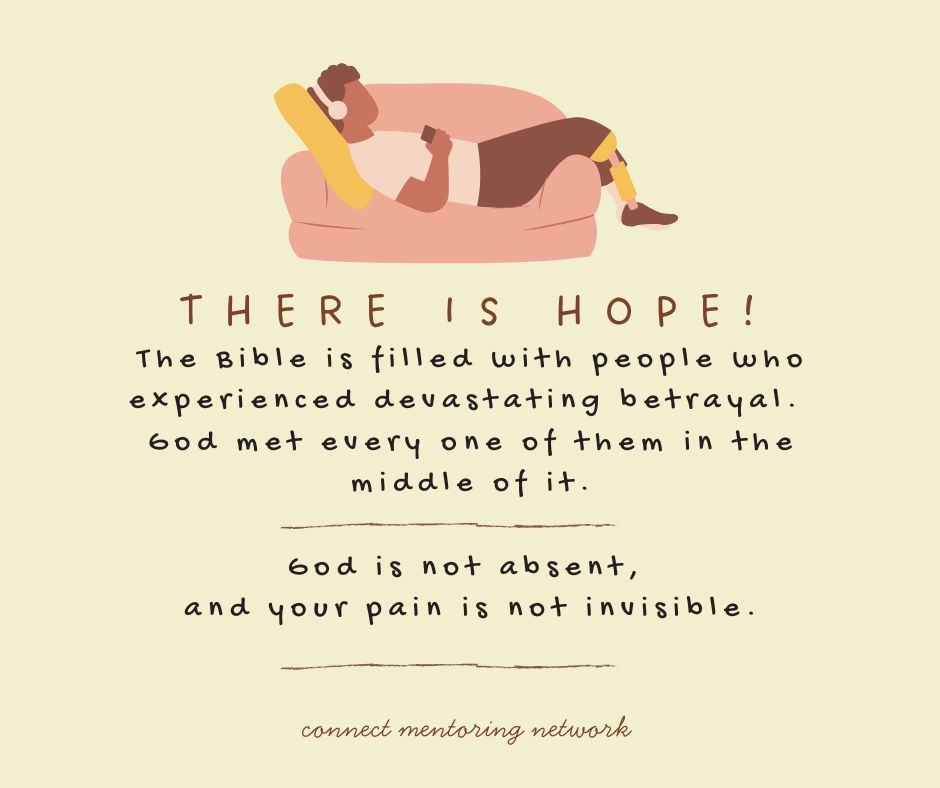
The Bible is filled with people who experienced devastating betrayal. Hang with me, though! The Bible is also filled with hope: God met every one of them in the middle of it. Their stories remind us that betrayal is not new, God is not absent, and your pain is not invisible.
If you have experienced the pain of betrayal, I’m praying for you as you journey through this pain. Please hear this clearly today: You will recover.
What Is Betrayal Trauma?
Before we talk about how to get over betrayal trauma, we need to understand what betrayal trauma actually is.
Betrayal trauma occurs when someone you trusted deeply violates that trust in a significant way. Because relationships are tied to safety and emotional connection, betrayal often affects not only the heart, but also the mind, body, and spirit.
Betrayal trauma may involve:
- Marital unfaithfulness
- Emotional affairs
- Lying and deception
- Abandonment
- Spiritual manipulation
- Broken confidences
- Financial betrayal
- Ministry betrayal
- Friendship wounds
- Family rejection
Betrayal can leave people feeling:
- Unsafe
- Confused
- Angry
- Hypervigilant
- Emotionally numb
- Anxious
- Deeply grieved
Sometimes people minimize betrayal because there are no physical bruises attached to it. However, emotional and spiritual wounds are real wounds.
At the same time, it is important to understand that not every disappointment is betrayal. Someone disagreeing with you, setting boundaries, or failing to meet every expectation does not automatically mean they betrayed you.
True betrayal involves a breaking of trust, covenant, loyalty, or protection where safety and love were expected.
When it happens, the pain is real.
Why Betrayal Trauma Makes You Feel So Alone
One of the cruelest parts of betrayal trauma is the isolation it creates. You may be surrounded by people and still feel completely alone in your suffering.
Part of that loneliness comes from the deeply personal nature of betrayal. Your story is specific. Your relationship mattered. Your wounds are tied to memories, promises, and trust that belonged uniquely to you.
That matters. Your feelings are valid.
Sometimes Christians feel pressured to “just forgive and move on” without honestly acknowledging the devastation betrayal causes. But healing cannot happen where pain is denied.
God is not intimidated by your grief.
He is near to the brokenhearted.
Sometimes one of the first steps in healing is simply realizing: You are not the only person who has walked this road.
Scripture Is Filled With Stories of Betrayal Trauma
The Bible does not hide human pain. In fact, many of the people God used most powerfully experienced deep betrayal.
Their stories remind us that betrayal does not disqualify you from God’s love, calling, or future.
Lucifer Betrayed God
One of the earliest betrayals in Scripture occurred in heaven itself.
Lucifer, once created beautiful and glorious, rebelled against God in pride and arrogance. Isaiah 14:12–15 and Revelation 12:7–9 describe his fall and rebellion against the Lord.
Imagine the heartbreak of betrayal originating in the very presence of God. Yet even this rebellion did not overthrow God’s authority or interrupt His ultimate plan.
This matters because betrayal often makes us feel like everything has spun out of control. But please remember: God has never once lost control of history—not in heaven, not in Scripture, and not in your life.
David Was Betrayed by Saul
David faithfully served Saul. He fought for him, honored him, and refused to harm him even when given opportunities to do so.
Yet Saul responded with jealousy, suspicion, and relentless pursuit.
First Samuel chapters 18 through 24 reveal a painful reality: sometimes you can love people sincerely and still be wounded by them.
David experienced:
- False accusations
- Threats
- Rejection
- Fear
- Emotional exhaustion
Perhaps hardest of all, David was betrayed by someone he once respected and trusted.
Still, David continued bringing his pain to God.
The Psalms show us that healing begins when we stop pretending and start praying honestly.
David cried.
David questioned.
David grieved.
David worshipped anyway.
True to His character, God remained faithful through every season.
Joseph Was Betrayed Repeatedly
Joseph’s story may be one of the clearest biblical pictures of betrayal trauma.
His own brothers betrayed him out of jealousy. They threw him into a pit, sold him into slavery, and lied to their father about his fate.
As if that were not enough, Joseph was later falsely accused by Potiphar’s wife and forgotten in prison by those he helped.
Betrayal after betrayal after betrayal.
If anyone could have become bitter, hopeless, or consumed by revenge, it was Joseph.
Yet Genesis 37 and Genesis 39–41 reveal something powerful:
God never abandoned him.
Not even in slavery.
Not even in prison.
Not even in isolation.
Joseph’s story reminds us that betrayal may delay things, but it cannot destroy God’s purpose for your life.
People may misunderstand you.
People may lie about you.
People may walk away from you.
You can be assured of this: God still knows exactly where you are.
Jesus Was Betrayed by Judas
Perhaps the most heartbreaking betrayal in Scripture is the betrayal of Jesus.
Judas walked with Him.
Learned from Him.
Witnessed miracles.
Shared meals with Him.
After all this, Judas still chose betrayal.
Matthew 26:14–16 and 47–50 describe the devastating moment Judas identified Jesus with a kiss—a symbol of affection twisted into betrayal.
Jesus understands betrayal personally.
He understands:
- Rejection
- Abandonment
- False accusations
- Broken trust
- Public humiliation
This is why you can bring your pain honestly to Him. There is no wound you carry that He cannot understand.
When you pray through betrayal trauma, you are not praying to a distant Savior unfamiliar with grief. You are praying to One who has suffered too.
God’s Plan Cannot Be Stopped - Not Even By Betrayal Trauma!
One of the greatest fears betrayal trauma creates is this:
“What if this ruins everything?”
What if my reputation is ruined?
What if my future is ruined?
What if my calling is ruined?
What if I never recover?
But Scripture repeatedly proves that betrayal does not have the final word.
Joseph still fulfilled his purpose.
David still became king.
Jesus still accomplished redemption.
God’s plans for your life are not fragile. People do not have the power to cancel what God has ordained.
That does not mean betrayal trauma does not hurt. It does not mean consequences disappear overnight. It does not mean healing is instant.
But it does mean this: Your destiny is safer in God’s hands than in human hands.
Your purpose did not begin with people’s approval, and it will not end because of their betrayal.
Romans 8:28 reminds us that God works all things together for good for those who love Him and are called according to His purpose.
Even this pain.
Even this heartbreak.
Even this chapter.
How to Get Over Betrayal Trauma Starts With Bringing It to God
Many people searching for how to get over betrayal trauma are looking for quick relief from overwhelming pain.
But biblical healing is not denial, avoidance, or pretending you are unaffected.
Healing begins with honesty.
God invites you to:
- Grieve honestly
- Pray openly
- Process wisely
- Seek godly support
- Allow Him into the deepest parts of the wound
You do not heal betrayal trauma by stuffing it down spiritually.
You heal by allowing God to meet you inside it.
Sometimes healing also involves:
- Counseling
- Mentorship
- Healthy boundaries
- Time
- Rest
- Community
- Learning to trust God again before trusting people again
Healing is a journey, not a switch - but you are not walking that journey alone.
A Prayer for the Betrayed Heart
Lord, thank You for reminding me I am not alone. You have walked this road. Others have walked this road. And You have brought redemption to every single one. Redeem my story too. Heal my heart. Restore my hope. Amen.
Betrayal Is Not the End of Your Story
If anything, betrayal may become the chapter that draws you closer to the heart of God than ever before.
The enemy wants betrayal to isolate you, harden you, and convince you your future is over.
But God specializes in redemption.
Scripture proves it.
The cross proves it.
And countless redeemed lives prove it.
You are not alone in this pain.
And you are not abandoned in this process.
God sees you.
God is near to you.
And God still has good plans for your life.
Continue the Conversation
Healing from betrayal is not a journey you have to walk alone. I’d love for you to continue learning and growing with me by subscribing to @JenniferWSpivey on YouTube. Join me Thursday as we dive deeper into God’s path toward healing, forgiveness, and restoration after betrayal trauma.
For additional encouragement and mentoring resources, visit Connect Mentoring Network and explore my e-course, Healing From Betrayal, where I share biblical tools and practical guidance for moving forward in freedom and hope.
Let's continue this conversation next week on the blog!
There is a unique kind of heaviness that settles over the heart when you are “in the middle” of a difficult season. You know God is faithful. You know restoration will come. You know the end of the story will be good because the Author is good. That doesn’t mean that today isn’t tough. That doesn’t mean that being “in the middle” isn’t a hard place. Check out the first and second in this "in the middle" series and let's get started!
I was trying to explain this to a friend the other day, about my own “in the middle” moment. Imagine it this way: your house has just burned down. You are sitting on your knees across the street looking at the ashes and rubble. You’ve already been told the insurance will cover everything. You know a rebuild is coming. However, at this moment, you are grieving. You liked that house. You liked that stuff. Better is coming, but for now you’re living in the space between the loss and the restoration, between the breaking and the rebuilding. The insurance agent has promised: the check is in the mail. That’s a valid spot to be in, an emotional spot to be in, even when you know it’s going to be okay, between looking at ashes and cashing that check.
In that vulnerable middle place, God can begin to correct, shape, and grow us. His heart is always for our best, even on days that feel hard in our limited judgement (and our judgement is limited - let’s put a bookmark there and talk about this on another day).

Why God’s Correction Feels Threatening
Even when we believe God is good, His correction might feel sharp when we’re already hurting. Job experienced this. In the midst of unimaginable loss, he wrestled with big questions and deep frustrations. When God finally spoke, His words didn’t condemn—but they did confront.
Correction can feel threatening for a few reasons. Maybe we fear that it means we’ve done something wrong. Maybe we worry God is disappointed in us. Maybe in this moment, we’re already fragile, and anything that feels like pressure can feel overwhelming.
Hear His heart for you. God is not angry, God is not disappointed, God is not done with you. He loves those He corrects, remember? (Hebrews 12:6-11) When God speaks, let’s lean in.
Listening Without Defensiveness
One of the most sacred disciplines in the middle season is learning to listen to God without defending ourselves. Pain often makes us want to justify ourselves - but God, in His kindness, invites us to open our hands and hearts instead.
Job shows us what this looks like. Even in his grief, he asked God honest, raw questions:
- “Why did I not perish at birth?” (Job 3:11)
- “Why is light given to those in misery, and life to the bitter of soul?” (Job 3:20)
- “Why do You hide Your face and count me as Your enemy?” (Job 13:23)
- “Why do the wicked live on, growing old and increasing in power?” (Job 21:7)
- “How can a man be righteous before God?” (Job 4:17)
- “If a man dies, will he live again?” (Job 14:14)
- “Oh, that I knew where I might find Him, that I might come to His seat! I would present my case before Him…” (Job 23:3–4)
God didn’t shy away from Job’s questions. In chapters 38–41, He responds. He doesn’t condemn, He reminds Job of His power, wisdom, and the larger story beyond Job’s understanding. God’s answers are gentle yet firm: trust His design, lean on His wisdom, and recognize His sovereignty even in the middle of confusion and pain.
Humility in the middle doesn’t mean silence. It means asking hard questions, listening carefully, and allowing God’s correction and guidance to shape us—even when we don’t see the full picture yet.
Responding Practically When God Brings a Hard Truth
Sometimes God’s correction comes through Scripture, prayer, or through the Holy Spirit’s gentle conviction.
Here are a few ways to respond:
- Pause before reacting, because correction is not rejection. Let God finish the sentence before you jump in to defend or excuse.
- Surrender instead of resisting, because correction is not condemnation. Say to God, “If this is from You, I will yield to it”.
- Stay rooted in grace, because correction is one of the ways God shapes us for the restoration He has already planned.
Reflection Questions for Your Middle Season
There are a couple of questions I love to ask the Lord in my own in-the-middle seasons or on my tough days:
“What aspect of Your character do You want to reveal to me in this?”
“What is it that You want to be for me today that You were unable to be to me yesterday?”
Not that there was ever a moment when God was limited - but perhaps I didn’t know what I needed. I didn’t know I needed a provider until my need was revealed. I didn’t know that I needed a healer until I had the negative diagnosis. I didn’t know I needed a shepherd until I felt lost. When those missing pieces were exposed, God’s character was revealed and I grew closer to Him. From that perspective, the in-the-middle moments are so valuable to our growth.
God answers those questions so faithfully every time. He is right there in the middle with me. He is right there in the middle with you.
Once again, we are leaving Job in the middle! Let’s continue this conversation again next week on the blog and on the podcast - I hope you’ll join me for this conversation next week as we continue talking about the value of our own in-the-middle days. It’s such a joy and honor to connect with you!
I hope I didn’t present Job’s friends as the picture of healthy godly friendships – they made some mistakes, as we all do. However, Job did keep them around. That’s a lesson in itself, isn’t it? We don’t get “done” with people, even though seasons may change. We can learn a lot of lessons from Job's friends. (you've heard the saying, "Sometimes there's a blessing, sometimes there's a lesson" - let's take the lesson from Job's friends today!)
If you didn’t read last week’s blog post, better catch up here. Come right back after you read it and let’s continue this conversation!
Job’s friends get a bad rap, but I honestly think that they meant well, and there are even lots of words they say that are true –
“God is famous for great and unexpected acts; there’s no end to His surprises” 5:9
“what a blessing when God steps in and corrects you” 5:17
“Does God mess up? Does God Almighty ever get things backward?” 8:2
“God will set everything right again, reestablish your fortunes” 8:6
“God is far higher than you can imagine, far deeper than you can comprehend” 11:7
I do think the friends mean well, but it is almost as if they are speaking without the experience of deep pain. They want to point out God’s goodness, but then immediately connect Job’s troubles to Job’s behavior. They cannot seem to understand why these things would happen when a God whom they know as good is on the throne. They’ve got to explain it away by calling Job’s test a punishment. It’s as if they want to plug God into a “if you’ll do this, He’ll do that” formula, but life isn’t that simple.
This is my opinion, but I wonder if Job’s friends tried to explain God in this way to protect themselves. Their theology did not leave space for struggle or grief. In their experience, if you were “good”, then God protected you and these things didn’t happen. Seeing Job in this situation had to punch a hole in that for them - “if this could happen to Job, it could happen to us… No, it must be that Job did something wrong and made God angry…. Job, just repent and get your life back….” That was the “safer” explanation.
We make these same mistakes in our ministry, leadership and friendships today sometimes. Job’s friends do a few things wrong here:
- they jumped to conclusions without considering the full scope or hearing the whole story - their conclusion was that Job must have sinned, and that his present circumstances were a punishment
- they over-spiritualized Job’s pain, turning a moment that called for compassion into a lecture on morality
- they assumed insight without asking questions, without asking clarifying questions or seeking to understand his experience
What was needed in the moment for Job was presence. He needed the comfort of a friend more than he needed answers or solutions for his situation, and they moved too quickly.
There’s a reason Scripture calls us to “weep with those who weep” (Romans 12:15). It’s not just about sympathy—it’s about entering someone’s sorrow long enough to reflect the compassion of Christ. Sometimes the most spiritual thing we can do is simply sit still beside someone who’s hurting. When we show up with listening ears and a soft heart, we mirror the gentleness of Jesus, who never rushed people through their pain but met them right in the middle of it.
In leadership and ministry, this takes humility. It’s not easy to resist the urge to fix, explain, or quote a verse that ties everything up neatly. But real friendship and godly care don’t demand resolution—they offer presence. When we slow down long enough to listen, we are communicating, “You’re not alone. I don’t have all the answers, but I’m staying.” That kind of love ministers more healing than any well-meaning advice ever could. Job's friends did stay - let's give them credit for that!
When leaders move too quickly, we risk replacing empathy with advice, and presence with analysis. True ministry begins with careful listening, humility, and the patience to let God’s truth unfold rather than rushing to conclusions. Job’s friends missed an opportunity to minister peace to Job in his troubles. How painful it must have been for Job to listen to this as he grieved.
Sometimes friends are trying to help, and don’t know how to do it – forgive them. Sometimes friends don’t know how to help, so they ignore the situation (and possibly you) altogether – forgive them. Don’t shy away from relationship, using past hurts as an excuse. Trust that the relationship will give you the opportunity to grow, and the Lord will fill in the blanks. Even when there must be a loss of relationship (sometimes it must be), trust Jesus to give you the continuity of community that you desire.
For now, Job is still in the middle. I want to hang out until we see his restoration, don’t you? Let’s come together on Thursday as we continue this conversation on the podcast, and come back to the blog next week as we continue this series on the blog!
I wrote this blog post about 7 years ago, but today I wanted to re-visit and add to it. I think we'll have a little series on the "in the middle" times that we all face in life. I'm in an "in the middle" myself - hard things happen, and also I know that God has a great plan. I'm in the middle of it! Maybe you can relate!
I know it's strange to say, but Job really is one of my favorites. 🙂 I was thinking this morning about how LONG the dialogue between Job and his friends continued. Maybe I should rephrase: Job allowed his friends' diatribe against him to go on for a really long time (chapters and chapters and chapters!). Not sure I would have sat there for that (I would have struggled, I'm sorry to admit!). However, Job didn't end the relationship with his friends. Since he allowed them a front row seat to his troubles, they also had a front row seat to his restoration. What a gift it must have been, to be able to see that season come full circle. If you are a ministry leader, invited trusted friends in may feel risky - but it positions you for greater restoration and depth.
Job could have left his friends at their first criticism and no one would have blamed him. But he stayed. Because we often don't know how to handle confrontation, we often run at the first cross word. However, this is oftentimes a wrong response. Here's my balancing comment: for the next little bit, please understand that I am talking about close friendships with like-minded people.

A true friend is someone who should have the earned privilege of speaking truth into your life - and you should have the earned privilege of speaking truth into theirs. Relationship gives you the opportunity to let "iron sharpen iron" (Proverbs 27:17), a mutual benefit to godly relationship. King David insists that correction from a friend is a kindness: “Let the righteous strike me; it shall be a kindness. Let him rebuke me; it shall be as excellent oil; let my head not refuse it” (Psalm 141:5). To be honest, correction is not optional—it’s a gift when given and received well.
Please make this important distinction: a difference of opinion doesn’t mean disloyalty; it means growth when handled with grace. There are times when correction is necessary, even helpful. David even considered correction an act of loyalty. There are times when friends disagree - and that's okay. When I was the pastor's wife in our church, I watch it happen time and again: friends disagree, and rather than hanging in there together, they allow a difference of opinion to drive a wedge. Couldn't you have a difference of opinion, discuss, continue to respect each other, and continue to move forward? Most of the time we can; but most of the time we don't.
Grace is required to give godly correction - even more grace is required to receive godly correction. By allowing a wedge form over a correction, you are also cutting yourself off from the wisdom and opportunities for growth that the Lord means for your godly friendship. The Bible says that "the wounds of a friend are faithful" (Proverbs 27:6), meaning that truth from a friend is to be desired, even if it hurts at first.
You cannot be EFFECTIVE in relationships without being AFFECTED. Feel all the feels - but don't let a godly relationship (and the growth that can come from it) end unnecessarily. Don't shy away from relationships, using confrontation as an excuse. You cannot lead or influence in ministry without being changed yourself. Let the wounds of a friend be faithful in you.
A new thought: Job's friends were harder on him than they had to be. There's a reason for it, there's a grace for it, and you and I are going to visit about them next week. While we wait for part two, maybe a little thought: sometimes you are the one who is "in-between", maybe it's your friend who is "in-between". Sometimes what is needed is someone who will simply sit in the ashes with you and say, "Man, it's tough, huh? I love you and I'm praying. What kind of day is today? Do you need a faith-filled-hype-speech (because I have one!) or do you need a gentle and quiet arm wrapped around your shoulder (because I can do that too!)?" Be sensitive to the leading of the Holy Spirit and to the heart of your friend. Hopefully they will be sensitive to you in return, when you are the one who is "in-between".
Learning that you can go through it and grow through it together is a treasure. I'm praying that you have and maintain these kind of blessing friendships in your life <3
Job's friends are a whole 'nother story - let's visit about them next week and get a little more balance to this conversation! Join me on the podcast on Thursday, and join me again on the blog next Tuesday - let's review together and add a little new insight for a new day as well! Love y'all!
Jennifer 🙂