Conflict: What Every Ministry Leader Needs to Understand
For a long time, I was afraid of conflict. Not just uncomfortable with it—afraid of it.
I wrongly assumed that if a disagreement surfaced, it was either (1) a poor reflection of Christian behavior or (2) an indication that something was wrong with me spiritually or emotionally. In my mind, conflict and holiness could not coexist peacefully.
My response? I learned to adjust myself - and not in a healthy way.
I softened my opinions. I stayed quiet when I should have spoken. I minimized my needs and stretched myself thin trying to keep everyone else comfortable. Over time, I began to equate spiritual maturity with emotional silence.
But what I was actually doing wasn’t maturity—it was shrinking. I was altering my character and shrinking my voice to fit the comfort level of others. And that is not what Jesus meant when He called us to be peacemakers.
Jesus said in Matthew 5:9, “Blessed are the peacemakers, for they shall be called sons of God.”
But there is an important distinction here that I didn’t understand at the time: there is a difference between a peacemaker and a peacekeeper.
Peacekeeping avoids tension at all costs. Peacemaking, on the other hand, is grounded, truthful, and willing to engage what is real. It doesn’t avoid conflict—it navigates it with wisdom, grace, and courage. It makes space for honesty without abandoning love.
That distinction matters more than we often realize, because much of healthy conflict resolution begins not with what you say, but with what you believe about conflict itself.
Here are two important starting points that reshape everything:
- avoidance is not a healthy starting place. Avoiding conflict may feel peaceful in the moment, but it often delays clarity, growth, and healing.
- the presence of conflict is not automatically evidence of sin. Sometimes conflict simply means there are different perspectives, different personalities, or different levels of understanding in the room.
Once those foundations are in place, we can begin to see conflict differently—not as something to fear, but as something to navigate with spiritual maturity.
Conflict Happens in Our Broken World
I don’t think I was alone in this wrong view of conflict. I think many believers assume that a disagreement automatically means something has gone wrong spiritually. The assumption is that if you are “really walking in the Spirit,” you should be able to avoid disagreement altogether.
But Scripture tells a very different story: conflict is not always evidence of sin. Sometimes it is simply evidence of humanity. We live in a broken world where misunderstandings happen, motives are misread, personalities differ, and even sincere believers see things differently.
Conflict is not unusual in Scripture—it happens often. Learning how to handle it well is part of spiritual maturity.
Conflict Exists Because We Are Human
At its core, conflict exists because we live in a fallen world. Romans reminds us that all have sinned and fall short of the glory of God. That reality touches every relationship we have.
Even the most spiritually mature believers:
- misunderstand one another
- process emotions differently
- approach decisions in different ways
- see situations from different angles
Conflict itself is not the problem - the issue is how we respond to it.
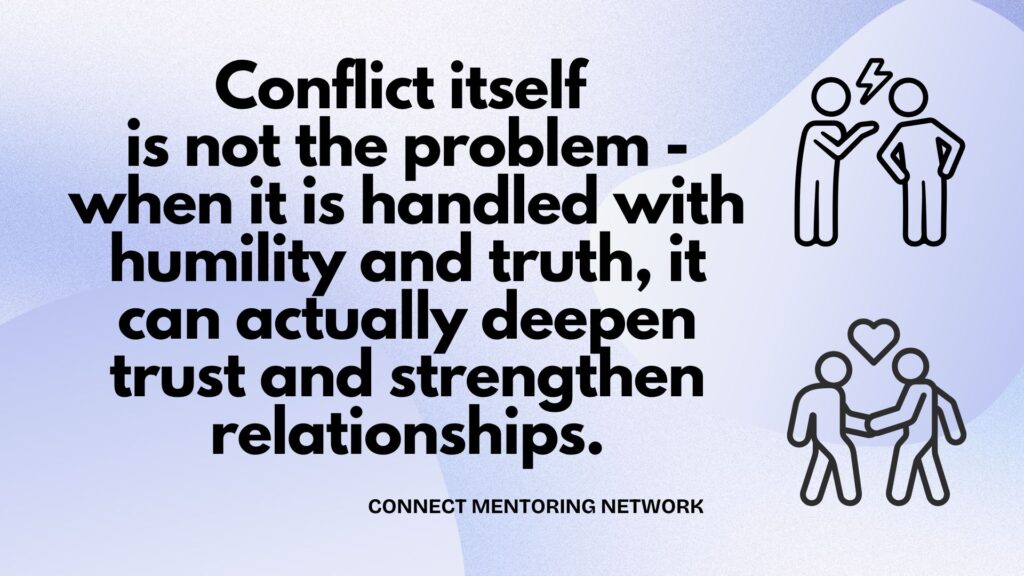
When conflict is mishandled, it can lead to division, offense, and distance. But when it is handled with humility and truth, it can actually deepen trust and strengthen relationships.
Jesus Experienced Conflict
If conflict were always a sign of spiritual failure, Jesus would have lived in constant confusion.
He regularly encountered opposition:
- Religious leaders questioned Him.
- Crowds misunderstood Him.
- Even His own disciples struggled to grasp His teaching.
In Luke 5:30, we see one example of conflict with the Pharisees: “Why do You eat and drink with tax collectors and sinners?”
Jesus was often challenged by people who believed they were defending truth. However, the opposition did not mean He was doing something wrong. In many cases, it simply meant truth was confronting pride.
This is a crucial distinction: some conflict is resistance to truth, not resistance to you personally.
If Jesus—the sinless Son of God—experienced misunderstanding and opposition, then we should not assume that these events signal spiritual failure in our lives either.
Paul and Barnabas: A Biblical Example of Conflict
Acts 15 gives us one of the clearest examples of godly leaders in real disagreement: “Then the contention became so sharp that they parted from one another.” (Acts 15:39)
Paul and Barnabas—both mature, Spirit-led leaders—disagreed sharply over John Mark. As a result, they separated.
What stands out in this passage is not condemnation, but honesty. Scripture does not label either man as sinful in this moment. It simply records the disagreement and shows that God continued working through both of them.
This moment is often uncomfortable for believers who prefer clean outcomes. We want that “win-win”, we want to believe that every person is for us in every season. But it reveals something important: spiritual maturity does not eliminate disagreement or conflict. Spiritual maturity shapes how we respond to it.
With Paul and Barnabus, God did not waste their tension. In fact, He multiplied ministry through it—Paul continued his missionary journeys, and Barnabas invested in restoration and encouragement.
Even in disagreement, God was still at work.
Conflict, Truth, and Emotional Health
Not all conflict is equal.
- Some is rooted in misunderstanding.
- Some is rooted in personality differences.
- Some is rooted in deeper issues like unspoken expectations or emotional wounds.
This is why emotional maturity matters in spiritual life.
Ephesians 4:15 calls us to: “Speak the truth in love…" Notice the tension held in that verse: truth and love. Not truth without care. Not love without honesty.
Healthy conflict requires both.
When truth is removed, we get avoidance and silence. When love is removed, we get harshness and harm.
Biblical maturity is learning to hold both at the same time.
Peacekeeping vs. Peacemaking
Let’s go back to the beginning and the fear that is created when we fail to differentiate between peacekeeping and peacemaking. This is one of the most important distinctions we’ll make in this conversation.
Jesus said: “Blessed are the peacemakers, for they shall be called sons of God.” (Matthew 5:9). Notice: Jesus did not bless peacekeepers—He blessed peacemakers. So, what’s the difference?
Peacekeeping avoids conflict:
- It suppresses truth.
- It fears discomfort.
- It prioritizes appearance over health.
Peacemaking engages wisely:
- It speaks truth with grace.
- It values restoration over avoidance.
- It is willing to have hard conversations when needed.
Real peace is not the absence of tension. It is the presence of truth handled in love. Sometimes, what feels like “keeping the peace” is actually just delaying necessary healing.
Avoidance Is Not Always Spiritual Maturity
Many believers have been unintentionally taught that:
- silence equals maturity
- avoidance equals peace
- discomfort equals sin
But avoidance can actually:
- allow bitterness to grow
- create emotional distance
- produce resentment
- delay healing
- confuse others about what is really true
There is a difference between prayerful restraint and fear-based silence. One is wisdom. The other is avoidance.
Not every conversation needs to happen immediately—but avoiding all difficult conversations is not biblical maturity.
When Conflict Becomes an Invitation
Not all conflict is meant to be eliminated. Some conflict is meant to be explored. Healthy conflict can become an invitation to:
- clarify expectations
- strengthen relationships
- uncover unspoken assumptions
- grow in humility
- practice forgiveness
- deepen trust
Proverbs 27:17 reminds us: “As iron sharpens iron, so one person sharpens another.”
Sharpening is not always comfortable - but it is productive. How about honestly saying to the person we are in conflict with: “This conversation might be hard, but at the end of it we will be better”? Timing and purpose can change everything.
Practical Steps for Navigating Conflict
Here are a few practical ways to approach conflict in a healthy, biblical way:
- Pause before reacting: Not every emotional response requires immediate action. Wisdom often begins with restraint.
- Ask Holy Spirit for perspective: Before speaking, ask: Lord, what am I not seeing?
- Separate facts from interpretation: What actually happened—and what am I assuming it means?
- Address issues directly, not indirectly: Avoidance often increases confusion. Healthy communication brings clarity.
- Use “I” statements instead of accusations: “I felt overlooked” is different from “You never value me.”
- Keep restoration as the goal: Not winning. Not proving a point. Restoration.
- Know when to step back: Not every conflict requires immediate resolution. Some require time, prayer, and maturity to unfold.
Forgiveness vs. Reconciliation
Another important distinction in conflict is this: forgiveness is always required, but reconciliation requires mutual participation. You can forgive someone without fully restoring a relationship that lacks safety, trust, or repentance.
Romans 12:18 says: “If it is possible, as far as it depends on you, live at peace with everyone.”
That verse acknowledges reality: sometimes peace is not fully possible in every relationship. However, we are still responsible for our part.
A Final Word
Conflict is not always sin. Sometimes it is simply the reality of living in a broken world. Sometimes it is an opportunity to grow in Christlike maturity.
The goal is not to eliminate conflict from your life. The goal is to learn how to walk through it with wisdom, grace, and truth.
Spiritual maturity is not the absence of disagreement—it is the presence of discernment.
It is knowing when to speak, when to listen, when to wait, and when to engage.
And above all, it is learning to reflect Jesus in the middle of it all.
Call to Action
This teaching is part of the Conflict with Grace e-course inside Connect Mentoring Network, designed to help ministry leaders navigate relationships, conversations, and tension in a biblical and emotionally healthy way.
If this message resonated with you, I’d love to invite you to explore Connect Mentoring Network and the resources available to support your growth in leadership and life.
Thanks for joining me on the blog today - let's continue the conversation on the podcast this week! Subscribe here so you don't miss it: https://www.youtube.com/@JenniferWSpivey. Talk to you soon, friend!

Legal
Privacy Policy2025 - Copyright. All Rights Reserved. Made by Arising Co.