The Heart of Healthy Ministry Transitions 1: Learning to Move with God Through Every Season
In this first part of a series on healthy ministry transitions, I want to invite you back into a conversation I had on my podcast some months ago — right from my kitchen, just plain vanilla as you know me to be. My prayer is that as we walk through this together, you’ll feel both seen and strengthened in whatever season of change you’re navigating.
I’m navigating another transition myself - 2025 was the year for transition for me, and 2026 is starting off the same! I thought I would bring you along on the journey like I did last time. We’ll circle back to some previous podcasts, and learn some new lessons together. Let’s get into it!
Transition. Even the word itself can stir something in us — excitement, uncertainty, grief, hope, or all of the above. In ministry leadership especially, transitions can feel emotionally layered and spiritually complex. Whether we’re stepping into something new or releasing something beloved, change has a way of revealing what we trust, what we fear, and where our hope truly rests.
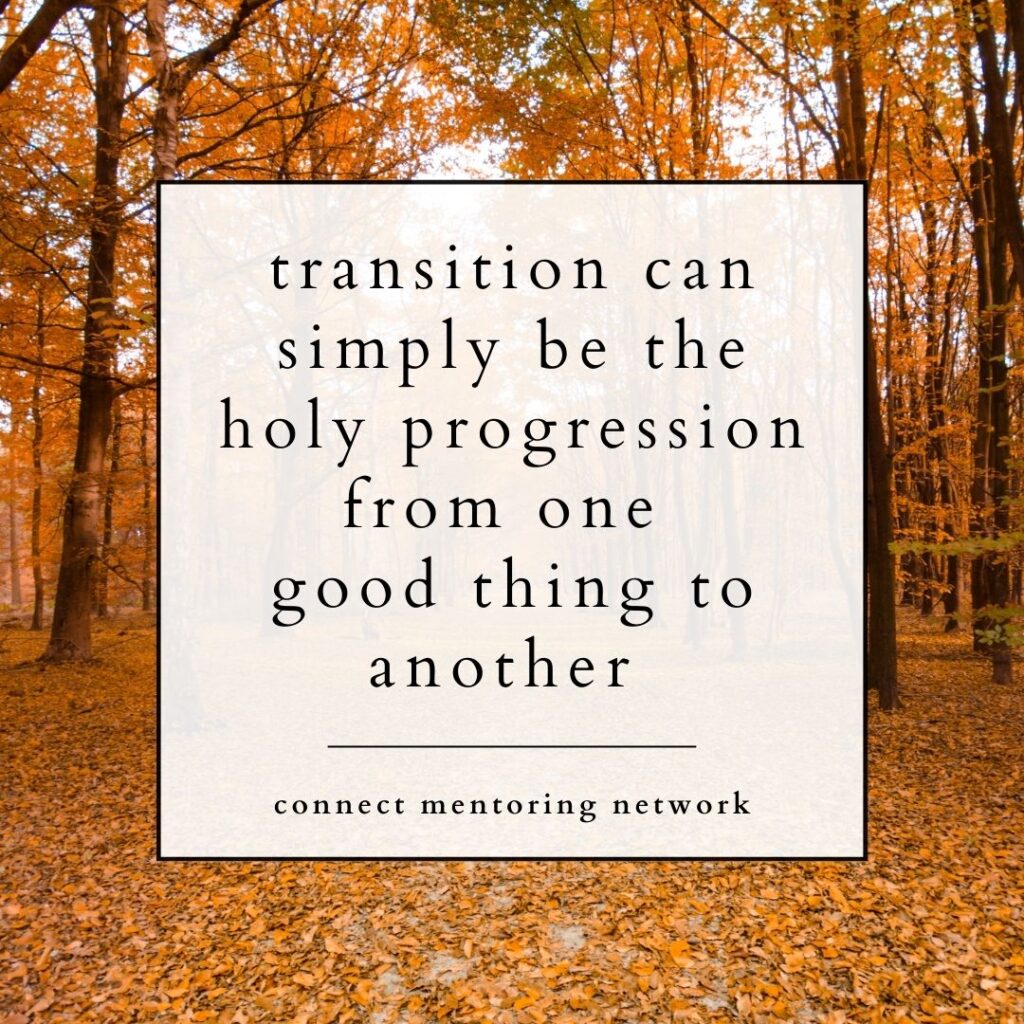
Here’s the truth: change isn’t always an escape from something bad. Sometimes it’s simply the holy progression from one good thing to another. I want to say that again: transition can simply be the holy progression from one good thing to another. Healthy ministry transitions are absolutely possible!
So many times, people think wrongly that they have to make one thing bad in order to make the next thing good. That’s not true. We can move from season to season with peace, gratitude and joy.
Learning to walk through those shifts with grace and obedience is part of the beautiful, lifelong journey of following Jesus.
Healthy Ministry Transitions: Starting Before You Feel “Ready”
If you know me, you know I’m not flashy. I’m not trying to be polished. Months ago when I re-launched the blog and podcast, I almost waited because I wanted the “perfect” setup — the right lighting, the right microphone, the right background. However, the Holy Spirit wouldn’t let me give into perfectionism.
Instead, I kept hearing the words from Zechariah 4:10 echoing in my heart: “Do not despise the day of small beginnings, for the Lord rejoices to see the work begin.”
So I began. Not perfectly, not professionally, but obediently.
I think that is the first lesson of any healthy transition: start where you are, not where you think you should be. God rejoices in beginnings — humble, simple, faithful beginnings — because they make space for Him to do what only He can do.
Naming the Season You’re In
Right now, I’m again in one of the biggest transitions of my adult life. After decades of pastoral ministry, last year my husband stepped down from his role as senior pastor. That shift automatically created a shift in my own identity. When he was no longer “the pastor,” I was no longer “the pastor’s wife.” Suddenly I had to ask myself: What does this new season look like for me? Who am I now? How do I steward what God has placed in my hands for this moment?
We didn’t leave hurt. We didn’t leave wounded. We didn’t leave frustrated.
We left loved.
We left whole.
We left on the mountaintop, celebrating everything God had done in our church and believing with full confidence that God has great plans for their next season as well. He loves the church more than we do!
This kind of transition — one from good to good — is often the least talked about and yet the most common. Ministry leaders sometimes feel pressured to treat every transition as a rescue from pain or a response to dysfunction. But often? It’s simply time: time for healthy ministry transitions.
And it’s okay to say that.
Normalizing Healthy Ministry Transitions
One of the reasons transitions feel so emotionally heavy is because we haven’t normalized them. We’ve spiritualized them, dramatized them, or made them synonymous with conflict. However, transitions are normal. Biblical. Healthy. I want to normalize that for you today.
You Don’t Have to Make One Season Bad to Celebrate the Next
Sometimes, in order to justify moving on, people feel they must villainize the past. They highlight what was wrong to explain why they’re stepping into something new.
But you don’t need to do that.
There are seasons in life when both the past and the future are good — and God is in both of them.
You can celebrate where you’ve been and celebrate where you’re going.
Honor Still Belongs in the New Season
As you move forward, the principles that governed relationships in your previous season still matter. If there were loyalties, confidences, or sacred trust — those don’t expire. Honor travels with you. It is never season-specific. Carry it forward.
Transition Is Not Betrayal
This one is big for women in ministry leadership. When you step out of a role, a church, or a position of influence, some people around you may feel abandoned or confused. They may search for a reason or even a villain.
But obedience is not betrayal.
In fact, the real betrayal would be staying somewhere God has asked you to leave.
This truth becomes even clearer when you look at Jonah.
Healthy Ministry Transitions: Learning from Jonah
In Jonah 1, the prophet runs from the assignment God gave him. He boards a ship heading in the opposite direction, and suddenly the sailors find themselves in a life-threatening storm.
They start searching for the source: Who caused this? Who do we blame? Who’s disrupting our peace?
And Jonah finally admits: “It’s me. I’m the one outside of obedience.”
If Michael and I had stayed in our pastoral role after God told us to move on, the storm would have eventually come. Not because God punishes His children, but because disobedience always creates turbulence — spiritually, emotionally, and relationally.
Your obedience affects the people around you.
Your disobedience does too.
If you’re sensing a shift, don’t ignore it. Don’t delay it. Don’t talk yourself out of it because others don’t understand. Stay in step with the Holy Spirit. Obedience is a key aspect of healthy ministry transitions.
Healthy Ministry Transitions: Fixing Your Eyes on What Is Eternal
If you find yourself in that “in-between” place — not fully in the old season and not fully settled into the new one — here are some principles that have anchored me.
Focus on What’s Eternal, Not What’s Immediate
Paul encourages us in Colossians 3:1–2 to: “Set your hearts on things above… Set your minds on things above, not on earthly things.”
When we focus only on what’s immediately in front of us — the changes, the emotions, the unknowns — transition feels overwhelming. But when we lift our gaze to what is eternal, something powerful happens:
We loosen our grip.
We release what isn’t ours to control.
We trust what God is doing in the long view.
And the healthy ministry transitions we pray for become possible.
Jesus Modeled This Too
In Hebrews 12:2, we’re told that Jesus endured the cross “for the joy set before Him.” He wasn’t focused on the pain of the moment but the glory of the outcome — our salvation.
Likewise, in times of transition, it’s powerful to pray:
“Lord, what is the greater good You’re working toward in this?”
Ask for Wisdom — He Gives It Generously
James promises that when we ask for wisdom, God gives it “liberally and without reproach.”
Liberally — more than you need.
Without reproach — without shaming you for not knowing earlier.
If you’re in the messy middle of a transition, God isn’t criticizing you. He is guiding you.
Healthy Ministry Transitions: Trusting God’s Good Plans For You and For Others
One of the most comforting truths in any season of change comes from Jeremiah 29:11: “For I know the plans I have for you… plans to give you a future and a hope.”
Jeremiah spoke those words to people who were in captivity — the ultimate “in-between.” Even there, God had plans. Even there, God had hope.
God’s Plans for You Are Good — Even If the Season Is Hard
You may not see the outcome.
You may not understand the timing.
You may even feel sorrow for what you’re leaving.
But God’s intentions toward you are good.
God’s Plans for the People Around You Are Good Too
This is especially important for leaders.
Sometimes we hesitate to leave a ministry role because we fear what will happen to the people we love. But God loves those people more than we do. He sees their future, their needs, their next shepherd.
He truly does hold the whole world — including your ministry world — in His hands. The healthy ministry transitions that we hope for depend on resting in that knowledge and staying anchored there.
Healthy Ministry Transitions: Releasing What Was to Receive What Will Be
Transition requires open hands.
You release one assignment so you can fully embrace the next.
You celebrate one season while anticipating the new one.
You trust God enough to let go.
This is part of walking in obedience — and obedience is always met with blessing.
Psalm 136 reminds us again and again: “His mercy endures forever.”
You and I may feel discomfort in the moment, but God is playing a long game. His mercy and faithfulness extend far beyond the boundaries of one season.
Healthy Ministry Transitions: Stewarding the Middle Space Well
If you find yourself in the “in-between,” here are principles to hold close:
Don’t Be the Jonah People Are Searching For
Stay obedient.
Stay soft-hearted.
Stay in step with God.
Let your obedience be a blessing to those around you.
Recognize that a key part of healthy ministry transitions is faithfulness and holding each season lightly.
Hold Your Assignments Lightly
What God puts in your hand is for a season, not for your identity.
Hold it with open palms.
Keep Your Eyes Fixed on Jesus
Recognize that He is doing a new thing — just as Isaiah 43:19 reminds us:
“Behold, I am doing a new thing… do you not perceive it?”
Our responsibility isn’t to create the new thing.
It’s simply to recognize it and move with Him.
Healthy Ministry Transitions: What’s Coming Next
Transition is such an important conversation in ministry, and honestly, it’s one we don’t get to see modeled well often enough. Over the next few weeks, I’ll continue to dive into the topic of healthy ministry transitions (healthy life transitions too!) as we talk through different aspects of navigating change with spiritual maturity, emotional intelligence, and biblical faithfulness.
If this conversation resonated with you, I want to invite you to continue this conversation with me on the podcast. Subscribe at @JenniferWSpivey so you don’t miss an episode!
Finally, check out www.connectmentoringnetwork.org for resources and mentorship opportunities - this community is designed for you!
Thank you for joining me today! I’m honored to walk with you as we learn to shift seasons with grace, wisdom, and confidence in God’s goodness. Healthy ministry transitions are a matter of stewardship - let's lean in and gain the tools we need to do it well.
I’ll see you here next Tuesday for the next blog on healthy ministry transitions, and Thursday for the next episode of the podcast. Until then, hold your season lightly, keep your eyes lifted, and trust the One who leads you from strength to strength. Placing your hand in His will be a treasure!

Legal
Privacy Policy2025 - Copyright. All Rights Reserved. Made by Arising Co.