Christian Leadership Development: God Called You - Now Do It!
Christian leadership development begins when we recognize what God has entrusted to us and take faithful steps to put those gifts to work.
In this new series, we'll explore what happens when we move beyond a mindset of scarcity and competition and begin embracing the abundance that comes from working together in the Kingdom of God. We'll look at how we can use our gifts faithfully, recognize the value others bring to the work, and invest in one another in ways that multiply our impact. Because ministry was never meant to be a competition.
Have you ever sensed that God was calling you to do something, but somehow you still haven't done it? Maybe it's a book you've been meaning to write. A ministry you've felt led to start. A person you know you should mentor. A message you need to share. An opportunity to serve, lead, teach, encourage, or step into something new.
You've prayed about it. You've thought about it. You've probably made a list of all the reasons you're not quite ready.
Maybe you need more time. More training. More money. More confirmation. Maybe you're waiting for the perfect circumstances—or for someone to come along and tell you that you're qualified.
But what if you've spent so much time preparing to obey that you've forgotten to take the next step? Maybe today is the day to take that next step - because you weren't given gifts, wisdom, and influence to keep them to yourself. You were given these gifts to put to work—and to invest in others.
God called you. Now do it!
This isn't a call to rush ahead of God or pursue every idea that enters your mind. It's a call to respond when you've prayerfully discerned what God is asking you to do.
Here's something else we need to understand: God's calling on your life isn't just about what you accomplish. It's also about what you do with what He has invested in you—and how you use it to invest in others.
Let's look at what that means.
Christian Leadership Development: Nehemiah's Example to Pray, Make a Plan, and Get to Work
When Nehemiah heard that the wall of Jerusalem had been broken down and its gates destroyed, he was deeply grieved. He wept, mourned, fasted, and prayed before God:
“So it was, when I heard these words, that I sat down and wept, and mourned for many days; I was fasting and praying before the God of heaven” (Nehemiah 1:4).
Prayer and fasting was the correct initial response - we have to lead with prayer, hear from God about our challenges and celebrations alike. However, prayer is a place to begin - Nehemiah didn't stop at prayer.
Nehemiah operated in wisdom. He assessed the situation and developed a plan. When the opportunity came to speak with the king, Nehemiah was prepared to explain the need. He was prepared to request permission and resources to rebuild the wall. Once he was given the permission he needed from the king, he gathered the people and organized the work.
As his prayer continued, his work began.
Nehemiah understood something we sometimes forget: prayer and action belong together.
Prayer isn't an excuse to avoid responsibility. Planning isn't a substitute for trusting God. And taking action doesn't mean we're trying to accomplish something in our own strength.
We pray for wisdom and direction. We develop a plan. We pray for courage and discipline. We make a commitment. We trust God with the outcome—and then we get to work.
Prayer was also what sustained him throughout the rebuilding. When opposition came, he prayed, took appropriate precautions, and kept working.
Nehemiah didn't rebuild the wall by himself. He had a burden, but he also needed a team. He mobilized people to work together. Families and groups took responsibility for different sections, and they worked toward a shared purpose.
What has God placed on your heart? Have you prayed about it? Have you identified the next step? Have you made a plan?
Perhaps the most important question: Are you willing to begin? You don't have to see the entire path to take the next faithful step.
Christian Leadership Development: The Harvest Is Too Big for One Boat
In Luke 5:4–7, Jesus instructed Simon Peter to put out into deep water and let down the nets. The catch was so large that the nets began to break.
What did the fishermen do?
“they caught a great number of fish, and their net was breaking. So they signaled to theirpartners in the other boat to come and help them” (Luke 5:6-7)
They signaled to their partners in the other boat to come and help. Both boats were filled with fish.
Think about that for a moment. They had an extraordinary harvest, but they couldn't manage it alone. They needed help.
They didn't have to pretend they could handle everything. They didn't have to protect their position or prove that they were the most capable fishermen on the lake. They called their partners.
Sometimes the answer isn't a bigger boat. It's more boats.
God may give you a vision that requires you to invite other people into the work. You may have an idea, a ministry, a resource, or an opportunity that can reach far more people when others bring their gifts alongside yours.
Don't let pride, independence, or the desire to receive all the credit keep you from asking for help.
When someone else calls you to help with their harvest, don't automatically assume their success threatens yours.
There is room for all of us to be faithful. There is room for different gifts, different assignments, and different ways of serving the same Lord.
Sometimes God doesn't send you more capacity because He wants you to learn how to collaborate.
Christian Leadership Development: Don't Bury What God Entrusted to You
In Matthew 25:14–30, Jesus tells the parable of a master who entrusted his servants with resources before leaving on a journey. When he returned, he called them to account for what they had done with what they received.
“he who had received five talents came and brought five other talents, saying, ‘Lord, you delivered to me five talents; look, I have gained five more talents besides them.’ His lord said to him, ‘Well done, good and faithful servant; you were faithful over a few things, I will make you ruler over many things. Enter into the joy of your lord.’
He also who had received two talents came and said, ‘Lord, you delivered to me two talents; look, I have gained two more talents besides them.’ His lord said to him, ‘Well done, good and faithful servant; you have been faithful over a few things, I will make you ruler over many things. Enter into the joy of your lord’” (Matthew 25:20-24)
The servants who put their talents to work were commended. The servant who buried his talent out of fear was rebuked.
The point isn't that everyone receives the same amount or has the same assignment. The servants were entrusted with different amounts, but each was responsible for what had been placed in his hands.
So let's make this personal: what has God placed in your hands?
Your knowledge? Your leadership? Your story? Your ability to teach, write, organize, encourage, mentor, or lead? The wisdom you've gained through years of experience? The lessons you learned through difficult seasons? The opportunities and relationships God has given you?
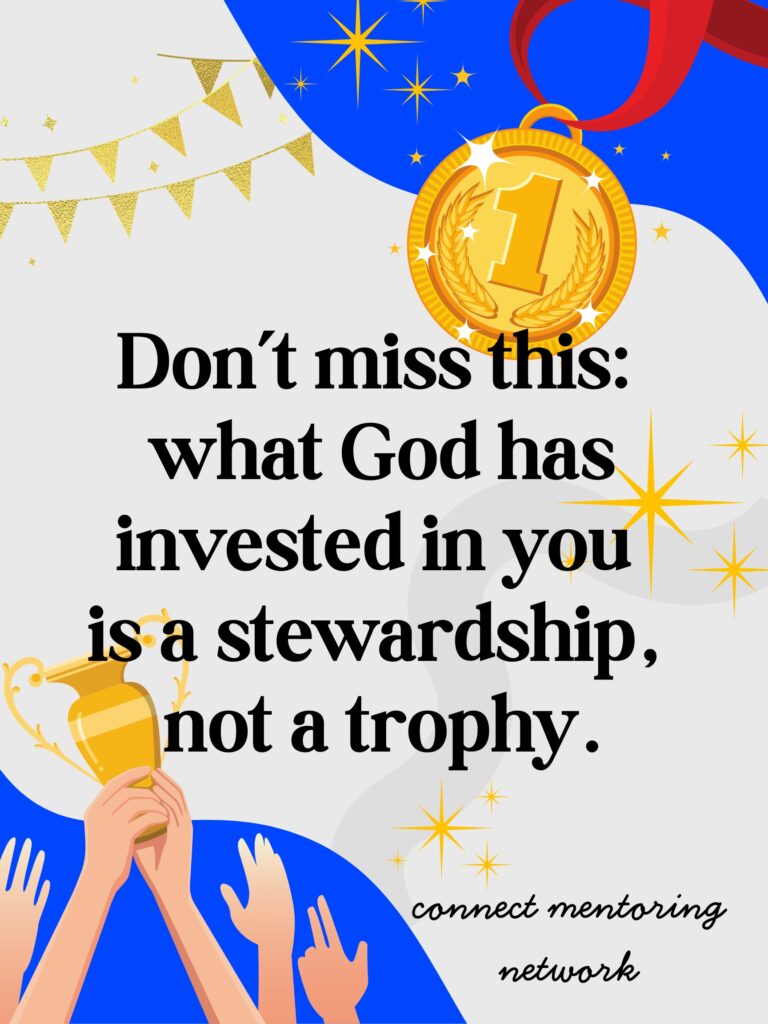
Don’t miss this: what God has invested in you is a stewardship, not a trophy.
You weren't given your gifts merely to admire them. You weren't given experience just to accumulate stories. And you weren't given wisdom so you could keep it locked away.
Put it to work for His purposes.
Write the book. Teach the class. Start the ministry. Mentor the younger leader. Share the lesson. Encourage the person who is walking through something you've already survived.
You don't have to wait until you feel completely qualified. You don't have to be the world's foremost expert. You simply need to be faithful with what God has entrusted to you.
As you use what you've been given, look for opportunities to help someone else develop what God has placed in them, too.
Christian Leadership Development: You Are a Member of a Body, Not the Whole Body
In 1 Corinthians 12:12–27, Paul describes the Church as one body with many members. Each member has a function, and the body needs all its parts.
“God composed the body, having given greater honor to that partwhich lacks it, that there should be no schism in the body, but that the members should have the same care for one another. And if one member suffers, all the members suffer with it; or if one member is honored, all the members rejoice with it” (1 Corinthians 12:24-25)
The hand doesn't have to become the foot. The eye doesn't have to do the work of the ear. No member can declare that the others aren't needed.
God designed us to need one another.
You don't have to do everything. You don't have to be good at everything. And you don't have to feel threatened when someone else is gifted in an area where you aren't.
What happens when you recognize that someone else can do something better than you can? You have a choice: you can feel intimidated, or you can celebrate their gift and make room for them to use it.
What happens when someone has an idea similar to yours? You can immediately see them as competition, or you can ask whether there is an opportunity to learn from one another, collaborate, or serve different people with a similar purpose.
Someone else's gift doesn't diminish yours. It completes the picture.
Imagine what could happen if we spent less time comparing ourselves with other people and more time discovering how our gifts could work together.
Imagine if leaders were as committed to developing other leaders as they were to developing their own platforms.
Imagine if we celebrated the people God was raising up instead of quietly worrying about whether they might outshine us.
That's what a healthy body does. It doesn't compete with itself. It works together.
Christian Leadership Development: Your Investment in Someone Else Multiplies the Harvest
In 2 Timothy 2:2, Paul instructs Timothy to entrust what he has learned to faithful people who will be able to teach others also.
“the things that you have heard from me among many witnesses, commit these to faithful men who will be able to teach others also” (2 Timothy 2:2)
Look at the multiplication in that verse: Paul invested in Timothy. Timothy was to invest in faithful people. Those people would teach others.
The knowledge and wisdom didn't stop with one person. It continued moving from one generation to another.
Paul wasn't simply trying to make Timothy more knowledgeable. He was equipping Timothy to equip others.
This is the heart of mentoring, discipleship, and Christian leadership development. We don't just grow so that we can become more capable ourselves. We grow so that we can help others grow.
Think about the people who have invested in you. Perhaps someone took the time to answer your questions, invited you into an opportunity, shared a lesson they learned the hard way, or believed in you before you fully believed in yourself.
Their investment made a difference.
Now consider this: Who is better equipped because of what you know? Who has been encouraged because of your story? Who has been given an opportunity because you opened a door? Who is growing because you took the time to teach, mentor, or encourage them?
You don't have to wait until you've reached the end of your journey to invest in someone else. You can share what you're learning along the way.
The real measure of what you carry may be what continues growing after you've passed it along.
Your calling can produce fruit through your own work. But when you equip other people, that fruit can multiply in ways you may never personally see.
Christian Leadership Development: Stop Competing. Start Multiplying.
Let's bring all of this together:
- Nehemiah had a burden, prayed, made a plan, gathered people, and got to work.
- The fishermen called their partners when the catch was too big for one boat.
- The servants were accountable for what they did with what had been entrusted to them.
- Paul reminded the Church that every member of the body matters.
- Paul instructed Timothy to pass along what he had learned so that others could teach others, too.
The pattern is clear: God gives us something to steward, and we are responsible for how we use it. However, we were never meant to think only about ourselves.
We sometimes treat ministry as though there is only so much influence, opportunity, recognition, or fruit to go around. We can become protective of our ideas, hesitant to share what we've learned, or uncomfortable when someone else begins doing something similar.
But the Kingdom of God isn't a competition for limited seats at the table.
If you know how to do something, teach someone else.
If you've learned something the hard way, help someone avoid the same mistake.
If you have a platform, use it to elevate someone else.
If you have influence, open a door.
If you have a gift, develop it and put it to work.
If your harvest is too big for one boat, call your partners.
And if someone else is doing something wonderful, celebrate what God is doing through them. Their obedience doesn't cancel yours.
You don't lose your calling by helping someone else fulfill theirs. You don't diminish your gift by sharing what you know. You don't have to be the only person doing something for it to be valuable.
We are not competing for the harvest. We are working together to bring it in.
God has invested in you. He has given you gifts, experiences, opportunities, and wisdom. What will you do with them? And who might be blessed if you choose to pass them along?
Christian Leadership Development: Your Next Step
Take a few minutes to pray and reflect on these questions:
- What has God entrusted to me that I haven't fully put to work?
- What excuse have I been using to delay taking the next step?
- Who could help me accomplish what God has placed on my heart?
- Who could I encourage, equip, mentor, or invite into the work?
- Is there someone else's success I've been tempted to view as competition instead of celebrating as Kingdom fruit?
Don't just think about the answers. Choose one action you can take this week.
Pray. Make a plan. Commit. Trust God with the outcome. Then get to work.
As you do, look beyond what you can accomplish alone. Ask God to show you how to use what He's invested in you to invest in someone else.
God called you. Now do it—and don't do it alone!
I’d love for you to join me this Thursday on the Connect Podcast as we take another look at this week’s topic. Subscribe so you don’t miss an episode, and share with a friend! We’ll continue the conversation and make room for fresh insights, deeper reflection, and practical ways to apply what we’re learning.
If you’re looking for more encouragement and resources to support you in ministry and your personal walk with Christ, I invite you to visit Connect Mentoring Network. You’ll discover resources designed to support you in every season—from growing in leadership and navigating the challenges of ministry to deepening your relationship with the Lord.
Legal
Privacy Policy2025 - Copyright. All Rights Reserved. Made by Arising Co.